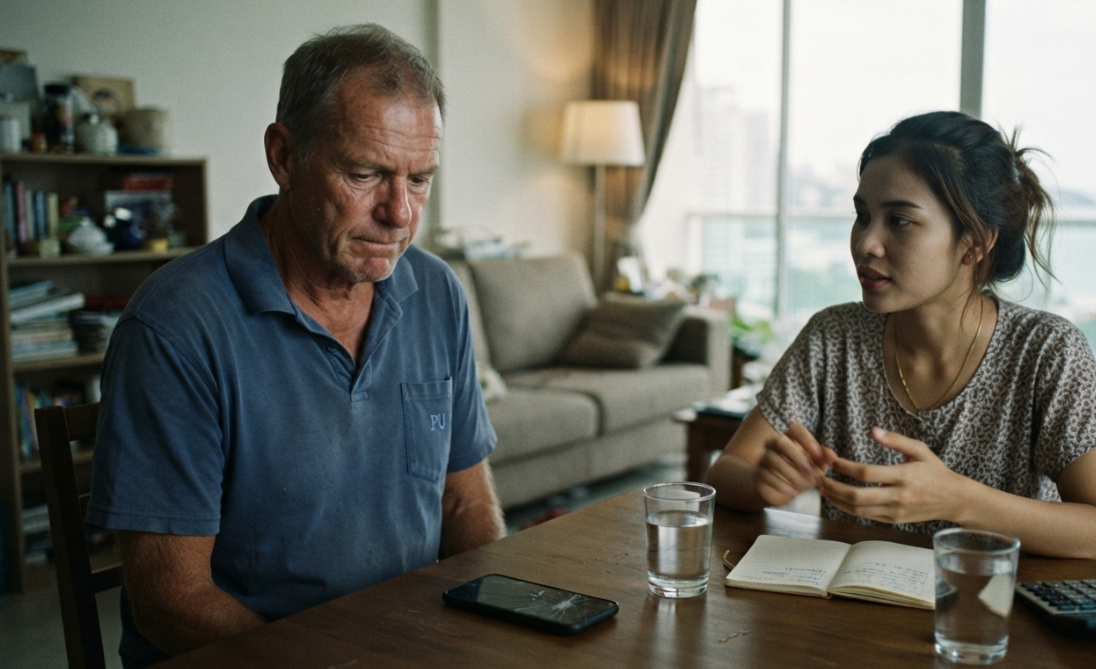
It is nineteen minutes to two on a Tuesday afternoon. Mark, a 55-year-old expat with a solid European pension, is sitting in his air-conditioned condo on Pratumnak Hill, looking at his 25-year-old girlfriend, Fon.
Through Mark’s Western eyes, the mathematics of Fon’s life are terrifying. She has absolutely zero savings. She does not own a condo. She has no financial safety net, her phone screen is cracked, and her Kasikorn bank app currently displays a balance of exactly 312 baht to last her until the end of the week.
Mark looks at her with a mixture of pity and pride. He thinks to himself: “She has nothing. I am saving her.”
But Mark is fundamentally misunderstanding how the Thai survival matrix operates. Fon doesn’t have money. But what Mark doesn’t realize is that Fon has something much more powerful in this country: social capital.
The Invisible Ecosystem
Fon might be financially poor, but socially, she operates like a CEO.
When a crisis hits, Fon never faces it alone. If her kid gets sick in the province and needs to go to the hospital, an unemployed cousin with a Honda Wave instantly appears to drive them. If she urgently needs to borrow 2,000 baht to pay the electricity bill, a friend from her old bar transfers it in three minutes.
If she needs someone to watch her child for a week, her mother takes over without a second thought. If she has a date with a customer and needs to look perfect but has no cash, the local nail girl lets her pay next month. If she needs to move to a cheaper room, a neighbor knows a landlady who will waive the deposit.
If she needs to negotiate with the police, argue with a school teacher, or fix a broken water pipe, someone in her village or her bar network knows a guy who knows a guy.
Fon is financially broke, but she is deeply, permanently embedded in a living, breathing human ecosystem. She doesn’t have employees, but her life is supported by an entire informal team: the mother, the auntie, the cousin, the neighbor, the nail girl, the market lady.
She is the girl who was poor, but had staff.
The Naked Expat
Now, look at Mark.
Mark is financially rich. He has a Visa Platinum card, a healthy retirement fund, international health insurance, an expensive watch, and a high-end laptop.
But socially? Mark is completely naked.
If Mark wakes up at three in the morning with chest pains, he is utterly alone. His family is 6,000 miles away. His ex-wife will not answer the phone. His adult children are too busy with their own lives. His “community” consists of a cynical expat Facebook group where asking a simple question will get him mocked, a visa agent who only calls when a fee is due, and a few guys at the corner bar who don’t even know his last name.
He has a bank account, but he doesn’t have a single person who would drop everything to drive him to the hospital for free.
The Reversal of Dependency
Here is the ultimate paradox of the Pattaya relationship, and the moment the illusion completely crashes.
Mark firmly believes that he is the patriarch. He believes he bought access to Fon’s life because he has the money. But slowly, month by month, the dynamic silently shifts.
When the condo Wi-Fi breaks, Fon yells at the technician on the phone. When Mark gets overcharged at the clinic, Fon steps in and ruthlessly negotiates the bill in rapid-fire Thai. She deals with the juristic office. She argues with the Bolt driver who can’t find the lobby. She navigates the labyrinth of Thai banking apps. She orders the food, translates the documents, and shields him from the chaos of the streets.
Mark, the wealthy man from a developed nation, wakes up one day and realizes a terrifying truth. He isn’t saving her. He has become completely, helplessly dependent on her.
He thought he was buying a companion. Instead, she became his translator, his negotiator, his shield, and his entire infrastructure. She might not have a single baht in her bank account, but in the brutal reality of Thailand, she is the one holding all the power.
Leave a Reply