Pattaya operates on a rigid, unspoken caste system. Western expats sit at the economic top, funneling money into the ecosystem. Bangkok Thais hold the corporate and real estate power. Isaan migrants run the bars, the taxis, and the service industry.
If you listen to the girls from Isaan, they will tell you they are looked down upon by the capital elites. But there is a caste even lower than them. A caste that the Isaan girls themselves look at with blatant disgust, stepping carefully over puddles to avoid them on the street.
The Cambodian migrant workers.
Dara is 23. He works on a massive, 30-story luxury condominium project in Jomtien. He earns 350 Baht a day. After a 10-hour shift under the scorching tropical sun, breathing in concrete dust and diesel fumes, he goes to sleep in a corrugated iron shipping container. There is no air conditioning. The heat inside the metal box at night is suffocating.
He didn’t come to Pattaya alone. He crossed the border from Poipet with Sophea, a girl from his village. In Dara’s mind, they were a team. He was hopelessly trapped in the friendzone, but he believed that surviving the brutal conditions of the construction camp together would eventually forge a bond. He had a romantic, naive vision of their shared struggle.
But Sophea was pragmatic. After three months of carrying heavy buckets of cement and watching her skin turn rough and dark, she did the math. She realized that 350 Baht a day was a slow death sentence.
She also realized she was young, and in Pattaya, youth is the most liquid currency available.
Sophea bought a cheap smartphone, downloaded a dating app, and set her location. She didn’t have to wait long.
Today, Sophea no longer lives in the iron container. She lives on the 15th floor of the exact same condominium complex that she and Dara helped build the foundation for last year. She lives there with a 62-year-old retired expat who firmly believes he “rescued a poor country girl.” He likely doesn’t even know she is Cambodian, nor does he care.
The true psychological horror of Dara’s reality happens around 2:00 PM on his lunch break.
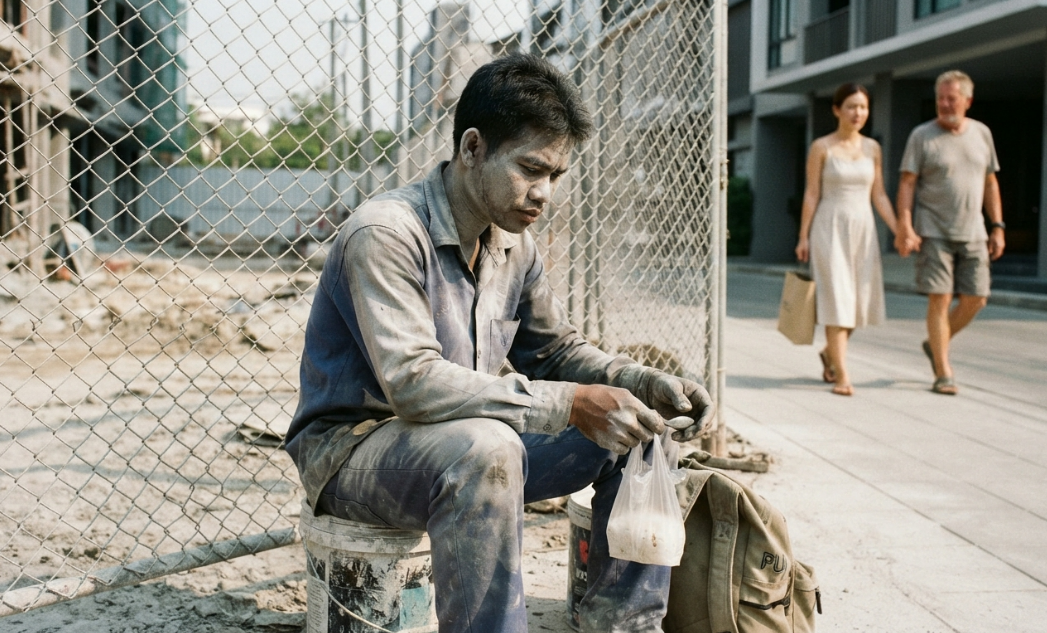
He sits on an overturned paint bucket, covered head to toe in a thick layer of gray cement dust, eating cold rice from a plastic bag. Suddenly, he sees them.
Sophea and her expat sponsor are walking hand-in-hand down the freshly paved sidewalk. Sophea is unrecognizable. She is wearing a clean white sundress, her hair is styled, and she is carrying a branded shopping bag. She looks completely integrated into the Western bubble.
As they walk past the construction fence, Sophea spots Dara. The expat doesn’t even look at him; to the Westerner, Dara is just a piece of the industrial landscape, as invisible as a lamppost.
Sophea stops for a brief second. She doesn’t look guilty. She just looks at Dara with a heavy, quiet pity. She reaches into her purse, pulls out a 100-Baht note, and hands it to him through the chain-link fence, telling him in their native Khmer to buy himself some iced coffee.
Then she turns around, links her arm through the expat’s, and walks back toward the air-conditioned lobby.
Dara is left holding the crumpled pink banknote. It is nearly a third of his daily wage. It is an act of charity from a girl he loved, who used the very building he is bleeding for to escape the hell they both started in.
This is the ultimate reality of Pattaya. The neon dream, the romantic illusions, the luxury condos—they are not just built on concrete and steel. They are built on the broken backs and crushed egos of the invisible caste
Leave a Reply