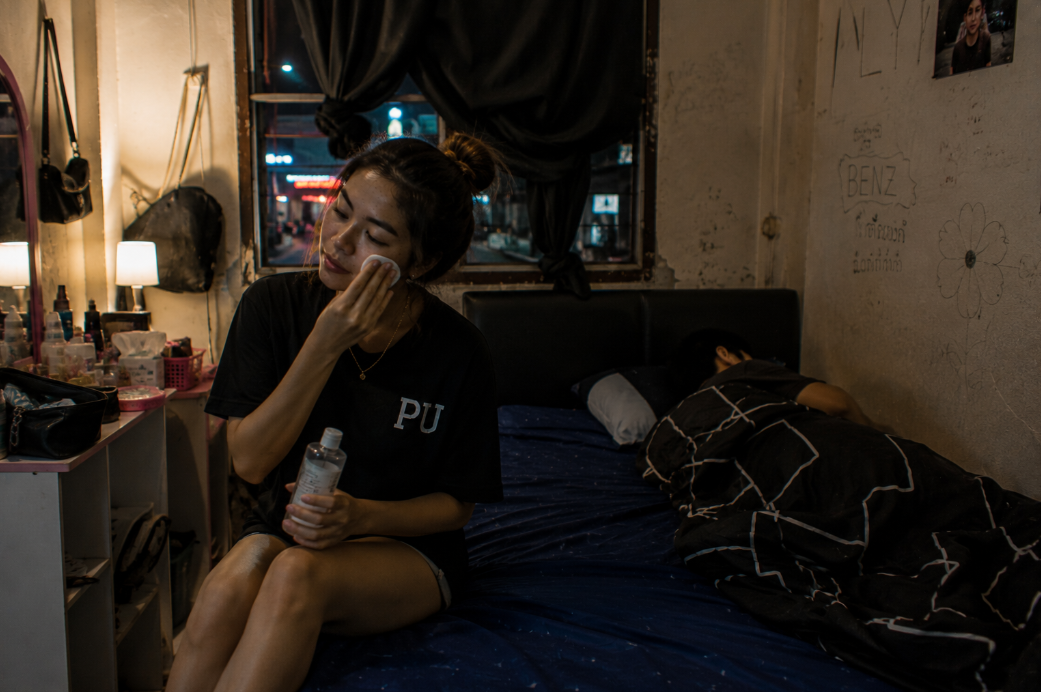
It’s 3:30 AM in a cramped, humid room on the Darkside.
She sits on the edge of the mattress, soaking a cotton pad in micellar water. With three heavy swipes, she erases the glitter, the winged eyeliner, and the fake eyelashes. The neon smile she wore for six hours is gone. She checks her phone, transfers 5,000 baht to a bank account in Isan to pay for her mother’s roof repair, and finally lies down next to her sleeping boyfriend.
Somewhere in Pattaya, a Western expat is sitting on a balcony, drinking whiskey, torturing himself with a question that destroys thousands of men in this city:
“How can she sleep with customers and still say she loves me?”
The agony comes from a fundamental clash of cultural coordinate systems. In the West, sex, love, exclusivity, and self-worth are tied into one incredibly tight knot. To a Western man, if his partner is with someone else, he is replaced. Humiliated. Devalued. He believes sex is the ultimate surrender of the soul.
But in the fishing village, the moral accounting works differently.
She doesn’t operate on the Western religious guilt that the physical body is a “sacred temple” being permanently defiled. In the practical, everyday application of Thai Buddhism, the moral weight of an action isn’t just about the physical act—it’s about the intent and the harm.
When she looks in the mirror, she doesn’t think, “I sold a piece of my soul.” Her moral ledger looks like this: “I did a difficult job. I didn’t steal. I didn’t kill. I didn’t destroy another woman’s home. I fed my child. I paid the hospital bill. I survived.”
It’s not a lack of morality; it is a redistribution of morality.
To survive the neon ecosystem, the human brain performs a masterpiece of psychological compartmentalization. She splits into two people: the “Work Self” and the “Private Self.”
Just as a waiter can smile at a rude customer without actually liking him.
Just as a nurse can wash a patient without it being sexual.
Just as an actor can kiss someone on screen without betraying their spouse.
The first time she walks into a hotel room with a stranger, it is terrifying. The tenth time, it is unpleasant. The hundredth time, it is a standard operating procedure. The thousandth time, it’s just another Tuesday shift. The body simply becomes a tool of economic labor.
For her, the difference between the Client and the Lover is an absolute, iron-clad boundary.
The Client gets the Work Self.
He gets the performance, the fake laugh, the latex condom, the strict time limits, and the absolute minimum of her true vulnerability. He is a financial transaction. He gets the surface.
The Lover gets the Private Self.
He gets the chaos. He gets the woman with no makeup, the exhaustion, the tears, the family debt, the jealousy, the sick child, and the terrible moods. He gets the reality.
The Western man hears: “She had sex with another man.”
She hears: “I went to work so my family wouldn’t starve.”
Both of them are telling the absolute truth within their own systems. For many Western men, paid sex feels like moral contamination. But for many women inside the industry, unpaid love is the place where the real danger begins. A client leaves in the morning. A lover can destroy your life with jealousy, control, broken promises, and false hope.
In Pattaya, the ultimate mistake is assuming that the body always tells you where the heart is. Sometimes, the body is just clocking in for a shift, while the heart is somewhere else entirely.
Leave a Reply