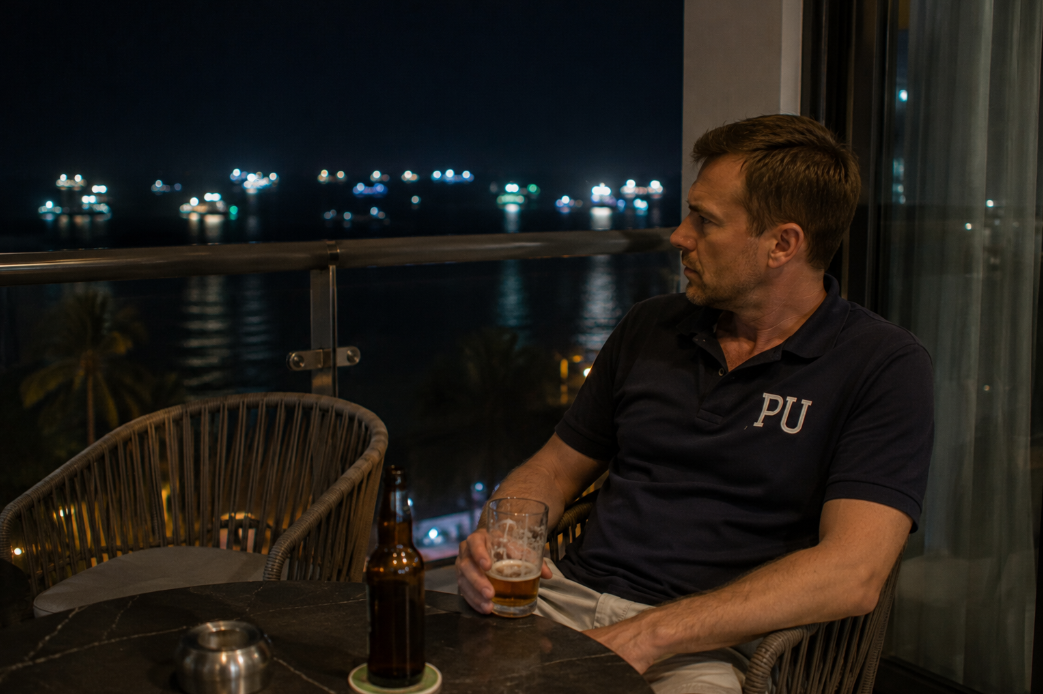
Oliver sat on the balcony of his high-rise condo, watching the distant lights of the fishing boats on the dark gulf. He felt a profound, heavy sense of purpose.
Two nights ago, Nam had finally broken down. Sitting on the edge of his bed, tears streaming through her makeup, she had unlocked her phone and shown him the photos. Her father’s hospital bed in Isan. The medical bills. She told him about the ex-husband who drank too much, crashed his pickup truck, and abandoned her with a two-year-old son and a massive debt to a local loan shark.
Oliver had held her, feeling like he was the first man to truly see her. He wasn’t just another customer or a tourist; he was her confidant. He was the man she trusted with her darkest, most private tragedy.
Two weeks later, Oliver was sitting in a sports pub on Pattaya Klang, having a pint with Caleb, a 30-something digital nomad he had met at a coworking space.
Caleb took a sip of his LEO, shaking his head with a sympathetic sigh.
“Man, the girl I’m seeing right now… breaks my heart. I’m trying to help her out. Her dad just had a stroke in the village. Her ex was a deadbeat who left her with a toddler and a crazy debt to the underground mafia. It’s wild what these girls go through.”
The condensation on Oliver’s glass suddenly felt freezing against his skin. His stomach dropped into a bottomless pit of cynicism and embarrassment.
It was the exact same story. Beat for beat.
The protective warmth in Oliver’s chest instantly turned to ice. It’s a script, he thought. A neon playbook. They hand out these identical tragic backstories at the village gate. He went home that night with his armor fully raised, looking at Nam not as a victim, but as a calculated, emotionless manipulator.
But Oliver was making a classic Western miscalculation.
In the West, a tragic backstory—a catastrophic illness, a predatory loan, an abandoned child—is a rare, unique event. It is a defining, individual trauma. Therefore, when an expat hears the exact same tragic story from three different women in Pattaya, his Western logic dictates: “If the stories are identical, they must be fabricated.”
He completely misses the brutal reality of the neon ecosystem: Poverty is not creative.
Poverty does not have a writers’ room. It does not need to invent intricate, unique storylines to manipulate foreigners. Poverty is an assembly line, and it mass-produces the exact same tragedies by the tens of thousands.
In rural Thailand, where there is no robust social safety net and farmers work until their bodies break, a parent having a stroke in their 50s isn’t a rare tragedy—it is a demographic statistic.
In villages where young marriages buckle under the crushing weight of economic despair, a husband leaving his wife with a child is not an anomaly—it is a standard outcome.
And in an economy where a girl needs a scooter to get to work but cannot qualify for a bank loan, borrowing money from the local mafia at 20% monthly interest isn’t a crazy Hollywood plot twist—it is Tuesday.
When Nam told Oliver her story, she wasn’t reading from a scammer’s script. She was simply describing the universal template of the Thai working class.
The hardest truth for the expat to swallow isn’t that she lied to him. The hardest truth is realizing that her tragedy is absolutely, devastatingly real—it just isn’t uniquely hers.
Leave a Reply