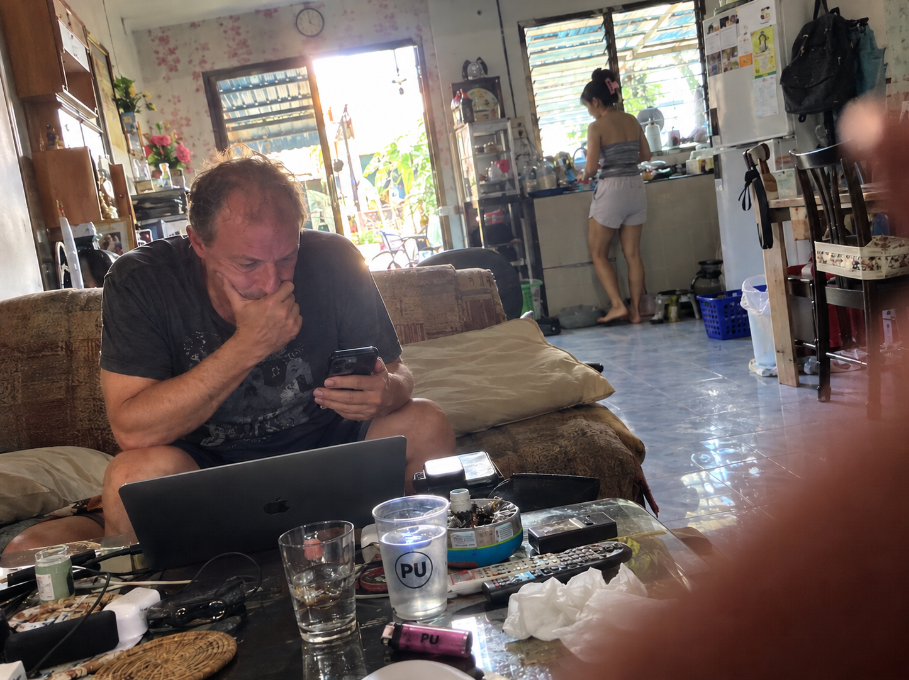
They live in a quiet gated moo baan in East Pattaya—the “Darkside”—far enough from the neon where you can hear the crickets at night. For four years, Paul and Fon have built what he proudly calls a “real life.” Fon doesn’t work in the bars anymore; she hasn’t for years. She runs their home, gets their daughter ready for school, and makes the best pad kra prow in the neighborhood. They have a mortgage, a Honda, and a dog. To Paul, a fifty-two-year-old expat from England, Fon was the gentle, shy girl he “rescued” from a harmless massage shop in the suburbs. That was the story. That was the peace he purchased.
Then came a rainy Tuesday afternoon, and the ghost in the Oppo phone.
The phone was an old, glitchy Oppo Fon had kept in a drawer, intending to pass it on to her younger cousin in the village. It had been sitting there, dead, for over three years. Fon asked Paul if he could clear the memory and reset it. Paul, sitting on their worn fabric sofa, plugged it in, booted it up, and began casually scrolling through the old albums to make sure her photos were backed up before wiping the drive.
Most of it was what he expected: grainy pictures of food, family reunions in Isaan, and selfies with her friends. But as he scrolled deeper, toward the years 2018 and 2019, the visual timeline began to change.
His thumb hovered, then stopped.
There was a photo. In the center of the small, scratched screen was Fon. But she wasn’t the Fon who folded his laundry or wore oversized t-shirts around the house. This was a younger, wilder, heavily made-up version of her, wearing a tiny, impossibly bright neon-pink string bikini. She was sitting on a bar stool, her arm draped aggressively around a heavily tattooed, red-faced foreign tourist who was holding a beer. Behind her was the unmistakable, packed, chaotic backdrop of Soi 6—the infamous afternoon gauntlet of Pattaya’s most raw and transactional nightlife. The bar’s name, “The Boy tox,” was clearly visible on the sign behind them, alongside a group of other girls in matching neon outfits, laughing and gesturing at the camera.
Paul felt a cold, physical drop in his chest, as if the living room floor had suddenly given way.
It wasn’t just the outfit. It was the look on her face. It was a confident, sharp, almost predatory laugh that he had never once seen her use in their four years together. The Fon he knew was quiet, deferential, almost motherly. This girl on the screen was a frontline soldier of the grid, operating at the very epicenter of the trade.
In Pattaya, there is a massive, unspoken hierarchy. Men like Paul will tolerate a history in a quiet massage shop or even a beer bar on a sleepy street. It allows them to maintain the illusion of a “good girl who just needed a hand.” But Soi 6 is different. Soi 6 is the deep end, a place where transactions are fast, public, and devoid of romance. Finding out your domestic wife was once a Soi 6 regular is like discovering a ghost in your own bed. It tears the carefully constructed narrative of “salvation” to shreds, revealing that she didn’t just touch the industry—she was fully immersed in it.
He sat there, the tiny phone heavy in his hand, staring at the pixels.
Through the doorway, he could hear the domestic sounds of his life: the wet thud of Fon washing dishes in the kitchen, the soft hum of the refrigerator, the distant bark of a neighbor’s dog. Just twenty feet away, Fon was there, wearing a faded house shirt, likely thinking about what to cook for dinner. Yet the woman on the sofa with him, frozen in 2018, felt like a stranger who had stolen her face.
He wanted to scream. He wanted to march into the kitchen, throw the screen in front of her, and demand to know how many others there were, how many times she had wore that neon pink string, and why she had lied to him about her “quiet” past.
But he didn’t move.
Paul looked at his laptop, the cluttered coffee table, and the framed photos of their daughter on the wall. He realized, with a sickening clarity, that asking the question would destroy everything. If he confronted her, the boundary between their peaceful “domestic” life and the chaotic truth would dissolve forever. To keep the peace, he would have to become an accomplice to the lie. He would have to act like he had never seen the girl in the neon pink, even as her ghost now sat invisible at their dinner table.
He slowly hit the delete button, watched the screen go blank, and stared out the window at the gray Pattaya rain, realizing that in this town, the past is never truly buried—it is just waiting for the battery to charge.
Leave a Reply