Noi had never owned a dress that cost 900 baht.
She bought it in Udon Thani at the Saturday market, from a vendor who swore it was a genuine “Korean cut.” Pale blue, a little too tight under the arms. She tried it on behind a curtain of hanging sarongs, looked at herself in a cracked mirror propped on a plastic chair, and for the first time in the six years since her husband died, she saw a woman someone might actually choose.
The man was named Hans. A fifty-eight-year-old Swiss engineer, a widower. His profile photo showed a tall, gentle-looking man in a gray jacket standing in front of an alpine lake. In the testimonials on the matchmaking page, a Thai bride in a white dress stood beside a man just like him, smiling with all her teeth—the specific way women smile when they have been promised a better life and then handed the proof.
The page was called Lucky Heart Matchmaking. The admin, who went by “Khun Sai,” messaged Noi late at night in perfect, warm Thai. Women your age are the most trusted by foreign men, she wrote. You are serious. Responsible. Not like the young girls.
Khun Sai explained that the registration and processing fee was 30,000 baht. It covered the professional profile, the dedicated translator, and the background checks. Noi had exactly that much in her bank account, and she knew exactly where every single baht came from.
It came from Mint, her twenty-six-year-old daughter, who worked nights on the neon grid of Pattaya and sent money home on the first of every month. Noi had never asked what exactly Mint did there, and Mint had never volunteered to explain. The transfers arrived, the tin roof got fixed, the rice got planted, and both of them fiercely protected the silent agreement they had never spoken aloud.
Noi transferred 10,000 baht on a Tuesday. On Friday, she had her first video call with Hans.
He sat in a bright, clean room, smiling at her warmly. But something was slightly wrong with the screen. His mouth would stop moving, yet the carefully translated Thai audio would continue playing for another half-second. A pre-recorded, stolen video loop. Noi noticed it, but she desperately forced herself to ignore it. She blamed the terrible rural internet signal in Nong Han.
She sent the remaining 20,000 baht the next day. Twelve hours later, the Lucky Heart page vanished. The admin account was deleted.
Mint came home unannounced on the second weekend of the month, taking the night bus from Chonburi with a gift bag from the terminal 7-Eleven. She walked into the house and found her mother sitting at the kitchen table in the pale blue dress, practicing English phrases in a child’s school notebook.
I am a good wife. I cook. I am not afraid of work.
“Mae,” Mint said, dropping her bag. “What is this?”
Noi panicked, closing the notebook too fast. “Nothing. I am just studying.”
But Mint saw the phone glowing on the table. She saw the dead Facebook link and the screenshot of the tall man by the lake. Mint knew that face. Not him specifically, but the archetype. She saw men with that exact patient smile every single night in her bar.
More importantly, Mint knew exactly what this was. In the cramped makeup rooms on Soi 6, the girls talked about these scams constantly. Thai syndicates operating out of boiler rooms in Poipet or Bangkok, running fake foreign profiles. They specifically targeted older, lonely widows in Isaan because the scammers knew a dark economic truth: these village mothers had cash on hand, perfectly regular deposits sent by their daughters working in the sex industry. The scammers were indirectly bleeding the Pattaya girls dry without ever setting foot on Walking Street.
Mint did not say the word scam. She did not ask how much was gone. Doing so would shatter her mother’s pride into a thousand unrecoverable pieces. Instead, she just looked at her and said, “Did you eat?”
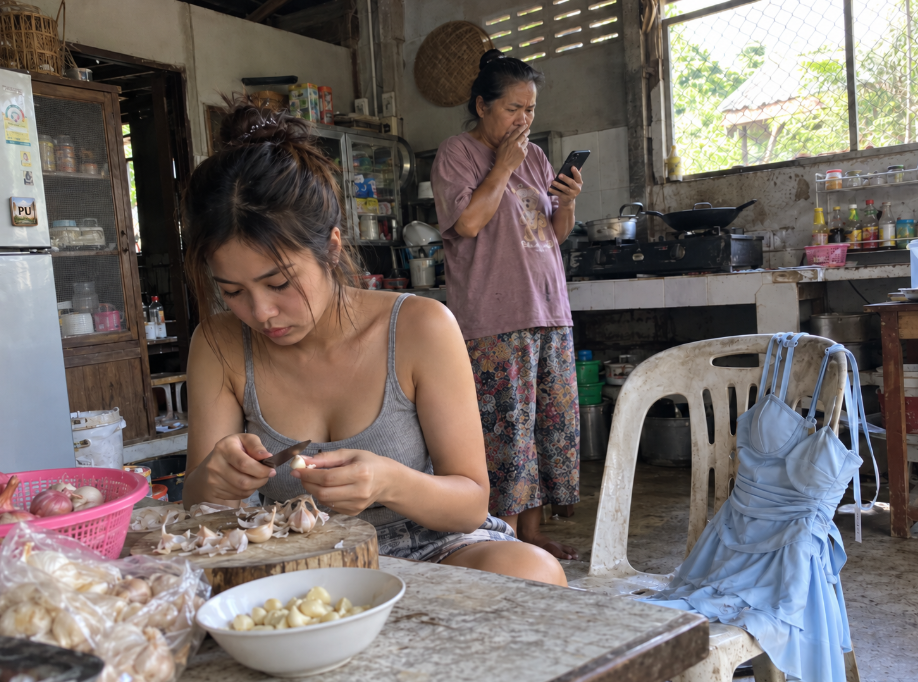
By the time they sat down for dinner, Noi had taken off the new outfit and changed back into a faded, oversized house shirt. They ate sticky rice, grilled fish, and a bowl of spicy jaew. Noi nervously talked about the neighbor’s sick buffalo. Mint just nodded. The pale blue dress hung completely abandoned on the back of a plastic chair, sitting at the table with them like a ghost.
At eleven o’clock, when her mother went to shower, Mint sat on the porch in the dark and opened her banking app. She stared at a specific savings account for a long time. It held the deposit for a small hair salon she wanted to open back home—her escape route off the grid. She had never told anyone about it.
She transferred 30,000 baht directly to her mother’s account.
In the memo field, she typed: Refund from Lucky Heart Matchmaking. Processed.
In the morning, Noi’s phone buzzed loudly on the kitchen shelf. She read the bank notification while standing at the stove, the sticky rice steaming behind her. A full refund from a matchmaking page that no longer existed, for the exact amount she had lost, arriving on the exact morning her daughter happened to be home from Pattaya.
Noi was not a stupid woman. She knew the internet did not give money back.
She looked at the glowing screen. Then she looked over at Mint, who was sitting at the table aggressively peeling garlic, refusing to lift her eyes from the knife. To acknowledge the truth would mean acknowledging that she had thrown away the money her daughter had sold her body to earn. It would destroy them both.
“Oh,” Noi said, her voice trembling slightly. “They returned it.”
“Mm,” Mint said, aggressively tossing a peeled garlic clove into a bowl. “I told you. Sometimes these agencies make mistakes. Sometimes it works out.”
“Mai pen rai,” Noi said softly, turning back to the stove.
Later that afternoon, Noi carefully folded the pale blue dress—the exact way you fold something you intend to keep forever but never wear again—and placed it at the very bottom of her wooden cupboard. Neither of them ever mentioned the Swiss engineer again.
Leave a Reply