Author’s note: The events described in this post are 168 percent real, thoroughly documented on national television, and represent the absolute apex of the neon grid’s predatory evolution.
The air in the Channel 7 television studio is aggressively air-conditioned, but the South Korean man sitting opposite the host looks entirely numb to the temperature. It is December 2024, and Danny, a man in his early forties, is calmly recounting the methodical destruction of his life. He isn’t crying, and he isn’t raising his voice. He speaks with the flat, hollow cadence of a man who has already processed the devastating truth and is now simply reading the autopsy report of his own illusions.
He tells the host about a bar in Pattaya back in December 2020, where he noticed a woman sitting entirely alone, radiating a quiet, magnetic sadness. When he asked her what was wrong, she looked away and whispered that she hated working there. Trapped by the intoxicating pull of the savior complex, Danny delivered the exact line that has ruined thousands of men before him: “Don’t work. I will support you.”
He says this directly into the television camera, and you can see that a small, broken part of him still believes in the nobility of that moment. The host simply nods sympathetically as a graphic flashes on the screen behind them, displaying a figure that silences the studio: 10,000,000 baht. Roughly 290,000 US dollars. He didn’t lose it in a single drunken weekend; it was surgically extracted from him over four agonizing years.
The mechanics of the deception were flawlessly executed, beginning in January 2021. Danny built his life around a strict rhythm, flying to Thailand every two months to spend ten days with her before returning to his corporate reality in South Korea. He wired her between 40,000 and 50,000 baht every single month, viewing the transfers not as transactional gifts, but as a binding moral contract he had signed with himself to protect her.
Then, the financial hemorrhage began. It started with a relatively standard request for her father’s funeral, which cost him 100,000 baht. He sent the money without hesitation and without demanding proof, trapped by the geographical distance and his own desperate need to trust her. That initial transfer unlocked a relentless, escalating cascade of manufactured tragedies. A devastating car accident required 250,000 baht. A hopeful investment in a provincial coffee shop drained another 100,000. Extended medical treatment from the accident cost 400,000, followed by the heartbreaking loss of their unborn child, which extracted a staggering 800,000 baht. When her brother allegedly accumulated dangerous gambling debts, Danny cleared them for 400,000.
The grand finale of this financial slaughter was a sudden cancer diagnosis, requiring 1,600,000 baht for emergency treatment. She even arranged video calls from what appeared to be a hospital bed, where Danny spoke directly to her “doctor.” He chose to believe every word, intentionally avoiding any investigation because verifying the truth meant acknowledging he had been living inside a beautifully constructed lie.
After the cancer treatments were funded, she vanished from his screen, claiming she was too weak for video calls and forbidding him from visiting. Then, the inevitable phone call came from her sister, delivering the crushing news that the woman he loved had passed away from cancer on December 11th.
Danny immediately boarded a flight to Thailand, desperately searching for closure. He went to the local hospitals, checked the morgues, and visited the provincial temples, finding absolutely zero records of her existence, let alone her death. Meanwhile, the sister coldly continued the script, demanding 2,000,000 baht for an elaborate funeral at Siriraj Hospital. When Danny hesitated, she pivoted, claiming there was a 5,000,000 baht life insurance policy with his name on it, but he needed to transfer a ten percent clearance fee to release the funds. Standing in the sweltering heat of a foreign country with no body, no grave, and a suddenly demanding family, the devastating reality finally crashed over him. When he refused to send more money, the entire family instantly blocked him across all platforms, erasing her from the digital world.
This is not the classic “sick buffalo” scam; this is an entirely new, existential mutation of the hustle. The traditional sick buffalo relies on a cascade of domestic disasters—a collapsed roof, a broken leg, a flooded rice paddy—designed specifically for Western clients who anticipate this exact narrative. Westerners have decades of institutional knowledge, shared across internet forums and expat bars, making them inherently skeptical.
The Korean demographic is a relatively new, highly lucrative market that hasn’t spent years reading those cynical warnings. Because they are culturally unequipped for the classic scams, the street adapted, shifting from domestic annoyances to profound, cinematic tragedies. While the sick buffalo merely extracts money through pity, the “dead girl” scheme extracts a fortune by weaponizing grief. When she fakes her own death, the client loses much more than his bank balance; he loses the future he was secretly building, the woman he deeply loved, and the intoxicating heroic identity he had carefully constructed for himself. Grief is the ultimate extortion tool because it demands absolutely no proof and overrides all rational thought.
Back in the television studio, the host leans forward and asks the inevitable question: “Have you filed a report with the police?”
Danny stares at the floor and quietly replies, “Not yet.”
A heavy, suffocating silence fills the room. He isn’t rushing to the police because he understands the grim mathematics of the situation. Even if the authorities manage to find her, even if she is arrested or handed a meaningless fine, the ten million baht is already gone. More importantly, the four years he spent loving a ghost will never be returned to him.
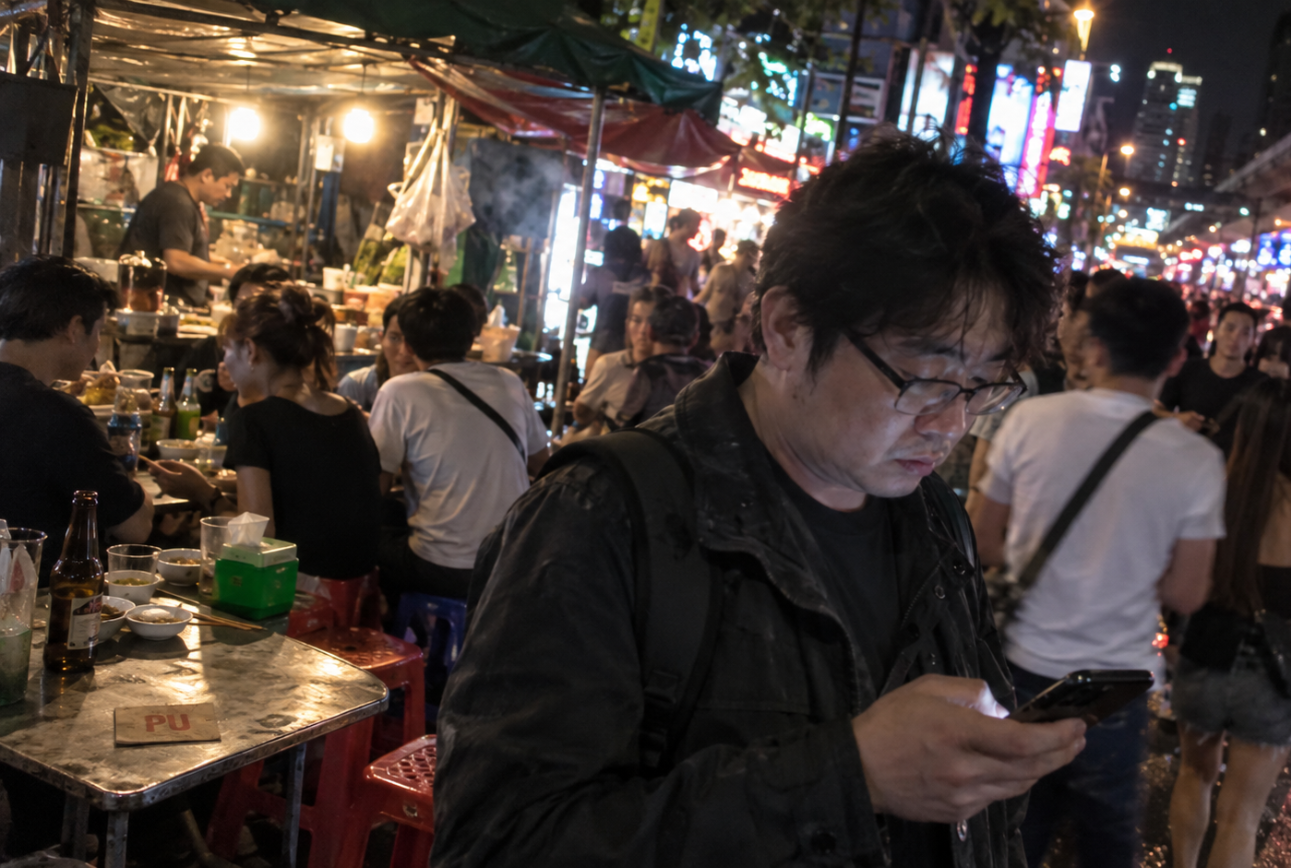
The broadcast ends, and Danny walks out of the aggressively air-conditioned studio into the suffocating humidity of Bangkok. He steps onto the chaotic street, completely ignoring the roaring motorcycles and the flickering neon signs around him. He just keeps his head down, staring intently at the glowing screen of his smartphone as he desperately searches through social media accounts. He knows with absolute certainty that he will never find her, but he just cannot stop looking.
Leave a Reply