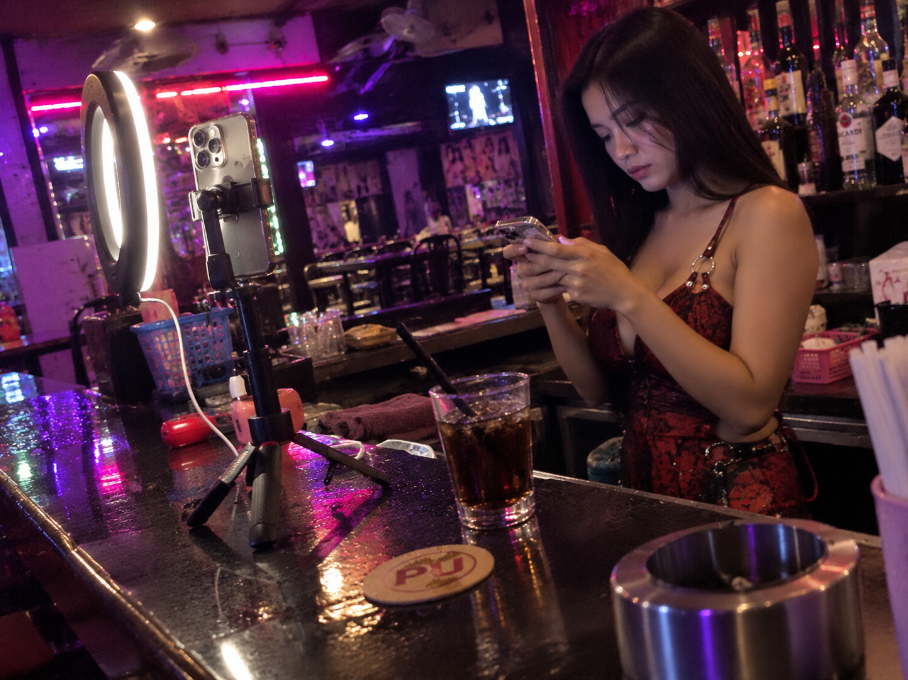
It is late evening in a quiet apartment thousands of miles away from the suffocating humidity of Thailand. A man sits alone in the glow of his laptop screen, clicking a well-worn bookmark that pulls up a live YouTube broadcast of a bar on Soi 6. On the screen, a girl in a tight dress shifts her weight at the counter, profoundly bored, scrolling through her phone. He clicks a link in the video description. A PayPal window opens: 125 baht to “Buy a lady drink for Nong.” He clicks confirm.
Thirty seconds later, the bartender hands her a glass of watered-down cola. She glances up at the monitor, flashes a practiced, momentary smile into the lens, and raises her glass. “Thank you, Johnny126,” she says. She doesn’t know who he is, and she will never ask. He doesn’t type a reply in the chat. He simply closes the laptop, feeling a strange, hollow sensation settling in his chest that isn’t quite happiness, but isn’t entirely sadness either.
This is not a charity stream; it is a highly optimized business model. Born out of the pandemic’s desperation, the digital lady drink has evolved into a permanent, highly lucrative pillar of the Pattaya economy. The mechanics are brutally simple. The bar sets up a camera, runs a continuous YouTube feed, and attaches a payment gateway. When a viewer pays 125 to 200 baht, the bartender gets a digital ping. A drink is poured, and the girl receives her standard 50-baht commission, exactly as if the customer were sitting on the stool next to her. It is a digital entrance ticket for men who cannot, or will not, board a flight to Suvarnabhumi. Some bars have scaled this into an industrial operation, broadcasting from over a dozen venues simultaneously, investing in high-end cameras, VR technology, and dedicated soundproof streaming booths.
The men funding this digital ecosystem rarely fit the aggressive “sex tourist” stereotype. You will not see them sweating and shouting on Walking Street. They are sitting quietly in their living rooms, and they generally fall into four distinct demographics.
First is the captive audience: the retiree on a fixed income, the man with physical disabilities, or the guy simply terrified of international travel. For them, the stream is an accessible, albeit imperfect, substitute for a life they cannot reach. The second type is the nostalgic veteran. He remembers the chaotic smell of the street, the oppressive heat, and the thrill of the grid. When he buys a digital drink, he isn’t actually tipping the girl; he is paying a subscription fee to his own memories. The third is the timid spectator, the guy who has read the expat forums for years but never possessed the courage to actually book a ticket. The stream offers a sanitized, risk-free viewing gallery where he can finally participate without leaving his comfort zone.
Finally, there is the profoundly lonely man. He isn’t looking for a virtual girlfriend; he is just a man moving through a world where nobody knows his name and nobody asks how his day was. When the girl on the screen says “Thank you,” she acknowledges his existence, even if only for a fraction of a second. That brief validation is enough to make an empty room feel slightly less suffocating.
For roughly the price of a burnt coffee in a Western city, he is purchasing an illusion of presence. He isn’t buying a sexual fantasy; he is buying a gaze. In a world where he feels entirely invisible, a woman looking into a camera and speaking his username holds immense tangible value. It is the exact same psychological machinery that powers a physical bar—exchanging cash for the illusion of connection—but the digital version is fundamentally more transparent. He knows she feels absolutely nothing for him. She knows that he knows. Neither party has to endure the exhausting charade of pretending it is anything more than a micro-transaction. And yet, the system works perfectly, because human beings will always pay to be perceived.
For the girls on the screen, the streams evoke a state of absolute, unapologetic indifference. This isn’t arrogance; it is just the reality of a grinding shift. The girl on the broadcast is simply fulfilling a basic physical function: stand near the camera, smile when the bartender gives the signal, raise a glass of soda, and collect the commission. She isn’t an actress; she is a shift worker doing exactly what she is paid to do. As one cynical forum user accurately observed, it is a profoundly exhausting job to stand for hours, shifting from foot to foot, staring at a monitor waiting for a notification.
If you watch closely, the girls rarely look directly into the lens. They stare at their phones, they gossip with the bartender, they look out at the street. The camera is just ambient background noise. The viewer is paying for the privilege of being a small part of that background, and he is entirely fine with that arrangement, because being part of the background is still better than being nowhere at all.
A Western observer might look at a man paying a stranger to drink a Coke on YouTube and immediately label it pathetic. It looks like a bleak caricature of human interaction. But it isn’t a caricature; it is just the logical, terminal evolution of the Pattaya business model. In a physical bar, a man pays for an hour of a woman’s time. In the digital stream, he pays for thirty seconds of her attention. The only difference is the scale.
In many ways, the digital transaction is actually more honest. On a bar stool, a man can easily trick himself into believing the girl genuinely likes him. Through a screen, that self-deception is almost impossible. He knows she smiles at everyone. He knows she will forget his username before the ice in her glass melts. But he pays anyway, proving that the brutal awareness of the illusion does not diminish the desperate need for it. The bar is no longer limited by physical walls. It is everywhere the internet reaches.
Later that night, long after he closes his laptop, he sits in the dark. He isn’t thinking about a specific woman, but rather the fleeting moment she looked into the lens and said his username. He picks up his phone, opens the YouTube app, and pulls up the archived broadcast. He scrubs through the timeline until he finds the exact timestamp. She raises the glass. She smiles. She says his name. He watches it twice, smiles quietly to himself, and turns off the screen.
Halfway across the world, on a humid morning in Thailand, the girl has already clocked out. She has taken off her dress, scrubbed the makeup off her face, and gone to sleep in a cramped, shared room. Her mind is completely empty of him. She does not remember his screen name. But he remembers the transaction, and for a lonely man in a quiet apartment, that is more than enough reason to open the laptop again tomorrow.
Leave a Reply