Recess at a rural school in Sa Kaeo province. A ten-year-old boy sits on a cracked concrete step near the entrance, flanked by two friends. He is holding a battered smartphone with a shattered screen, proudly displaying a photograph to the others. The image shows a woman in a crisp white shirt standing in front of a reception desk, framed by sliding glass doors, potted plants, and polished marble floors. She is smiling brightly, wearing a plastic nametag. He tells his friends that his mother works at a very nice hotel in Pattaya. They nod in unified understanding. One of them mutters that it looks cool, while the other simply stares at the ground, remaining entirely silent because his mother is also “working in a hotel” down on the coast. The boy puts the phone away, completely unaware that the photograph was staged six years ago when his mother briefly stepped into a random lobby just to snap a picture for her family. He does not know that her actual shift begins at eight in the evening and ends at three in the morning. He only knows the narrative he was handed.
There are roughly two hundred houses in this particular village, and women from at least forty of those families are currently working in Pattaya. If you ask any relative, neighbor, or local official, they will smoothly inform you that these women are employed in hotels, seafood restaurants, or retail shops. Officially, not a single woman from this district works in a beer bar, a go-go, or a massage parlor. This is not an individual lie, but a meticulously maintained, collective architectural structure of denial that supports the entire community. The grandmother raising the boy knows exactly where the money comes from. The neighbor casually asking about the daughter knows. The village headman signing the municipal paperwork knows. Even the school teacher who praises the boy’s grades and tells him his mother must be proud knows the exact reality of the grid. But absolute silence is the mandatory currency of the village. If someone were to speak the truth out loud, they would be forced to answer devastating questions that would instantly demolish the financial foundation they have spent years building. The boy lives in a sturdy concrete house with air conditioning, a large refrigerator, and a flat-screen television, standing in stark contrast to the older wooden homes nearby. The monthly bank transfers from Pattaya pay for all of it, and nobody ever questions the accounting.
The boy operates on a very specific set of established facts. He knows his mother left for the coast when he was barely two years old. He knows she comes back exactly once a year for the Songkran holidays, staying for just a few days before rushing back down south. He knows she brings expensive gifts—new sneakers, oversized t-shirts, and occasionally a handed-down mobile phone. He knows she initiates a video call every Sunday afternoon, and he notices that his grandmother always quietly leaves the room during those conversations to give them privacy. What he does not understand is why his mother cannot visit more often, or why she aggressively avoids sharing any specific details about her daily hotel duties. He does not know why his grandmother sometimes quietly cries in the kitchen after the Sunday call disconnects. Most importantly, he does not know why the quiet boy next door suddenly stopped bragging about his own mother’s hotel job and began staring blankly at the ground whenever the topic was mentioned. The boy simply holds onto the assigned narrative: his mother has a good, respectable job, and she is sacrificing her time entirely for his future.
The inevitable collision with reality will not come from a dramatic confession by his mother or his grandmother. It will arrive through the silent, ruthless efficiency of the internet. In a few years, when he is thirteen or fourteen, he will stumble across a YouTube travel vlog, notice a familiar street background on social media, or simply overhear the older boys behind the school discussing what working in Pattaya actually entails. The revelation will not be a sudden explosion, but a slow, agonizing leak dripping through the cracks of his childhood. He will start quietly assembling the scattered pieces. He will analyze that single, unchanging lobby photograph. He will realize she never brings her hotel nametag home. He will process the sheer mathematical impossibility of a junior hotel receptionist consistently sending back enough money to build a concrete house. He will finally decode the heavy silence of his grandmother and the collective amnesia of the village. He will understand everything, but he will not say a single word to his mother, and she will never confess it to him. The Sunday video calls will continue exactly as scheduled. She will ask about his homework, and he will tell her everything is fine. They will both smile into their screens, both fully aware that the foundational illusion has been permanently shattered, and both absolutely committed to never acknowledging it out loud.
When the truth settles, he will not hate her. He will not view her with the contempt that the cynical foreign tourists on the grid hold for the industry workers. Instead, he will carry a profoundly complex, suffocating weight—a permanent mixture of immense gratitude, quiet shame, deep anger, and an overwhelming tenderness that cannot be cleanly separated. He will understand that she surrendered her dignity purely for his survival. He will realize that if she had stayed in the village to harvest cassava, he would not be sitting in a classroom wearing name-brand sneakers, and he will finally comprehend why she was so relentlessly strict about him memorizing his English vocabulary. But he will also have to accept that a massive portion of his childhood was constructed on a foundation of absolute silence. That heavy silence will follow him when he eventually graduates, when he moves away to the city, and when he raises his own children. He will occasionally lie awake wondering if life would have been easier if she had just told the truth from the beginning, or if the entire village speaking the truth would have simply destroyed them all. He will never find the answer, because no one in the province has ever dared to run the experiment.
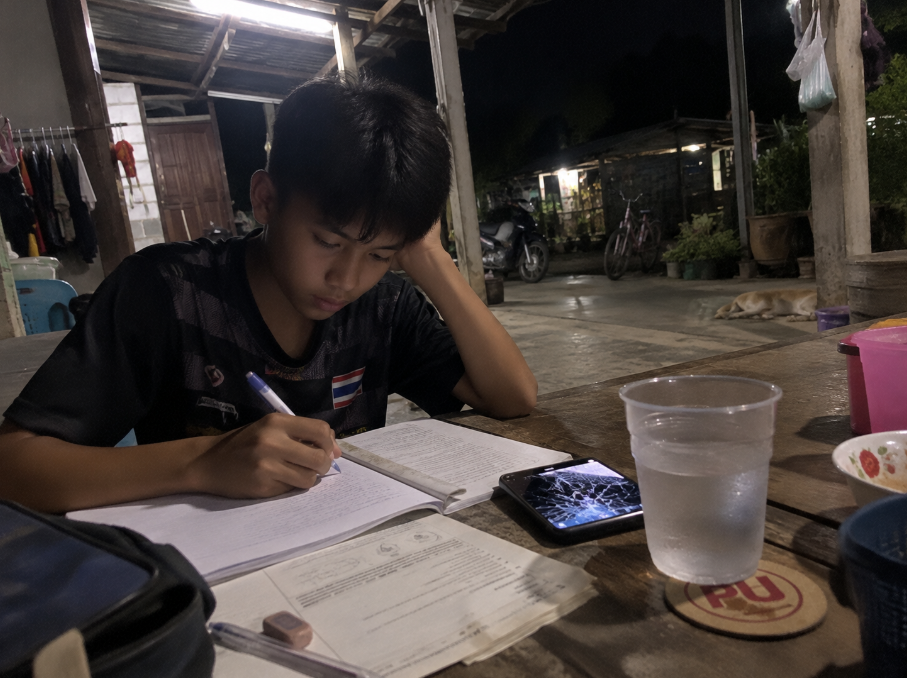
Five years pass. The boy is now fifteen years old, standing alone on the concrete veranda of the house his mother bought. It is late evening. He holds his smartphone in his hand, staring quietly at the faded digital photograph of his mother smiling in that random hotel lobby. He does not press the dial button. He just stares at the screen for a long time, absorbs the weight of the lie, and slides the phone back into his pocket. He walks back inside the air-conditioned house. His grandmother looks up from the kitchen counter and asks if his mother called today. He shakes his head and casually says no. She nods and goes back to preparing dinner. He sits down at the wooden table, opens his school textbooks, and begins his homework. He deliberately stops thinking about the coast, the bars, and the reality of his mother’s evening shift. He just focuses on the math equations in front of him, playing his assigned role perfectly, exactly as if he were still the little boy who believed his mother worked in a hotel.
Leave a Reply