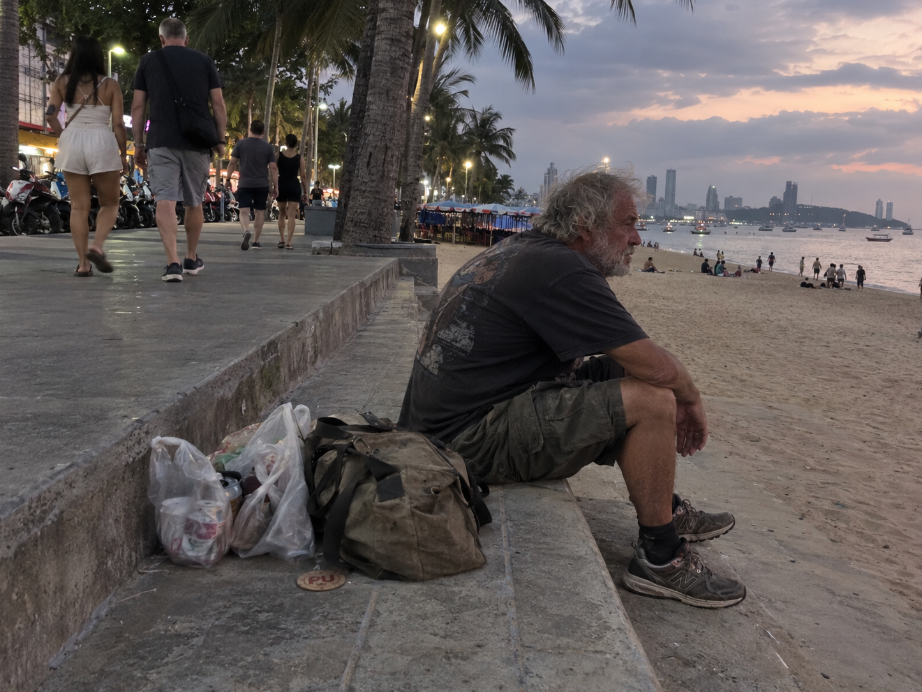
A former local resident recently told a British tabloid the only truth that matters about this town: “I had to get out. Staying there will kill you. The city chews people up and spits them out with empty pockets.” He was one of the lucky ones who managed to buy a ticket out. But he left behind dozens of men who didn’t. Men who never should have come here, and now have absolutely no way to leave.
Walk down the beach promenade at six in the morning, and you will see the ghosts. There is a European man, somewhere in his late sixties, sleeping on the concrete steps with his entire life stuffed into a faded plastic bag. He isn’t a tourist, and he certainly isn’t an expat anymore. He is just existing, blending into the background like the stray dogs and the cracked pavement. He’s been there for months. Back in December 2025, immigration officers picked up a Russian national living in total squalor near Pratumnak Beach for a two-month overstay. When they finally tracked down his mother, she admitted he had severe mental health issues long before he ever boarded a plane.
Nobody keeps an official ledger of the foreigners who hit rock bottom here, but the grim math always leaks out. Foreigner suicides in this city sit at roughly five times the national average, jumping from three dozen in the first half of 2024 to nearly fifty in 2025. A charity running a shelter up in Bangkok recently reported pulling over forty destitute Westerners—Germans, Swedes, Danes—off the streets. They are victims of romance scams, divorced men who lost their anchors, or pensioners who thought their retirement checks would outpace inflation forever. Thailand offers no social safety net for them, and they are entirely out of cash for a flight home.
But the darkest part of this reality is that many of them don’t actually want to be rescued. They burned every bridge to get here. They sold their houses, cut ties with their families, and proudly announced they were retiring to a tropical paradise. Flying back broke and broken is a public humiliation they simply cannot swallow. They are caught in a brutal psychological trap where moving forward is financially impossible, and moving backward is too shameful to bear. So they just stand still. They sit on the beach and they drink, which is exactly why chronic alcoholic liver disease quietly claims more long-term foreigners here than traffic accidents ever will.
The local laws, like the 2014 Protection of Destitute Persons Act, look humane on paper but fail entirely on the street. Authorities sweep the promenade, pick up a dozen people, and issue warnings, only for the exact same men to return to their concrete benches by nightfall.
Western readers love to frame this as a personal failure—a guy who couldn’t budget or didn’t know when to stop. But that ignores the massive machinery designed to lure them here. YouTube algorithms relentlessly feed vulnerable, lonely men an idealized fantasy of cheap living and endless attention. The city operates as a highly efficient system that makes these men feel like they have finally won at life, right up until the exact moment they realize they have lost everything.
By evening, the man on the beach steps is awake, just staring blankly out at the dark water. He isn’t thinking about his past or his future; he is entirely exhausted by the sheer mechanics of daily survival. Packs of laughing tourists walk right past him, snapping photos of the sunset, completely blind to his existence. Resting on the concrete beside his plastic bag is a damp, crumpled cardboard coaster with faded letters reading ‘PU’. It might have blown over from a nearby bar, or someone might have dropped it yesterday. It just sits there on the pavement, ignored by the world moving around it. Exactly like him.
Leave a Reply