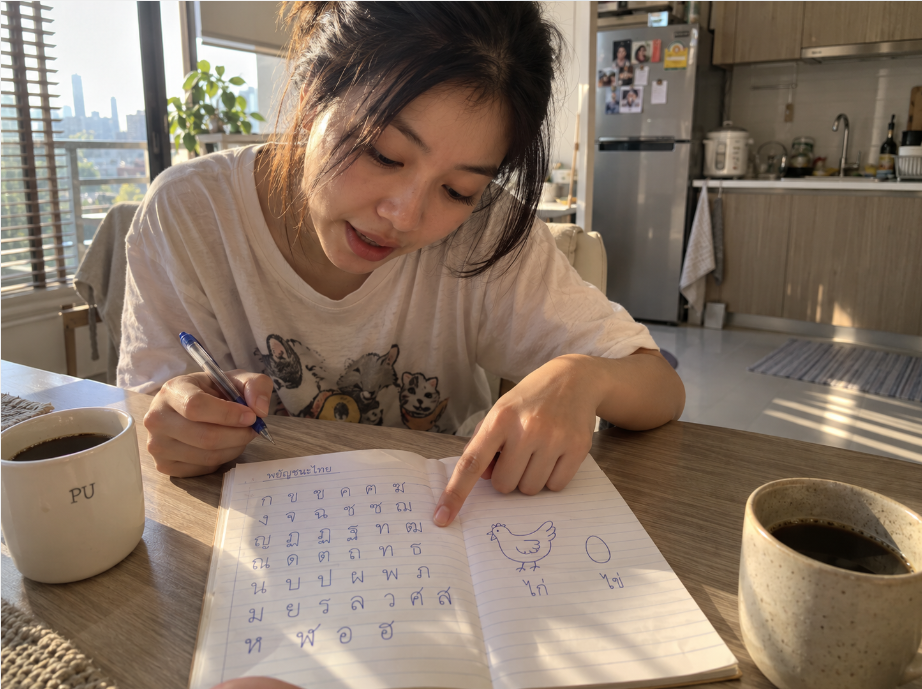
The morning sun was cutting through the gaps in the balcony blinds, pooling on the cheap laminate of the dining table. The air conditioning hummed quietly in the background. Down on the street, the city was entirely dead, still sleeping off another night of heavy bass, spilled drinks, and bad decisions. Up here, on the sixth floor, there was only the soft scratching of a ballpoint pen.
“Again,” she said, tapping the back of the pen against his notebook. “Kho gai.”
“Kho gai,” he repeated, feeling his tongue hit the roof of his mouth awkwardly.
“Chicken,” she said, her face completely serious as she drew a terrible, lopsided bird next to the Thai character. She moved her pen slightly to the right. “Next one. Kho khai. The egg.” She sketched a small, uneven oval inside a basket.
He didn’t look at the paper. He watched her lean over the table, entirely focused on the lesson. He watched the way her hair fell across her shoulder and the quiet, completely unguarded expression on her face.
For the first time since he had moved to this coastal town, the crushing, inescapable gravity of Pattaya felt utterly nonexistent. The open-air bars, the neon signs, the endless transactional arithmetic of the nightlife—it all evaporated into the humid morning air. There were no customers here, no shifts, no negotiations, and no masks. It was just a quiet room, two mugs of instant coffee, and a language lesson.
He realized, with a sudden and quiet clarity, that he loved this. He liked this mundane, domestic morning infinitely more than any thrill the city had ever offered him. He wanted to sit at this cheap table and watch her patiently repeat kho khai for the thirtieth time. He wanted to see her draw that terrible little chicken every single morning.
The industry outside didn’t matter anymore. Her history in the bars didn’t matter, and his own past as just another cynical, wandering expat didn’t matter either. Let it all burn. Let the whole chaotic city wash away into the Gulf, as long as this specific room, in this specific moment, remained untouched.
She stopped writing and looked up, catching him staring. A small, knowing smile broke through her teacher’s persona. She tapped the paper again, pointing to a symbol that looked like a small, jagged bell.
“You are not looking,” she said softly. “What is this one?”
He looked down at the notebook, traced the shape with his eyes, and then looked back up at her, carefully shaping the unfamiliar sound.
“Kho rakhang.”
Leave a Reply