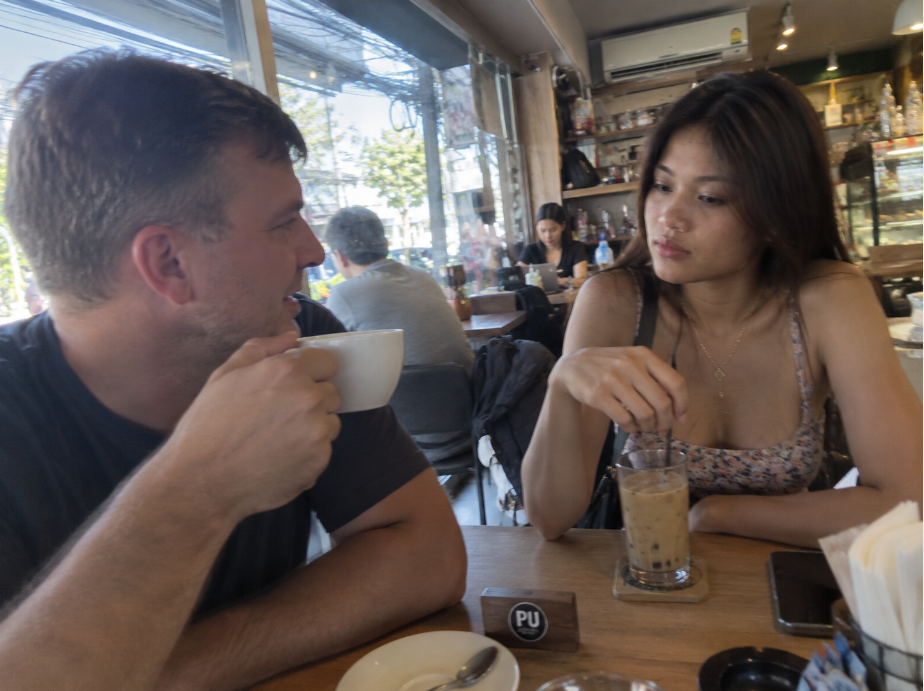
They are sitting at a corner table in a quiet cafe in Jomtien, four years after they met.
Gavin is forty-one, an architect from Seattle. Kwan is twenty-nine, from Chaiyaphum. If you ask them to recount the story of how they fell in love, you will not hear one story. You will hear two completely different biographies of the exact same events.
“I knew from the first night there was something different about her,” Gavin says.
“He was just another customer,” Kwan says.
The First Night
Gavin remembers instant chemistry. She didn’t rush him. She laughed at his jokes. They stayed up talking, and she stayed for breakfast. He remembers thinking, This doesn’t normally happen.
Kwan remembers that he was calm, he wasn’t blackout drunk, and he paid the bar fine without negotiating. She stayed for breakfast because she was hungry, and he was a pleasant customer.
Neither of them is lying.
The Second Week
Gavin remembers the exact moment he knew it was real: she started texting him first. Good mornings, photos of her food. Proof that they had transcended the transaction.
Kwan texted first because repeat customers are the lifeblood of the grid, and she didn’t want to lose a good one. But by the end of the week, a micro-shift happened: she found herself actually waiting for his replies. Pragmatism slowly bleeding into attachment.
The First Gift & The First “I Love You”
When her phone broke, Gavin bought her a new one. He remembers her deep gratitude. It felt like true intimacy.
Kwan was genuinely grateful, but it was also the exact moment she felt her first wave of anxiety. In her world, when a man starts spending real money, expectations inevitably follow.
A month later, Gavin said, “I love you.” He remembers the emotional weight of the declaration. A turning point.
Kwan doesn’t actually remember the exact words. She remembers the condition that immediately followed them: “Will you stop working at the bar now?”
He remembers a declaration. She remembers a contract negotiation.
Leaving the Grid
“I took her out of the bar,” Gavin often tells his friends. He is certain he offered her a better life.
“I was already planning to leave,” Kwan says. “He just appeared when I was ready.”
To him, he is a savior. To her, he is a convenient bridge. Both firmly believe the decision was entirely their own.
The Economics of Routine
When Gavin started sending her a monthly allowance, he viewed it as an act of generosity and proof of commitment. But he assumed that since she was no longer in the bar, money should become less of a central focus in their dynamic.
Kwan viewed the allowance as replacement income. She was no longer earning her own money. Therefore, his financial reliability didn’t become less important—it became the absolute foundation of her survival.
The Illusion of Trust
Gavin prides himself on their mature dynamic. “We trusted each other from the beginning,” he says. “She was never jealous.”
Kwan was terrified every single time he went out drinking with his friends. She knows exactly how Pattaya works. She knows how easily a five-minute bar chat turns into a hotel room. But she never threw a tantrum, because she refused to look like an insecure, controlling Thai girlfriend.
Gavin sees a man enjoying his freedom. Kwan sees a man taking a test that she silently grades every time he replies two hours late. His absolute certainty in their trust is built entirely on her exhausting self-control.
The Family Audit & The Village Trip
When Gavin met her family, he was overwhelmed by their warmth. They accepted him instantly. He saw it as emotional validation.
Kwan remembers her mother pulling her aside into the kitchen to ask if he was serious, exactly how much he was sending, and if he would actually come back after his next flight home. For Gavin, a welcome means emotional acceptance. For the family, a welcome is a cautious financial evaluation.
Gavin’s memories of Chaiyaphum are a warm montage of smiling relatives, spicy food, and playing with the village kids. A relaxing vacation.
For Kwan, the trip was a paralyzing, multi-day stress test. She had to manage the entire scene: making sure he didn’t drink too much, ensuring he didn’t accidentally insult an elder, and terrified her relatives might ask for too much money and make him think it was a scam. He was resting. She was working.
The First Big Fight
Their first major argument was over a medical bill for her uncle. Gavin thought the fight was about the amount of money. Kwan thought the fight was about the fact that he instinctively assumed her family was scamming him. He was arguing about the math. She was arguing about his fundamental lack of trust in her humanity.
The Distance
When Gavin flew back to Seattle for a month, they talked every day. “Distance made us stronger,” he says.
But for Kwan, those video calls were a brutal reality check. She saw his house, his car, his coworkers, his ex-wife picking up their kids. She realized that in his vast, complex Western life, she was just a tiny face on a LINE app. Daily contact confirmed his closeness, but it showed her the terrifying scale of the distance.
She refused to post him on her social media. It hurt his feelings. He didn’t understand that she simply didn’t want old customers and village gossips analyzing her survival strategy.
The Turning Point
When a heavy storm damaged her mother’s roof, Gavin paid for the repairs without hesitation. He remembers this as the day he officially became part of her family.
Kwan remembers it as the exact moment she finally exhaled. It was the day she realized he was truly reliable. For the first time in their relationship, their two biographies perfectly aligned.
The Blurred Intimacy
When did the transaction actually end?
Gavin thinks it ended the day they stopped discussing money before getting into bed.
Kwan knows exactly when it ended. It was a Tuesday night, six months in. They slept in the same bed, they didn’t have sex, and he didn’t get angry about it. That was the real boundary.
“You’ve Changed”
Two years into their domestic routine, they had their second big fight. Gavin was frustrated. The passion had faded.
“You’ve changed,” he told her. “You were so much happier and more spontaneous when we first met.”
Kwan looked at him and delivered a single, devastating sentence.
“Yes. I was working.”
She wasn’t admitting that it was all fake. She was simply stating a fact: the hyper-affectionate version of her was a professional requirement. Now, they are just real.
The Four-Year Mark
Back in the cafe in Jomtien, they are holding hands across the table. They survived the transition. The magic is gone, replaced by the quiet, boring stability that Gavin sometimes mourns and Kwan fiercely protects.
“So, when did you become a real couple?”
Gavin answers instantly. “The first day.”
Kwan laughs. “No.”
Gavin looks at her, confused. “When then?”
She thinks about it for a long time. “Maybe after one year.”
Gavin is genuinely stunned. “One year?”
Kwan shrugs. “Before that, I still think maybe you go home and just disappear.”
Gavin stares at her. “I never knew that.”
“I know.”
People don’t remember relationships as CCTV footage. They remember what events meant to their survival. In a Pattaya relationship, the exact same event can carry completely different economic and emotional weight for each person, playing out in perfect, silent parallel.
Leave a Reply