What a factory worker, a bar girl, and a billionaire’s wife all have in common?
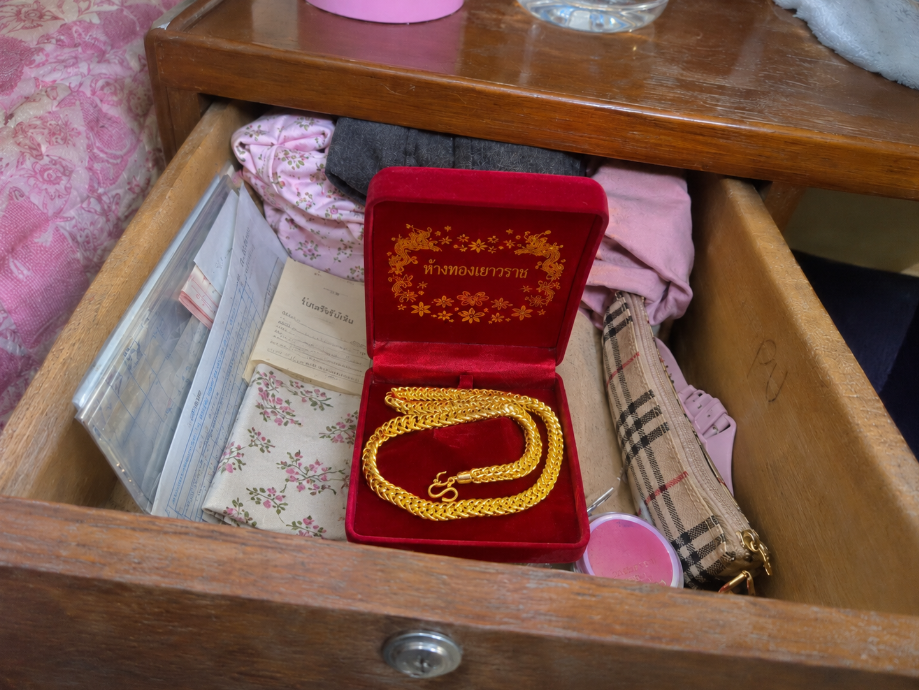
Open the top drawer of a bedside table in a rented studio behind Soi Buakhao, a dormitory locker outside an industrial estate in Rayong, a wooden cabinet in an Isan farmhouse, and a walk-in safe in a Thonglor penthouse. In all four places, tucked beneath folded clothes or passport folders, you will find the exact same object: a small, crimson velvet or plastic box stamped with gold Chinese-Thai lettering from a shop in Yaowarat.
Foreigners in Pattaya love to reduce Thailand’s relationship with gold to a cheap bar-room cliché. They see a girl ask for a gold necklace and immediately write the story off as shallow greed—just an asset she plans to walk down to the nearest pawnshop the second her sponsor’s flight takes off.
That reading misses the entire cultural operating system of the country. What looks to an outsider like an obsession with jewelry isn’t vanity at all. It is a centuries-old financial survival mechanism shared by every woman in the kingdom, regardless of her bank balance.
For generations in rural Thailand, formal banking was distant, intimidating, or nonexistent. Land deeds were messy, paper currency rotted in the monsoon humidity, and cash kept under a mattress vanished the moment a relative needed bail, a hospital deposit, or fertilizer for the next harvest. In a society where daughters carry the unspoken burden of keeping the family afloat, women needed an asset that was portable, invisible to relatives until necessary, immune to inflation, and convertible into cash within three minutes anywhere from Chiang Rai to Hat Yai.
Gold wasn’t an accessory. It was a sovereign central bank that fit inside a handbag.
That is also why Thai gold looks completely alien—and often “fake”—to Western eyes.
In Europe or North America, fine jewelry is typically 14-karat (58.5% gold) or 18-karat (75% gold), mixed heavily with copper, silver, or nickel so the metal is hard enough to hold diamonds and survive daily wear. To a Thai buyer, Western gold is diluted scrap—essentially costume jewelry with terrible resale value.
Traditional Thai gold (thong rupphan) is standardized by law at 96.5% purity (23 karats), and serious savers go straight for 99.99% pure gold (24 karats). Because it contains almost no alloy, it is heavy, remarkably soft, and glows with a deep, saturated orange-yellow hue that surprises first-time visitors. You will almost never see diamonds or gemstones set into traditional Thai gold either. In Thailand, everyone knows a diamond loses half its value the moment you carry it out of the mall. Pure gold is pegged to the exact global spot price displayed on digital boards in every gold shop window across the country.
Which brings us to the real insider distinction that separates tourists from locals: a chain is for showing off, while a bar is for keeping.
When you buy a gold necklace or bracelet, you pay kha kamnet—a workmanship and design fee on top of the metal’s weight. Wearing a heavy chain to a village wedding or a temple festival signals status and solvency, and if an emergency hits, any gold shop will buy it back on the spot—minus that craftsmanship fee and a small spread.
Once a Thai woman stops caring about impressing neighbors and starts building real security, she stops buying chains and starts buying gold bars (thong thaeng)—flat, stamped ingots of 96.5% or 99.99% pure metal sealed inside tamper-proof plastic cards. A gold bar carries virtually zero workmanship markup. When you sell it back across the counter, you get the exact daily buyback price down to the last baht. No haggling, no appraisals, no awkward questions.
Even the way Thai gold is weighed tells the story of how deeply metal and money are fused together here.
Gold in Thailand isn’t measured in ounces or grams—it is measured in baht. Before the Thai baht existed as paper bills or coins, it was a unit of mass: specifically, the weight of pod duang, the small, folded silver “bullet” ingots used as currency in Siam for over six hundred years. One baht of gold equals 15.244 grams—just under half a troy ounce. When a Thai woman asks for “one baht” or “two baht” of gold, or saves up quarter-baht increments (salung), she isn’t confusing currency with jewelry. She is speaking an ancient measurement language in which weight and wealth were never separated.
Foreigners often sneer when a woman in Pattaya asks for gold instead of a romantic dinner or a designer handbag, convinced it proves she has no sentimentality.
In reality, she is simply operating with far clearer eyes than he is. A Louis Vuitton bag loses half its value on the sidewalk; a man’s promises expire the moment his boarding pass is scanned; paper money disappears into bills and favors. A 15-gram ingot of 99.99% gold inside a red velvet box doesn’t lie, doesn’t cheat, and doesn’t leave.
Leave a Reply