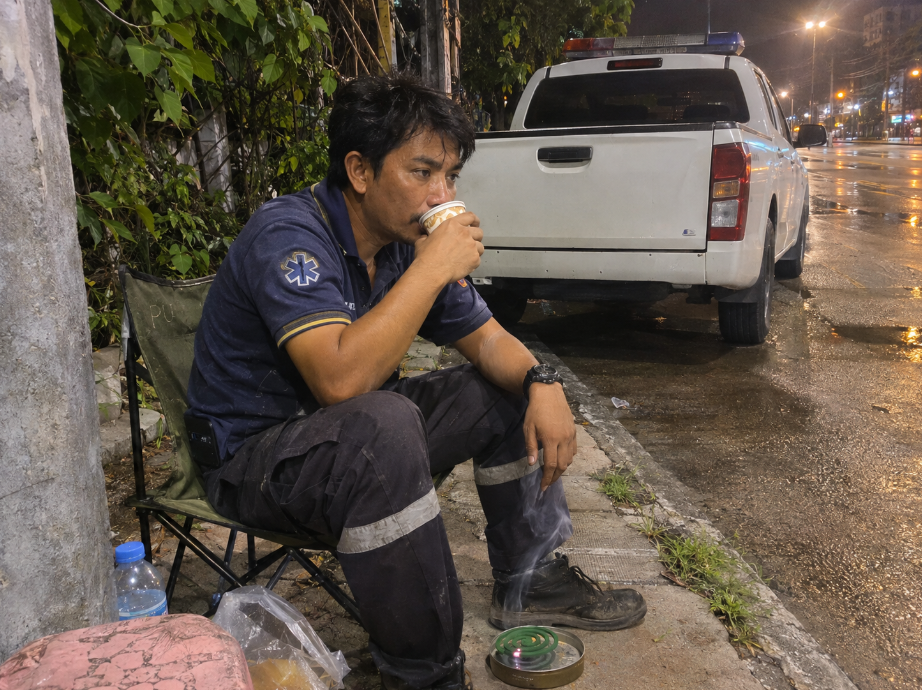
At 3:10 AM, a white Isuzu pickup sits idling with its headlights off near the corner of Pattaya Tai and Sukhumvit Road, the blue and red lightbar dark against the humid sky.
Beside the rear bumper, Lek—thirty-six, wearing a faded navy polo shirt with the Sawang Boriboon Thammasathan patch stitched over the chest—sits on a low folding chair sipping lukewarm 3-in-1 coffee from a paper cup. A cheap green mosquito coil burns slowly inside a tin lid by his boots.
Tourists who see the flashing lights screaming down Beach Road at night usually assume these crews are paid city paramedics. In reality, Lek balances tires at a garage off Third Road six days a week. Four nights a month, from ten until five, he puts on the rescue uniform for zero baht. Like most of the men riding in the back of those trucks, he is a mechanic, a delivery driver, or a market vendor doing tham bun (ทำบุญ)—making merit by cleaning up whatever the city leaves behind after last call.
At 3:25 AM, the walkie-talkie clipped to his shoulder crackles to life in rapid Thai: Accident, Jomtien Second Road, foreign male, down on the asphalt.
No speeches, no rush of adrenaline. Lek drops his cigarette butt into an empty water bottle, climbs into the cab, and his partner flips the siren on as they pull onto the empty road.
Four minutes later, their headlights catch a rented Honda Click wedged under the rear axle of a parked baht bus. One rubber flip-flop lies ten meters back beside a dark streak of leaking petrol and shattered plastic. The rider—a British guy in his late twenties, shirtless, no helmet—is groaning on the tarmac with a jagged compound fracture above his ankle and road rash tearing half the skin off his left shoulder. Twenty feet away, his Thai girlfriend sits crying on the curb, trying to unlock his cracked iPhone to find an insurance number while three passing tourists hold up their phones to film from across the street.
Lek doesn’t glance at the cameras. He drops to one knee on the grit, straps a rigid foam collar around the neck, presses sterile gauze against the bleeding shoulder, and signals his partner to slide the orange spine board underneath. Twelve minutes from the radio call, they are backing into the emergency bay at Banglamung Hospital.
Road crashes are loud, messy, and routine. It is the quiet calls that stay in the cab on the drive back.
Just after four-thirty, the radio crackles again with a coded address at a thirty-story condominium off Second Road. When the pickup turns down the narrow access lane, the security guard is already standing by the barrier gate, waving both hands for them to kill the siren so the paying guests on the lower floors don’t wake up.
There is no crowd here. Just two uniformed guards standing stiffly beside a row of potted palms near the parking ramp, and a sixty-something European man lying motionless on the grey paving stones in boxer shorts and a stretched cotton T-shirt. Up on the twenty-fourth floor, a sliding glass balcony door stands wide open, the sheer white curtain drifting outward in the pre-dawn breeze. Upstairs on the laminate table, the police will later find a half-empty bottle of local rum and a phone screen still lighting up with unread messages.
Down on the concrete, Lek knows within two seconds that there is nothing left for an ambulance to save.
He walks back to the truck, pulls a clean white cotton sheet from the metal storage box, unfolds it smoothly over the body, and tucks the corners under to keep the wind from lifting it while they wait for the duty doctor and the tourist police investigator to arrive with clipboards. Nobody cries. Nobody delivers a lecture about the dangers of Pattaya. In Thai logic, the man’s clock simply ran out—and the last kindness left to offer a stranger ten thousand miles from home is keeping his body covered until the van gets there.
By 5:15 AM, the sky over the hills behind the railway tracks turns a bruised, pale grey.
Back at the staging point, Lek unwinds a green garden hose, washes a smear of dried blood off the rubber mat in the back of the pickup, and hangs his blue rescue shirt over the passenger headrest. In two hours, he has to roll up the steel shutter at the tire shop. Pattaya spends all night selling fantasies—and leaves it to ordinary men in unpaid uniforms to quietly fold up the receipts before sunrise.
Leave a Reply