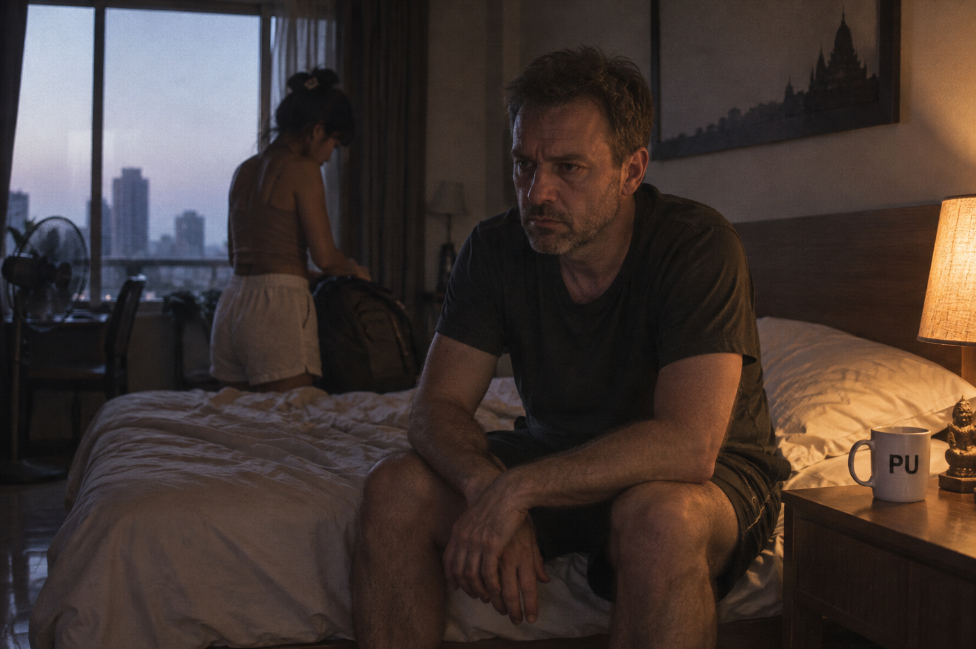
The phone rings at 4:30 AM. Derek doesn’t wake up; he simply stops pretending to be asleep. From the tinny speaker, he hears the rapid cadence of Isaan dialect, a cracked voice, and the word phor. He immediately begins grading the performance. Too loud for genuine shock, too early for a planned theatrical release. He isn’t a villain. He is just a man with a severe, crippling allergy acquired from two years in the Pattaya ecosystem.
Mai sits on the edge of the bed and delivers the news in her functional English: her father died, she needs a minivan this evening, and she needs to cover her share of the temple hall. She doesn’t put on a show. She is simply too tired to translate death into a language understood by the man who pays her rent.
Derek turns on the light. He doesn’t reach out to hug her. He asks for proof. Why can’t her uncle pay? Why not the brother? Mai silently forwards a photo from her family LINE group: a tiled temple hall, floral wreaths, a framed portrait. To her, it is devastating proof of loss. To Derek, it is forensic material.
He goes down to the 7-Eleven, not because he needs coffee, but because he needs distance. Standing by the counter with a 45-baht Americano, he zooms in on the image. He feels a grim, familiar satisfaction when he spots the flaw. The lighting is too sharp for 5 AM. He texts an expat buddy: New script dropped today. Excellent production value. This is how his humor operates. If he evaluates the cinematography, he isn’t required to feel anything.
Parallel to this, four hundred kilometers away, Mai’s sister Fon sits on a plastic chair in the humidity. There is no script. The coffin is heavy and real. The bill for the monks and the ice is a strange, uneven number. Fon doesn’t know or care about the foreigner in Chonburi. She just called because she needs her older sister to come home. That is her entire economy.
Back in the condo, Mai translates her grief into a highly specific, uneven baht amount, because exact numbers are the only things that pass through Derek’s emotional customs. Derek executes a gesture of calculated decency: he transfers 10,000 baht and announces he will stay home. His spoken formula is simple: I paid the temple tax, but I’m not attending the circus.
The actual truth is much heavier. If he gets in that minivan, stands in that village, and looks at a real dead body, he has to throw away two years of protective cynicism. A bank transfer is infinitely cheaper.
Mai packs her backpack without slamming the door. Drama yields no dividends here.
By 4 PM, Derek is sitting on a barstool with a 70-baht Leo, explaining to the guy next to him how surgically he spotted the classic funeral hustle. Later that evening, Mai posts an Instagram story: monks chanting, incense burning, a wooden casket.
Sitting alone in his condo, Derek pinches the screen, zooming in on the casket. He stares at it until he decides the varnish is too glossy for a poor village. He locks his phone. He won again.
He didn’t expose a fraud. He just successfully exposed his own inability to show up.
Leave a Reply