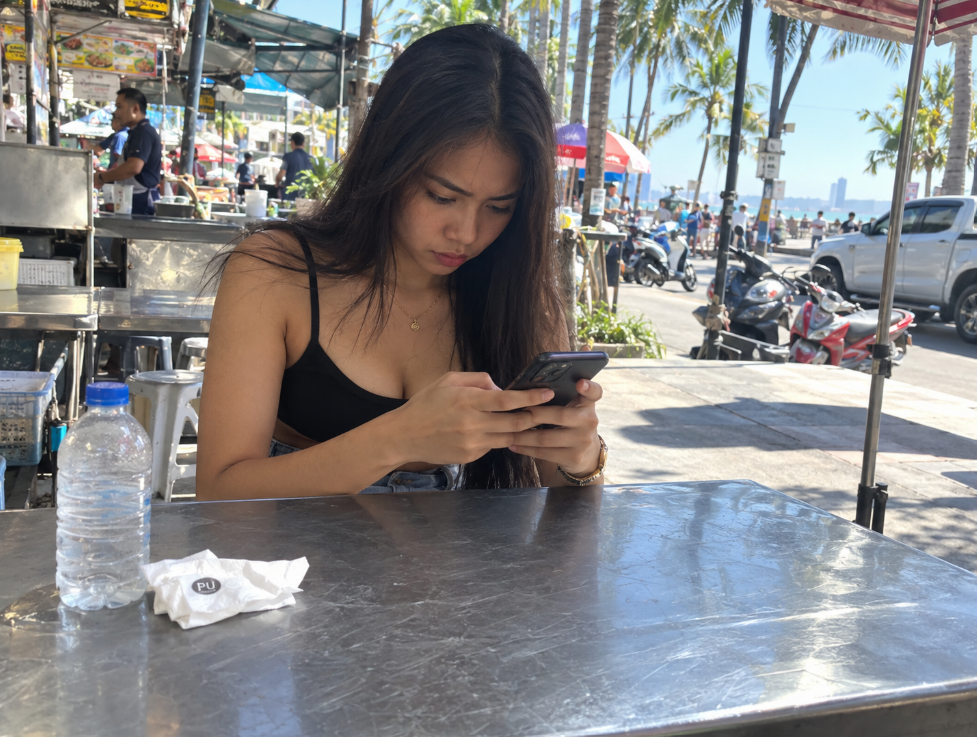
Right now, somewhere in a Wongamat condo, a newly arrived tourist is staring at a dating app, genuinely believing he is having a witty, nuanced conversation in English. At the exact same moment, a girl sitting in a dark room in Second Road is frantically copying his messages, pasting them into Google Translate, and firing back pre-written templates from her Notes app.
He assumes she understands Western sarcasm and cultural context. She assumes he has been in Pattaya long enough to understand the brutal, hyper-efficient slang of the grid.
It is a flawless, passionate dialogue between two people who have absolutely no idea what the other is saying.
To survive this ecosystem, you have to realize that the local slang is not a cultural quirk. It is the front-end terminology of a highly optimized economy. Before you misinterpret another message, you need to understand the actual dictionary of the grid:
Freelancer (FL): Delete the image of a remote graphic designer from your head. She is exactly what you are looking for on the app; she just doesn’t have a bar manager. She is an independent contractor.
The Third-Person Perspective: “Ploy is hungry.” She doesn’t have a split personality. In Thai grammar, using your own nickname instead of “I” is just a standard way to sound polite or cute.
Brother / Sister: The Western ego immediately imagines a wholesome family reunion. On the grid, “brother” (Pi) or “sister” (Nong) rarely implies blood relations. It is a universal pronoun for a neighbor, a bartender, or—very frequently—another sponsor who happens to pay her rent.
Take Care: This is not a request for emotional support. On the grid, this is a financial term. It is an invoice. It means paying the rent, covering the motorbike installments, and funding the lifestyle.
Up To You: The single most dangerous phrase. It is a trap. It means: “I already have a very specific expectation, but I am going to make you guess it. If you choose the cheap option, the headache begins.”
These translation errors happen because the farang fundamentally misunderstands the underlying math. The entire industry sells the exact same product—companionship. But that product is distributed through three entirely different economic models. Each one optimizes for a different variable.
1. Short Time (ST): The High-Velocity Model
Price: 1,000–2,500 THB | Time: ~1 hour per transaction
The goal is speed and turnover. In theory, this model offers the highest hourly rate. In practice, it comes with massive hidden costs. The main bottleneck is customer acquisition. Every hour requires a new client. That means constant visibility, negotiation, rejection, risk, and physical wear. There are no secondary benefits—no food, no transport, no gifts. Once the hour ends, revenue resets to zero. It works for short bursts, but as a daily model, it is volatile and exhausting.
2. Long Time (LT): The Batch Transaction
Price: 2,500–10,000 THB | Time: 6–10 hours
LT is fixed income. It is about securing the day in one deal. The hourly rate drops, but income stability rises. One transaction covers the freelancer’s break-even point and removes the need to hunt. The trade-off is opportunity cost. Once locked into an LT, the night is gone. If the client is difficult or cheap, there is no upside beyond the agreed price. It reduces stress, but it strictly caps the financial potential.
3. GFE: The Platform Model
Base rate: from 2,000 THB per day
GFE (Girlfriend Experience) is frequently misunderstood because tourists focus exclusively on the base price. Economically, that is a fatal mistake. GFE is not a service—it is a platform with embedded upsells.
The freelancer effectively moves in with the client. She becomes a companion, guide, translator, and lifestyle accessory. The real profit comes from what doesn’t show up on the initial invoice:
Cost Absorption: Food, drinks, transport, and entertainment are paid by the client. The girl’s daily operating expenses drop to near zero. The base rate becomes almost entirely net income.
Micro-Upsells: Small requests accumulate fast. Cosmetics, a new dress for dinner, a phone repair, spontaneous shopping. Each request feels minor, but together, they materially increase daily revenue.
Lifestyle Subsidies: Trips, hotels, and gifts replace expenses she would otherwise carry herself.
Subscription Potential: GFE arrangements often extend beyond a single trip. Repeat visits and monthly remote transfers dramatically increase the Lifetime Value (LTV) of the client.
Average daily operating costs for a worker sit around 1,000–1,500 THB. In ST and LT, she pays those costs herself. In GFE, those costs are entirely externalized to the client. That single shift completely alters the profitability curve.
The most successful players on the grid are not selling hours. They are managing time, attention, and auxiliary revenue streams. The tourist on the dating app thinks he beat the system because he avoided a bar fine and found a “normal” girl. He simply doesn’t realize he just walked into a premium subscription model with the highest risk-adjusted returns on the market.
Leave a Reply