This post might be unpopular, but after more than a decade of managing and marketing venues on the grid, it’s time to aggregate what is actually happening behind the neon curtain.
Let’s start with a controversial truth: I rarely work with farang owners. And let’s call things by their actual names. In this ecosystem, the farang is almost always the “nominal” owner, not the Thai partner. The Western ego hates hearing this, but it is the reality. The farang is temporary. Today he is here aggressively micromanaging the bar, and tomorrow his money is gone, his visa is expired, and he is on a flight back to home. But the venue remains. The Thai stakeholders remain. Yet, the temporary farang always assumes he knows exactly how the machine should operate. That is why I prefer working with the actual local operators.
And if you watch the smart local operators right now, you will see a massive, quiet evolution. I won’t name specific venues, but the blueprint of a “healthy” establishment in Thailand is drastically changing.
The Human Capital Realization
The healthy venues have finally realized that their only real asset is the staff. The girls bring the clients. A Facebook ad about a 99-baht Happy Hour doesn’t bring clients. A desperate lottery to win a Honda Click by buying fifty lady drinks doesn’t bring clients. The talent does.
The Burmese Cleaner Paradox
For decades, the grid operated on a bizarre, dystopian paradox. The Burmese cleaner mopping the floor of the bar actually had more legal labor rights than the Thai girl generating the revenue on the stage. The cleaner was formally employed, had a work permit, social security, and a stable salary. The Thai worker was a financial ghost—no official income, zero chance of getting a bank loan, and absolutely no safety net.
Today, this is changing. Smart venues are officially putting the girls on the payroll (usually registered as “waitresses”). It is a massive breakthrough. It gives them a legal financial footprint.
Competing with the Cloud
Why the sudden burst of corporate responsibility? It isn’t charity. The industry has realized that it is competing with the internet. A girl can easily stay in her room, open an app, and make money without the physical toll of the bar. To pull them back onto the physical grid, the bar has to offer something the internet cannot: real-world stability, community, and legal leverage.
Burnout and Retention
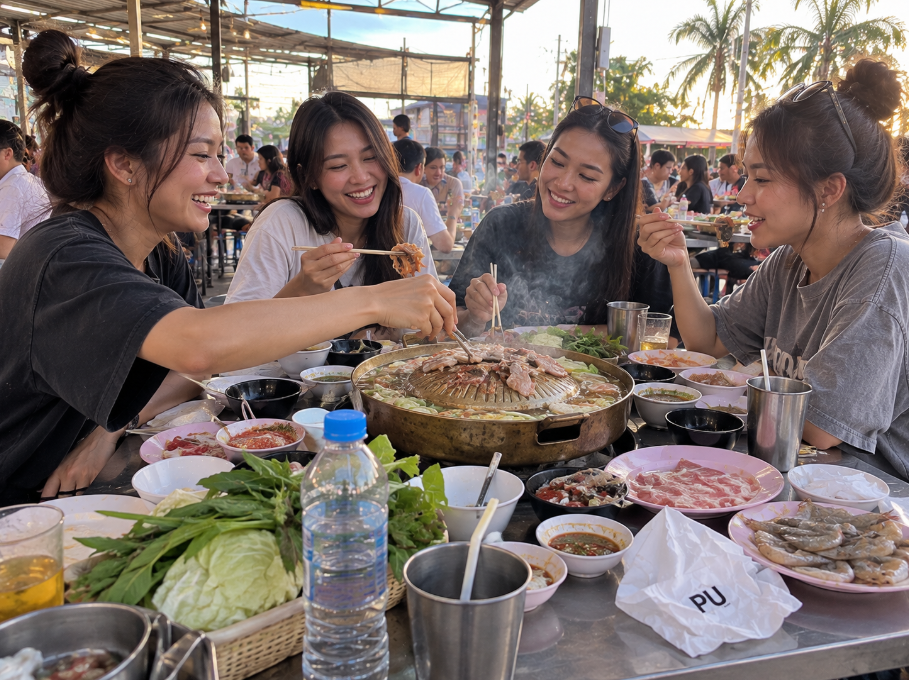
Healthy venues also understand that the grid is a factory, and factory work is grueling. The staff burns out. Now, you are seeing actual corporate-style retention strategies applied to the nightlife sector. Venues are fully funding staff trips to the islands. They are organizing team-building nights over giant tables of Moo Krata. They are treating the girls like actual employees who need psychological decompression, rather than disposable commodities.
The Death of the Cover Band
Finally, the product itself is shifting. Sitting in a dark room listening to a sweaty guy aggressively strum an acoustic guitar while screaming the lyrics to “Zombie” doesn’t work anymore. It is boring for the tourists, and it is completely mind-numbing for the girls.
The healthy venues are pivoting toward a real show format. They are booking actual artists and organizing high-tier concerts inside the venues. They are creating an environment that entertains the staff just as much as the customers, because they have figured out a fundamental rule of the new economy: a bored, miserable worker is terrible for unit economics.
The grid is maturing. The establishments that treat their staff like ghosts are slowly dying, and the ones treating them like a core corporate asset are quietly taking over the city.
Leave a Reply