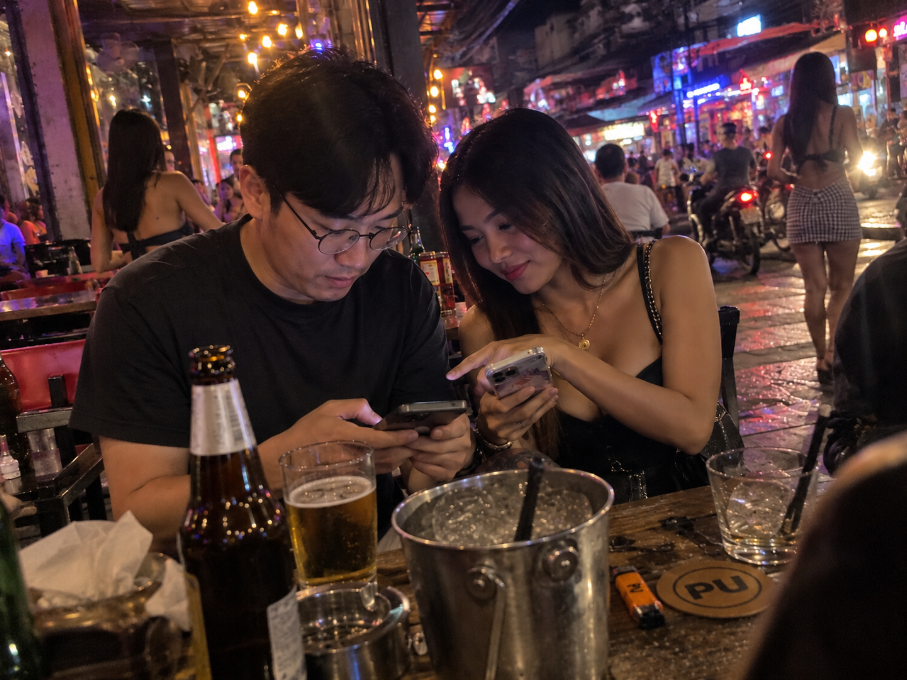
Author’s note: With this post, I am opening a short series on the hidden relationship patterns between Thai women in the industry and Asian clients—Koreans, Japanese, and Chinese. Why them? First, because my current work in the industry brings me face-to-face with these demographics daily. Second, beneath their polished facades lie entirely different cultural codes that are completely alien to the Western mind. Let’s start with the basic mechanics: how the street adapts its lies to the color of a passport.
A single bar girl can tell three entirely different stories to three different men in a single night. To the Englishman, she will tearfully describe a sick water buffalo and a leaking roof. To the Korean, she will talk about her mother’s sudden cancer diagnosis. To the Japanese man, she will confess a missed period and a pregnancy. To the Chinese man, she won’t tell any story at all.
This doesn’t happen because she is a pathological liar. It happens because she is speaking the exact language each of them is programmed to understand. A scheme in Pattaya is rarely just a scam. It is a masterful translation of poverty into a dialect the client can decode, allowing him to part with his money without losing face.
The entire industry relies on adapting the narrative to three variables: the client’s emotional involvement, his willingness to pay, and his domestic cultural context. The Western man flies in looking for the illusion of “true love”—he needs a drama where he plays the savior. The Korean is looking for cinematic romance—he needs a fatal tragedy that makes him the main character. The Japanese man seeks a long-term, structured bond—he needs a heavy responsibility he can carry for years. The Chinese man comes for a service—he doesn’t want drama; he wants a clean transaction.
The Western Client: The Cascade of Disasters
The infamous “sick buffalo” is no longer just a lie; it is an established literary genre. Back in 2004, a translated letter from a Thai bar worker circulated on an expat forum, becoming the ultimate encyclopedia of this style. In a single paragraph, she brilliantly compressed the death of a buffalo, a father’s broken leg, a collapsed roof, a brother’s motorcycle crash, that same brother’s arrest, a mother’s severe illness, a guilt trip blaming the foreigner (“this is because I am with you”), and a final threat to go with other men if he didn’t wire cash.
This scheme operates purely on a cascading effect. Every new disaster logically flows from the last, leaving the target no time to breathe. The foreigner cannot verify a single fact, but he doesn’t need to. He sees the narrative he desperately wants to see. He wants to be needed. He wants to believe his Bank transfer is literally saving a life. The “sick buffalo” still drains the wallets of thousands of Western men every year, not because they are stupid, but because the scheme exploits their deepest vulnerability: the white savior complex.
The Korean Client: Cancer and Death
Koreans represent the new, aggressive money on the grid. They pay more and stay longer, but they don’t read old English forums and know nothing about sick agricultural livestock. For them, the street had to invent a darker, heavier genre.
In December 2024, the story of Danny, a South Korean tourist, made headlines. He met a girl in a Pattaya bar in 2020 who complained she was exhausted from the nightlife. Playing the hero, he offered her a full allowance of 50,000 baht a month to quit. Then, the script accelerated according to the laws of a K-drama: first, money for a father’s funeral, then a car accident, an investment in a fake coffee shop, a miscarriage, and covering a brother’s gambling debts. The climax was cancer. Danny wired 1.6 million baht for a life-saving surgery. A few months later, the girl’s “sister” messaged him to say she had passed away. When the shocked Korean flew to Thailand, he found no grave, no hospital records, and no crematorium. He lost over 10 million baht in total.
The Korean client wants to be the tragic hero. A sick buffalo is too petty and comedic for his tastes. He requires fatalism, self-sacrifice, and a devastating finale. The scheme simply adapted to the exact cinematic genre he consumes at home.
The Japanese Client: The Pregnancy
The Japanese are old money. They have been flying here for decades, they know all the buffalo jokes, and they are far too cynical to believe in sudden cancer. But they have their own Achilles’ heel: the pregnancy scheme.
In 2026, Japanese media analyzed a classic case. A wealthy Japanese man with 50 million yen in the bank regularly visited the same bar, dropping 40,000 yen a night on drinks for one specific girl and the staff. On one trip, the mamasan sat him down with a grim face and informed him the girl was pregnant, and out of deep shame, had fled to her rural village to give birth in hiding. The man panicked, insisting, “I always used protection, it physically cannot be me!”
But the trap was already sprung. The pregnancy scheme doesn’t run on love; it runs on guilt and hyper-responsibility. The Japanese man doesn’t want to be a savior; he is terrified of losing face and disrupting social order. He will pay child support for another man’s (or a completely fictional) baby simply because his culture dictates that he must fulfill his duty. The concept of duty is baked into his DNA.
The Chinese Client: Rent-a-Wife
With Chinese clients, none of this works. They are absolute pragmatists. They don’t believe in buffalos, they don’t care about cancer, and they will easily ignore a pregnancy claim. They only believe in numbers and agreements. Therefore, the scheme disappears, replaced entirely by a contract.
The “Rent-a-Wife” model is not a scam; it is a straightforward commercial service. A retired Chinese man pays a Thai woman a fixed monthly rate. For 8,000 baht, he gets a basic companion. For 20,000 to 25,000 baht, he gets a well-groomed woman with industry experience. She cooks his meals, gives him massages, does his laundry, and calls him “husband.” He knows exactly what he is renting. She knows exactly that she is on the clock. There is no drama, no suddenly ill relatives, no tears. For a Chinese pensioner living on 10,000 RMB a month, it is an incredibly cheap way to buy care and status in his old age. Scams aren’t needed here—they are bad for business.
The Thai Client: Outside the Game
The most fascinating dynamic occurs when the client is Thai. A Thai man will never walk into a neon-lit Go-Go on Walking Street to buy an illusion. He goes to a dusty karaoke joint on the outskirts of town, pays a third of the price, buys zero lady drinks, and leaves no tip.
He doesn’t believe in transactional love because he is a native to the culture. Statistically, 95 percent of all sex work in Thailand consists of Thai clients with Thai workers. And in that massive, underwater portion of the iceberg—completely invisible to foreigners—there are no sick buffalos, no cancer, and no fake pregnancies. There is only sex, a price, and a transaction. All those multi-layered emotional traps are strictly an export product.
The Mirror
Ultimately, a scheme is never just about extracting cash. It is a flawless mirror a Thai woman holds up to a foreigner’s face, reflecting exactly what he desperately wants to see. You want to be a noble savior? Here is a collapsed roof. You want cinematic suffering? Here is terminal cancer. You want the heavy burden of duty? Here is a pregnancy test. You want pragmatic comfort? Here is the monthly invoice.
The street doesn’t adapt because these girls take psychology courses. They adapt because they exist in a ruthless ecosystem where their family’s physical survival depends entirely on their ability to read human beings. They segment their clients by nationality with the same cold, calculating precision a Western marketing executive uses to segment demographics.
Leave a Reply