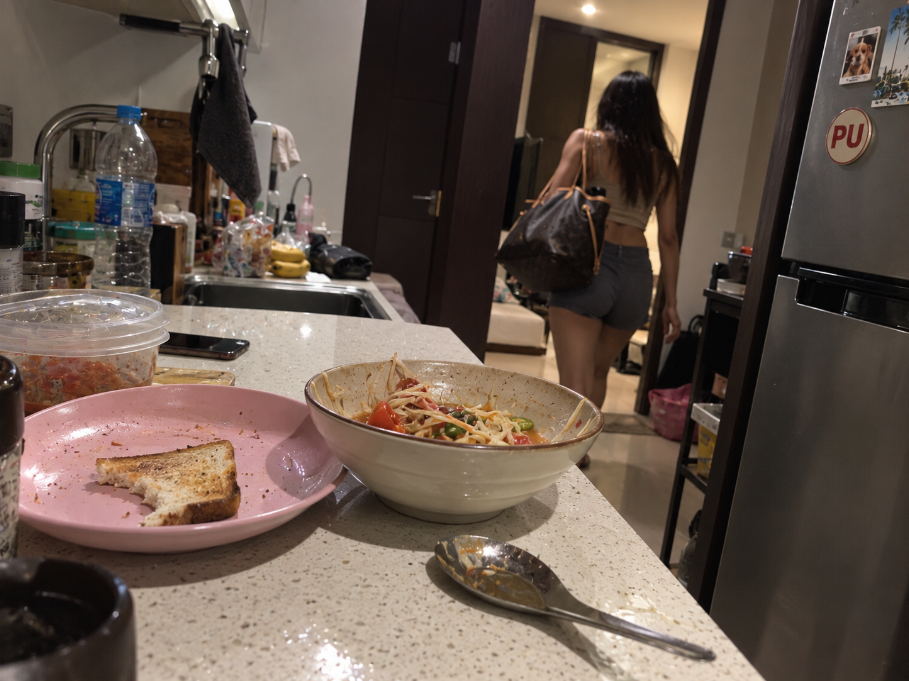
The screaming match in the Pratumnak condo started at exactly eleven in the morning, and it was entirely about a cheap, pink plastic plate from Big C.
Bruce, a fifty-three-year-old mining supervisor from Perth, was standing in the kitchen, trembling with disproportionate rage. He was furious because Mint had served his morning toast on a flimsy plastic plate, while she was casually eating her spicy papaya salad out of the heavy, expensive ceramic bowl he had explicitly bought for himself at Central Festival. He accused her of lacking basic respect. He yelled that she had no concept of how to treat a home. She screamed back, slamming her spoon onto the counter, calling him a crazy, controlling old man who wanted to make her a prisoner over a piece of plastic.
If you listened to the audio through the thin walls of the condo, it sounded like a catastrophic clash of cultures and domestic habits. But the fight had absolutely nothing to do with the plate. The plastic plate was just a heavily armed proxy war.
The truth was entirely economic, and it was suffocating both of them.
Bruce wasn’t yelling about dishware; he was yelling because his lucrative mining contract in Western Australia had not been renewed, his severance payout was rapidly evaporating, and he was secretly terrified. He knew that the moment his money dried up, the carefully constructed illusion of their relationship would instantly vaporize. He could feel his financial leverage slipping away, and his bruised ego desperately tried to reassert dominance and demand “respect” through aggressive domestic tyranny. Admitting that he was going broke meant admitting he had lost, so he chose to fight about the kitchen instead.
Mint wasn’t screaming about the plate, either. She already knew he was running out of money. She had seen him hesitate while looking at the price of imported butter at the supermarket the day before. She knew the monthly rent was due in four days, and he hadn’t mentioned it once. She was profoundly exhausted from playing the role of the devoted, grateful housewife for a man who was rapidly transitioning from a financial asset into a financial liability. But the rigid rules of the neon grid dictate that a woman can never simply say, “I am leaving you because you can no longer afford my time.” That would break the unspoken social contract and make her look ruthless.
She needed an exit strategy that preserved her pride and cast him as the villain. A psychotic argument over a plastic plate was the perfect escape hatch.
They spent another twenty minutes viciously attacking each other over kitchen etiquette before Mint finally burst into tears, grabbed her pre-packed bags from the closet, and walked out the door, claiming she could no longer live with a madman. Bruce sat alone on the sofa in the sudden silence, convincing himself that she was just an ungrateful village girl who didn’t understand how a civilized household operated.
The cheap pink plate sat abandoned in the sink, having successfully absorbed the entire weight of their mutual failure. It is always much easier to end a relationship over irreconcilable domestic differences than it is to look across the table and acknowledge the cold, transactional reality that brought you together in the first place.
Leave a Reply