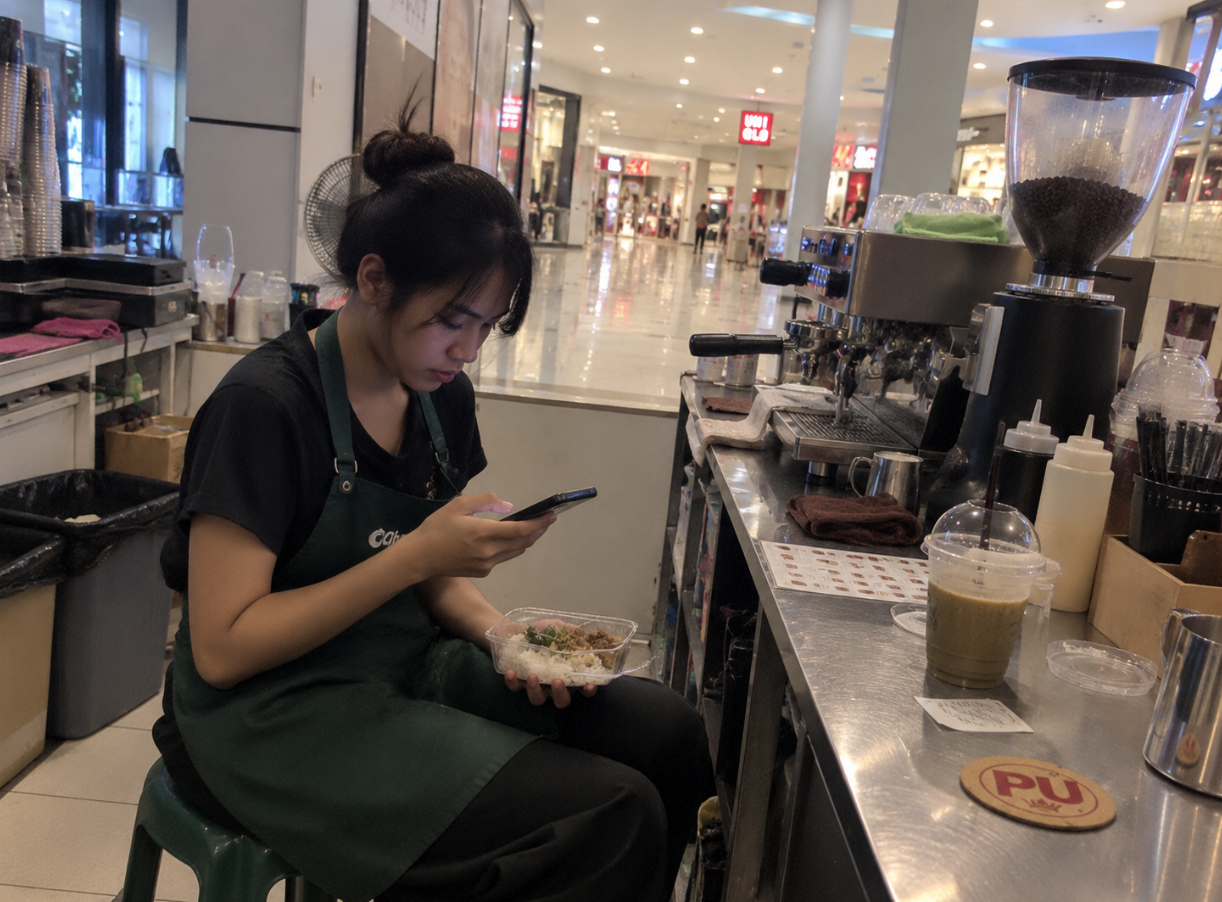
At two in the afternoon on a quiet Tuesday, Fon sits on a plastic stool behind the counter of a small coffee kiosk in a provincial shopping mall. The air conditioning hums monotonously. There are no customers. She is eating a cold boxed lunch by herself, staring blankly at the polished tile floor. She is twenty-eight years old, she makes 400 baht a day, and according to every Western expat forum and rescue NGO, she is the ultimate success story.
She has successfully exited the neon grid.
In the mythology of the Pattaya bar scene, the “exit” is always portrayed as a cinematic happy ending. A girl saves enough money to open a small business, or a foreign sponsor pays her debts, allowing her to finally escape the exploitation, the late nights, and the predatory environment. The tourists assume that the moment a woman hands in her bar badge, she feels nothing but profound relief and overwhelming freedom.
What the foreigners completely fail to understand is the ruthless sociology of the dressing room. They assume the bar is just a place of trauma. They don’t realize it is also an entire, fully functioning micro-society.
When Fon looks at the clock at 2 PM, the silence of the mall physically hurts her. Back in her LK Metro days, 2 PM was the exact moment the shared apartment came alive. It was four girls sitting cross-legged on the floor, eating brutally spicy papaya salad straight out of a plastic bag. It was the chaotic noise of hair dryers and a highly specific, dark camaraderie.
When you spend years evaluating human desperation for a living, your sense of humor warps into something sharp, cynical, and exclusively understood by the women working next to you. The bar workers share a trauma-bonded vocabulary. They have running jokes about the precise mathematical formulas for extracting a lady drink from a stingy British tourist, or the theatrical performance of faking jealousy to secure a monthly allowance.
Now, three months into her new civilian life, Fon is surrounded by “normal” coworkers, and she has never felt more profoundly isolated.
She cannot make her jokes here. The other women at the mall talk about their electricity bills, their children’s homework, and their ordinary Thai husbands. If Fon were to tell a hilarious story about a sixty-year-old Norwegian having a psychological meltdown over a broken bar stool, her new coworkers would not laugh. They would look at her with polite horror, instant judgment, and pity.
To survive in the civilian world, she has to aggressively censor her entire past. She has to pretend she doesn’t know how to instantly calculate a man’s net worth. She has to pretend she doesn’t understand the violent, zero-sum economics of the coastal red-light districts. She has to build a completely fake, sanitized persona just to fit in with people who make a fraction of what she used to make on a slow Tuesday night.
The most underestimated tax of leaving the industry isn’t the massive drop in income. The true cost of the exit is the sudden, complete obliteration of your daily social circle.
The grid is a cartel, but for the women inside it, it is their cartel. It provides a brutal but highly organized support system where everyone understands the schedule, the exhaustion, and the exact price of dignity. Stripped of that ecosystem, the exited worker has to learn how to socialize from scratch in a world that views her previous life as a shameful secret. If she manages to navigate this social exile, she might eventually build a normal life. But the transition is a lonely, suffocating process.
Fon finishes her lunch and checks her phone. There is a notification from the LINE group she still hasn’t muted—the girls from her old bar. Someone just posted a blurry photo of a notorious, notoriously cheap customer walking through the door, followed by a string of laughing emojis.
For a second, Fon smiles. She knows exactly what that joke means. She types out a sharp, funny reply, her thumb hovering over the send button. Then she stops, slowly deletes the text, and locks the screen. She puts the phone in her pocket, stands up, and goes back to wiping down the espresso machine in absolute silence.
Leave a Reply