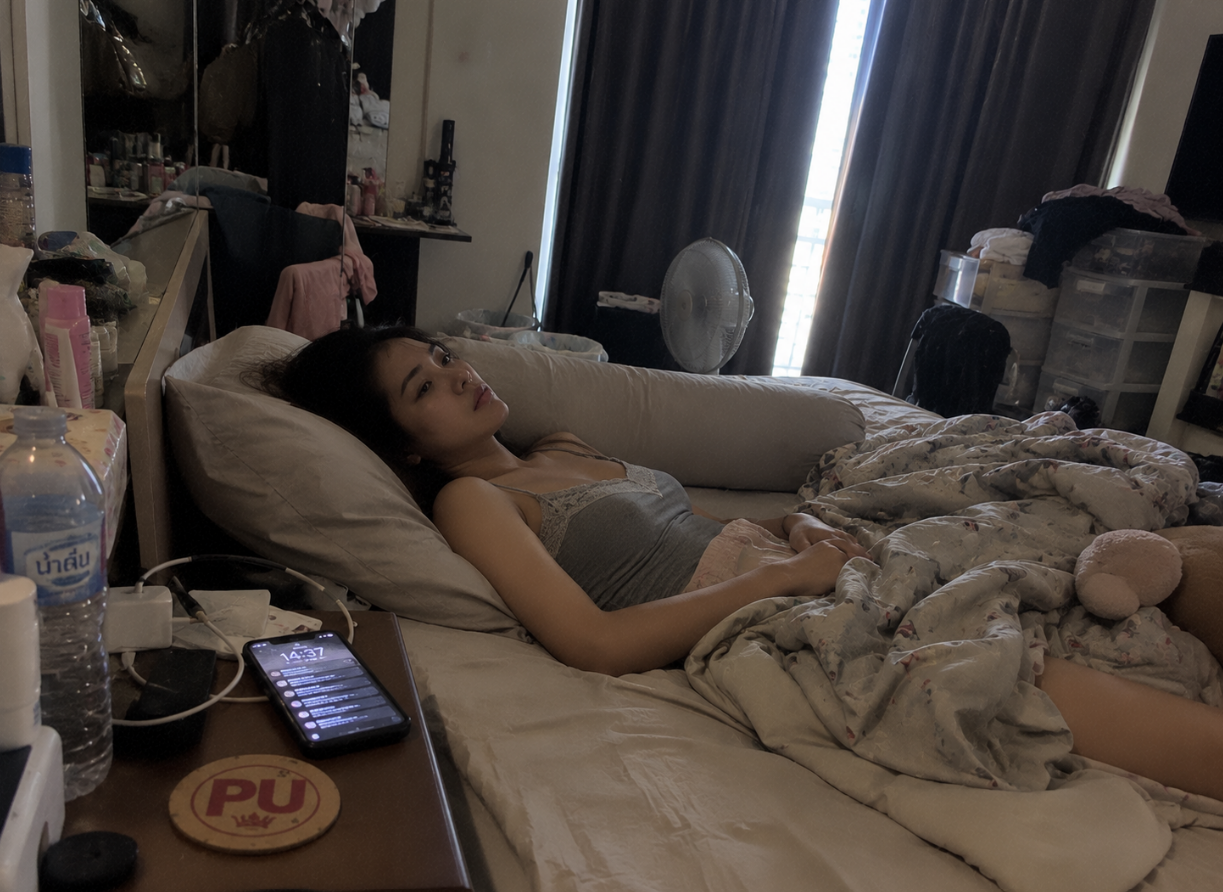
It is two in the afternoon in a cramped Jomtien condo. A thirty-year-old woman is lying flat on her back on the mattress. The heavy blackout curtains are drawn tight. Her smartphone buzzes on the cheap nightstand—four missed calls from a friend at the bar. She doesn’t call back. She doesn’t cry. She just stares blankly at the water stains on the ceiling.
She hasn’t slept properly in weeks. She hasn’t eaten since yesterday. She hasn’t shown up for her shift in three days. She messaged the mamasan to say she was sick, and she wasn’t lying. She is profoundly sick, just not in the way the bar manager thinks.
She knows something is structurally wrong with her mind. She has known for at least two months. But she doesn’t go to a doctor. She doesn’t seek help, not because she wants to suffer, but because she knows exactly what they will say. Or worse, what they won’t say, but will loudly think.
She picks up her phone, opens TikTok, and types the Thai word for “psychologist” into the search bar. She scrolls through the top three results, her face entirely expressionless. Then she closes the app, puts the phone face down on the mattress, and goes back to staring at the ceiling. The first barrier she hits is the professional stigma.
A 2026 study published in Frontiers in Sociology mapped out the brutal reality of this isolation. Among sex workers in Bangkok, only 20% had ever reached out to mental health support resources. A staggering low of 5% had ever contacted an NGO for help, and only 16% had ever reported experiencing violence to the police. The vast majority of the grid operates in absolute silence. This is not out of stubbornness or a lack of desire for help; it is driven by a profound, learned fear of the consequences.
The researchers noted that workers avoid mental health services “due to fear of stigma and a fundamental distrust of the system.” That distrust is not paranoia. It is a highly accurate reading of a society that views them not as vulnerable patients requiring medical care, but as criminals requiring moral correction.
If the problem was solely the stigma of sex work, the solution would be relatively simple. A woman could just go to a private psychiatric clinic, pay cash, and lie about her profession. But she is trapped behind a second, much thicker wall.
In Thai culture, mental illness is stigmatized just as heavily as the sex industry itself. A 2024 sociological study confirmed that the reluctance to seek treatment is tied to “long-standing and deeply rooted stigma and discrimination regarding mental illness in Thai society.”
The foundation of this stigma is built entirely on the Buddhist concept of karma. According to the research, Thais culturally tend to perceive people suffering from mental illness as individuals who committed bad deeds in past lives, and are therefore “receiving bad karma in their current life in the form of suffering from a mental illness.”
This is not a casual metaphor. It is treated as a spiritual diagnosis. If you have severe depression, it means you deserve it. If you suffer from crippling anxiety, you are simply paying off a karmic debt. Going to a psychologist is a public admission that your soul is damaged. It is the ultimate loss of face. The societal default dictates that psychiatric patients are weak, and mental illness is a shameful family secret that must be hidden at all costs. It is a norm that enforces absolute silence.
Even if a woman manages to climb over both of those walls and actually books an appointment, she slams into a third barrier: the cultural incompetence of the medical system itself.
A 2023 study by the SWING Foundation revealed a critical failure point: “Mental health services are not culturally tailored.” The psychologists, psychiatrists, and social workers in the public hospitals do not understand the mechanics of the neon grid. They do not understand the specific, grinding psychological toll of the bar life. They do not understand what it does to a human brain to manufacture fake affection and smile relentlessly for eight hours a night when you actually want to scream.
Medical professionals are simply not equipped to handle this specific demographic. They can write a prescription for antidepressants. They can offer generic cognitive behavioral therapy. But they cannot offer a genuinely safe space—a room where a woman does not feel like a tragic exhibit, where she isn’t pitied, and where her survival strategies aren’t judged.
A 2022 study published by Burapha University captured this bleak reality through the lived experiences of four industry women. One of the core themes that emerged from their interviews was devastatingly titled: “Psychological distress from sex work may (un)heal.” The parentheses around the “un” are not a typo. They represent a deep, foundational doubt among the women that healing from this specific type of trauma is even mathematically possible.
So, what does she do instead? She does what everyone else on the grid does. She drinks.
The Burapha University study identified three primary coping mechanisms used by women in the industry. The first is utilizing alcohol as the primary assistant. The alcohol does not cure the depression; it just temporarily mutes the screaming in her head. It stops her from overthinking the reality of her environment just long enough to finish her shift. As one worker noted, alcohol helps manage the immediate psychological fallout because “it prevents you from thinking for a short time.”
The second strategy is aggressive, weaponized hope. The researchers called it “hoping for hope fulfillment as the main driving force.” She cannot afford the luxury of clinical despair. She has a strict financial quota to hit. She has a family in the provinces relying on her transfers. She has to build a house. If she loses hope, the entire economic structure of her family collapses.
The third strategy is the ultimate fantasy: the exit. “Exiting sex work is the exit from suffering.” But quitting is rarely a viable immediate option. There is crushing debt. There are zero civilian jobs that pay enough to cover her obligations. She knows the exit is the only real cure, but she cannot afford the medicine. Not yet.
So she doesn’t go to a clinic. She lies in a dark room with the curtains drawn. She ignores the ringing phone. She waits for something to change, even though she knows exactly how the grid works.
The SWING Foundation understands this paralysis better than anyone. In 2023, they conducted a comprehensive needs assessment among 200 sex workers. The data was a quiet scream for help: 58.5% explicitly stated they needed mental health counseling. 63% begged for worker-friendly services that wouldn’t judge them. Half of them requested anonymous online self-assessments—a way to check their own sanity without leaving a paper trail, without giving a name, and without facing a moralistic doctor.
The numbers prove that they desperately want help. But they cannot access it because the system demands they step into the light to get it, and the light on the grid is incredibly dangerous. Organizations like SWING are trying to patch the holes, offering depression screenings using PHQ-2 and PHQ-9 forms right inside their clinics. But one NGO cannot rewrite the cultural DNA of an entire country. They can only offer a small lifeboat in a very dark ocean.
Back in the Jomtien condo, the sun finally sets. The room goes completely dark.
The woman slowly sits up on the edge of the mattress. She knows the bank account is draining. She knows her mother is waiting for the monthly transfer. She walks into the bathroom, turns on the harsh fluorescent light, and steps into the shower. She meticulously applies her heavy makeup. She puts on her dress. She walks out the door.
An hour later, she is walking down Soi Buakhao. The neon signs are buzzing. The baht buses are honking. She walks right past the entrance of the bar where she usually works. She doesn’t look inside. She just keeps walking down the crowded street, moving through the noise, entirely alone, completely unsure of where she is actually going.
Leave a Reply