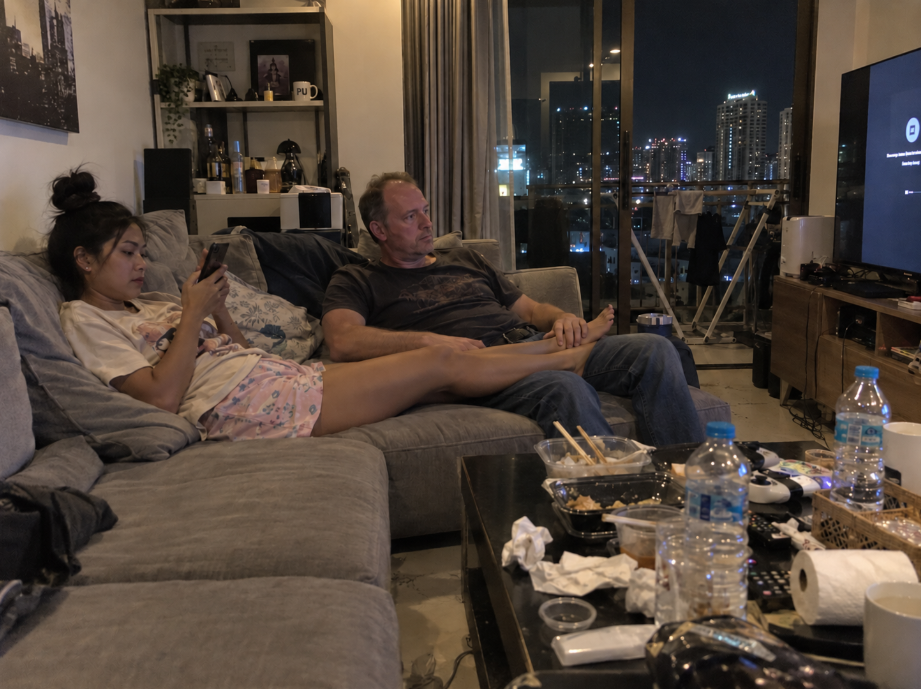
It was four months in, and they were sitting on the grey sofa in his Jomtien condo. On the low coffee table rested plastic containers from a local takeaway, half-eaten green curry congealing beside the wooden chopsticks. The television screen had darkened, displaying the familiar prompt: Are you still watching?
Pang had her feet rested in Fraser’s lap, her thumbs moving rhythmically across her phone as she scrolled through TikTok. Fraser, forty-eight and originally from Leeds, rested a hand absentmindedly on her ankle, his eyes drifted toward the dark reflection in the balcony glass. Pang was thirty-two, born in Surin, though she had spent the last five years navigating the coastal momentum of Chonburi.
They had met perhaps twelve or fifteen times since the middle of the year. Sometimes she stayed the night, slipping out around noon the next day; sometimes she simply came over to eat, watch a movie, and catch a late ride back to her room. Sometimes Fraser helped her with Grab fares and gave her two or three thousand baht on her way out. Sometimes he gave her nothing at all, assuming that a cooked meal or a bottle of imported wine meant they were beyond that.
That ambiguity had quietly metastasized into their main problem. It was not the money itself that caused the quiet tension in the room, but the total absence of structural rules.
I
Things had been vastly simpler at the beginning. They had met in a noisy bar off Soi 6, where the parameters were explicit and understood by everyone in the room. No one had to guess anything. He was a customer, she was on shift, and every interaction was governed by a transparent logic. There was a clear price for the evening, an agreed-upon routine, and a definite conclusion when the morning came. Neither of them had to lie awake wondering what a text message meant the next afternoon, or whether offering breakfast was an act of hospitality or a breach of protocol.
The strange paradox was that their lives grew exponentially more complicated as their feelings became more genuine. The less their time together felt like a commercial transaction, the more both of them found themselves thinking about the money.
Fraser was not a stingy man. He made decent money working remotely in logistics quality assurance, enough to live comfortably in Thailand without scrutinizing every receipt. Yet, at the end of almost every evening they spent together, an uncomfortable internal arithmetic began to run through his head.
If I hand her three thousand baht now, does it make this feel like a transaction and insult her? If I give her only one thousand, does it look like I am taking advantage of her? If I give her nothing at all, will she secretly think I’m using her growing affection just to save money?
In the early weeks, he had handed over cash without giving it a second thought. It was just a line item in an evening out. But now that he genuinely liked her, every physical banknote seemed heavy with implicit meaning.
Standing by the kitchen counter while Pang put on her shoes, Fraser discreetly opened his leather wallet. He shuffled through a fan of thousand-baht notes and purple five-hundreds, trying to decide on the appropriate sum without making a scene. From across the doorway, Pang caught his reflection in the kitchen mirror, watching his fingers hesitate over the paper money. She looked down at her phone, her chest tightening slightly.
II
Pang operated under a completely different financial reality. She was not merely looking to extract cash from an older foreign man, though that was how many outsiders would unceremoniously categorize it. Initially, her understanding had been straightforward: an evening spent away from the venue was an evening that required fixed compensation to cover her basic living costs.
Now, the math had blurred. She might spend six hours with Fraser, cooking dinner together and talking about her family in Surin, only to leave with a single thousand-baht note. Other times he would hand her three thousand without a word. Occasionally, he would take her to an expensive Italian restaurant, pay the large bill, and treat the outing as a standard romantic date, leaving her wallet entirely empty when she returned home.
She hated the thought of asking him directly. Raising the question—Are you going to give me money today?—instantly forced her back into a role she felt she had gradually stepped out of during their time together.
Yet she could not afford to ignore the underlying numbers. If she spent a prime Friday night sitting on Fraser’s sofa watching series, she missed her scheduled shift at the venue. That single night away cost her guaranteed daily income, potential tips, and drink commissions. She was not trying to monetize a boyfriend; she was simply bearing the heavy opportunity cost of spending time with him.
The first quiet resentment surfaced on a Tuesday morning. They had spent a long, comfortable evening together—wine, takeout, a film, followed by a slow, easy night and a late breakfast downstairs at the cafe. For Fraser, it felt like a breakthrough into normal, domestic life. He had walked back up to his apartment feeling a warm sense of contentment, thinking to himself: Finally, it didn’t feel like I was paying for a service.
On her long minibus ride back to her apartment, Pang opened her purse to pay the driver fifty baht. After counting her remaining cash, she realized she barely had enough to cover her upcoming utilities. She sat near the window, staring out at the passing construction sites, calculating the loss of her missed shift against her rent deadline. She was not furious over a missed two thousand baht, but she felt a profound, quiet ache that Fraser had decided that once their affection became real, her financial survival simply ceased to exist.
III
The following week, Fraser attempted to correct course, making things infinitely worse. As she was packing her small overnight bag, he walked over and handed her five crisp thousand-baht notes.
Pang looked down at the thick stack of bills in her palm, then up at him. “Why so much today?”
“Because last time I didn’t give you anything,” Fraser said, offering what he hoped was a reassuring smile. “Just balancing things out.”
The phrase hung heavily in the air. To Pang, it felt like an administrative adjustment, as if he were retroactively recalculating the value of the quiet morning they had shared the week before. The intimacy they had built over the past month suddenly felt recalculated and accounted for.
She turned around, placed three of the notes back on the wooden side table, and zipped her bag shut. “Keep it,” she said flatly. “I don’t need.”
Fraser stood in the hallway, completely at a loss. The invisible rules had shifted again, and every attempt to be fair seemed to land as an offense. Both of them were attempting to navigate the relationship with good intentions, yet every gesture only deepened the misunderstanding.
Two days later, during a tense conversation over drinks at a quiet bar near the beach, Fraser lost his patience with the constant hesitation.
“Pang, just tell me what I’m supposed to give you,” he said, rubbing his temples.
She stopped mid-sip, her posture instantly stiffening. “What you mean?”
“Not like that,” he tried to recover quickly, sensing the drop in temperature. “I just mean… I don’t want this to be awkward every time she leaves, or every time we plan something. I just want to know what you expect so we don’t have to keep doing this dance.”
It was too late. He had intended the question as a practical way to eliminate stress—Let’s stop guessing. But to Pang, the words translated into a harsh, familiar evaluation: After four months, you are still ultimately a service with a price tag.
She did not yell. She simply went quiet, finished her drink in small, measured sips, and asked to go home early. For the next three days, her text messages were terse, reduced to single-word answers and late replies.
IV
During the silence, Pang sat on the floor of a beauty salon in South Pattaya while her friend Benz got her nails done.
“He asked me how much he should give me,” Pang said, staring at her own unpainted fingernails.
Benz looked up from her phone, frowning in confusion. “Good, no? So tell him. Better than him giving you one thousand baht like last month.”
“It’s not good,” Pang insisted softly.
“Why not? Before, you complain because you don’t know if you get money or not. Now he ask you directly, and it’s still a problem for you?”
“Because before he was just a customer,” Pang said, struggling to find the right terms in English or Thai that captured the nuance. “Now he’s not a customer.”
Benz shrugged, entirely pragmatic. “Okay, so if he’s not a customer, why do you still need his money?”
Pang opened her mouth to explain, but found no simple answer. Fraser was not just a customer anymore, but her landlord still required rent on the first of the month, and her family in Surin still expected their monthly transfer. His status in her heart did not alter her financial responsibilities.
On the other side of town, Fraser sat in a sports bar with Mark, an Australian expat who had lived in Chonburi for over a decade.
“If she actually likes you, mate, why are you still paying her at all?” Mark asked, leaning back with a bottle of beer. “Either she’s your girlfriend or she’s not.”
“Because she loses money every time she spends a night at my place instead of working,” Fraser explained, frustration evident in his voice. “She has bills. I’m asking for her time.”
“Sounds like you’re just paying for her company with extra steps,” Mark said with a shrug.
“It didn’t feel like that,” Fraser said quietly, looking down at his glass. “It didn’t feel like that at all until I had to start pretending the money didn’t exist.”
V
A few days later, they met at a bright, air-conditioned cafe near Pratumnak Hill. The venue was intentional: neutral daylight, no alcohol, no evening expectations.
Fraser set his coffee cup down and looked at her directly. “What if I just give you ten thousand baht at the start of every week? Automatically. Then we never have to talk about it when we see each other.”
Pang leaned back, her brows furrowing slightly. “Like a salary?”
“Call it whatever you want,” Fraser said. “It’s not for any specific night. It’s just so you don’t have to worry about your expenses, and I don’t have to stand in my hallway like an idiot wondering what to put in your purse.”
She looked at him thoughtfully, testing the concept in her head. “And if I don’t come to your condo for three days? If I stay home?”
“Same,” Fraser said. “It doesn’t change.”
By uncoupling the money from specific evenings, the nature of the transaction subtly shifted. He was no longer purchasing an individual encounter, an evening of conversation, or an overnight stay; he was providing a predictable measure of financial stability in exchange for her presence in his life.
The arrangement brought an immediate, unexpected relief to both of them. Pang stopped lying awake after he fell asleep, wondering if she would need to stretch her remaining cash through the end of the week. Fraser stopped staring at his open wallet near the kitchen counter every time she put her shoes on.
They could argue about mundane things, watch movies, fail to have sex, or simply sit in silence without either person feeling as though an unspoken balance sheet was being calculated in real time. Irony sat quietly at the center of their lives: they had been forced to formalize the financial arrangement entirely just to make the relationship feel less like a business deal.
Yet, the ambiguity never truly disappeared; it merely shifted shape.
A month after the arrangement began, Fraser would occasionally sit on his balcony late at night while Pang slept inside, wondering quietly to himself: Am I just paying a regular rate for a girlfriend?
And in her own quiet moments, while taking a taxi back to her apartment on a Tuesday afternoon, Pang would occasionally ask herself: Would I still be taking this taxi to his place if the transfers stopped?
Neither of them had an answer, so neither of them brought it up.
VI
Four months later, on an ordinary Thursday evening, a minor argument broke out in the kitchen. Fraser had come out of the bathroom to find his favorite bath towel crumpled in a damp heap on the tile floor, right where Pang had dropped it after her shower.
“Pang, I’ve asked you three times this week,” Fraser said, his voice sharp with tired irritation. “Just hang it on the rack. It takes two seconds. It smells like mildew if you leave it on the floor.”
Pang, who was sitting at the counter peeling a mango, threw the small paring knife down onto the cutting board with a loud clack.
“You always complain about small things,” she said, her voice rising in frustration. “Towel, coffee cup, everything. I am tired of listening to you.”
She walked briskly to the bedroom, pulled her canvas tote bag from the closet, and began tossing her toiletries into it with quick, aggressive movements.
Fraser stood in the bedroom doorway, watching her pack. He felt the familiar anxiety creeping into his chest, but this time, under the new framework, a different thought surfaced.
“You don’t have to stay here just because of the money,” Fraser said softly, leaning against the doorframe. “If you’re miserable, you can go.”
Pang stopped her packing, turned around, and looked at him directly, her eyes hard and steady.
“I know,” she said quietly. “That’s why I’m going home.”
She zipped her bag, walked past him down the narrow hallway, and let the front door click shut behind her without looking back.
Fraser sat on the edge of the unmade bed for a long time, the silence of the apartment settling around him.
At eight o’clock the next morning, as the sun began to heat the balcony glass, Fraser’s phone buzzed twice on the nightstand. He picked it up and unlocked the screen.
It was a text from Pang.
You eat yet?
Leave a Reply