Julian sat on the terrace of a minimalist, polished-concrete café in Jomtien, carefully adjusting the angle of his laptop camera. It was 11:00 AM, and he had a Zoom meeting with a client in Berlin. He shifted his chair a few inches to the left. It was a precise, calculated movement to ensure his webcam captured the aesthetic palm tree behind him, completely blocking out the faded massage parlor across the street.
Julian, a 34-year-old UX designer in a beige linen shirt, identified strictly as a “digital nomad.” Whenever his friends back in Europe asked why he chose to live in Pattaya—a city globally infamous for its massive nightlife industry—he had a rehearsed, defensive script. He was there for the culture. He was there for the affordable cost of living, the high-speed internet, and the authentic street food.
He despised the older Western men he saw walking down the street. The guys in their sixties with sunburns, faded football singlets, and Thai girls half their age holding their arms. Julian referred to them with absolute disgust. He called them “sexpats.” He spent an enormous amount of psychological energy building an invisible wall between himself and them. He needed everyone to know that he was an entirely different species of foreigner.
But Julian’s moral high ground was an architectural illusion.
He lived on the twenty-fifth floor of a modern, luxury condominium just five minutes away. He loved the building for its rooftop infinity pool, its pristine gym, and its cheap monthly rent. What Julian refused to acknowledge was the economic foundation of that building. Those high-rises were not constructed because a few graphic designers wanted a cheap place to do yoga. That massive, foreign-owned real estate infrastructure was built, funded, and sustained by the exact same demographic he looked down upon.
Julian’s entire pristine lifestyle was subsidized by the red-light district.
The cheap laundry service that washed his linen shirts, the English-speaking pharmacist who sold him vitamins, the 24-hour convenience stores, the foreign-focused hospitals, and the wide array of international restaurants—all of this existed because decades of bar tourists had poured billions of dollars into the local economy, paving the way for the comfort Julian now enjoyed. He was surfing on a wave of infrastructure paid for by the men in the Chang tank tops.
The collision of these two worlds always happened in the most mundane places.
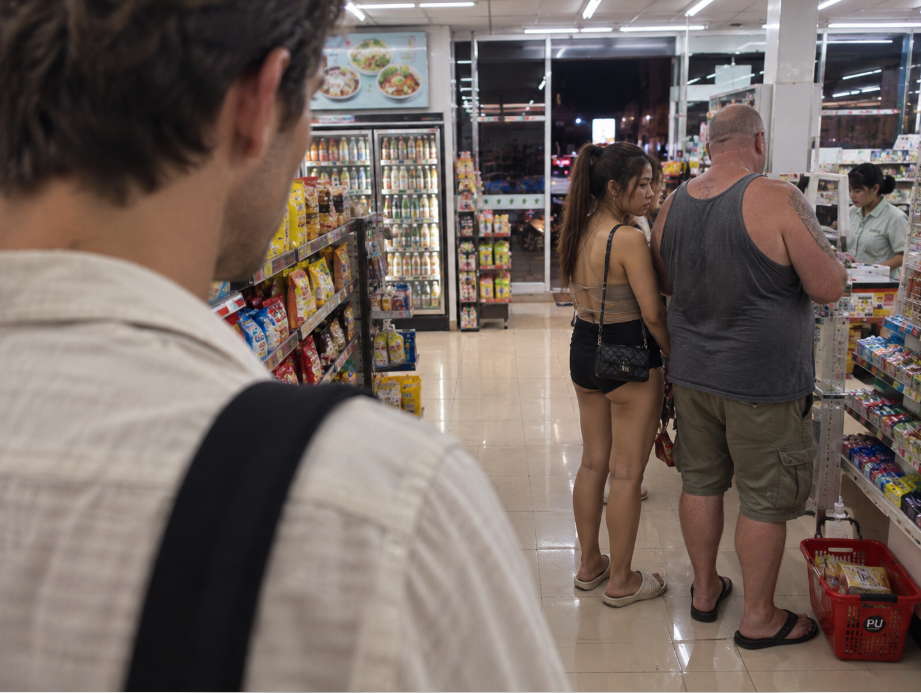
At 2:00 AM, Julian stood in line at the local 7-Eleven, holding a bottle of imported mineral water and a vegan protein bar. Directly in front of him stood a heavy, 60-year-old British man buying a six-pack of local beer and a pack of condoms. Leaning against the older man’s shoulder was a young Thai woman in a tight, sequined dress, yawning after a long shift.
Julian physically took a step back. He created a deliberate gap in the queue. When the older man finished and walked out, Julian stepped up to the counter. He looked at the exhausted Thai cashier and offered her a warm, polite smile. It was a look of attempted solidarity. He was trying to non-verbally communicate: “I am not like him. I respect your country. I am one of the good ones.”
The cashier didn’t smile back. She didn’t see a refined digital nomad, and she didn’t see a degenerate sexpat.
She just scanned his water. To her, the ecosystem didn’t have moral categories. There were no “good” foreigners and “bad” foreigners. There were only temporary guests extracting value from her city, relying on the same supply chain, and standing in the exact same line. Julian wasn’t morally superior. He was just a different market segment in the exact same industry.
Leave a Reply