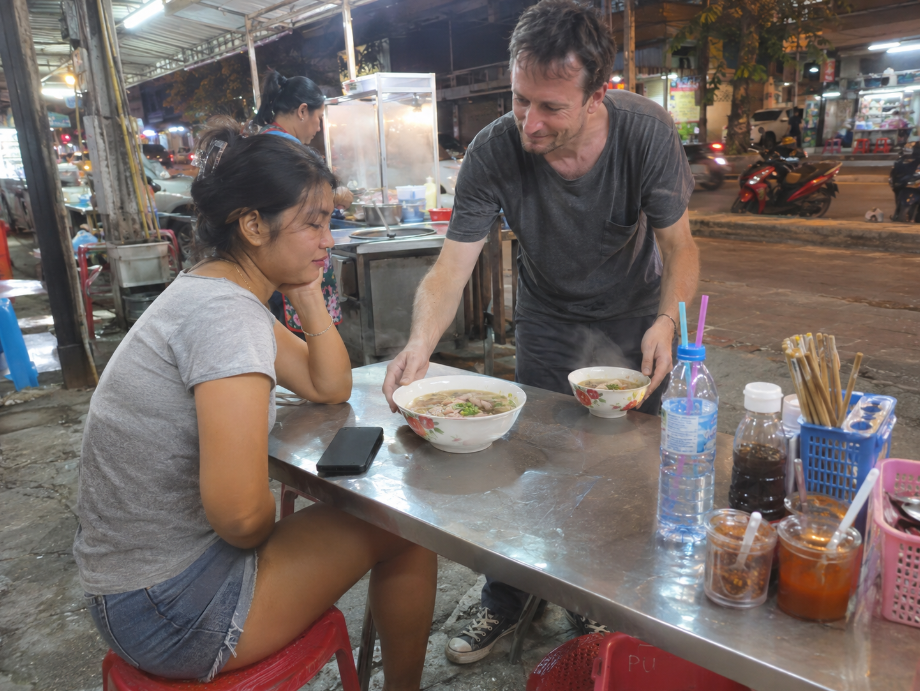
At eight o’clock on a humid Thursday evening, Kwan sits on a red plastic stool at a roadside noodle stall off Soi Khao Talo, staring at her phone screen as her mother’s name flashes across an incoming LINE call.
Ten paces away at the steaming stainless-steel cart, Tom—thirty-four, from Cork, wearing a faded cotton shirt and scuffed canvas sneakers—is counting out crumpled twenty-baht notes to pay for two bowls of pork noodle soup and one large bottle of water with two plastic straws.
Kwan lets the phone ring four times before hitting decline and typing a quick message: Working right now, Mae. Call you tomorrow.
Her hands are slightly damp when she sets the phone face-down on the metal tabletop.
Two years ago, Kwan’s Thursday nights looked completely different. Back then, she spent her evenings in beachfront seafood restaurants along Na Kluea across from a fifty-nine-year-old Swiss retiree who chewed with his mouth open, smelled faintly of sour beer and cigars, and regularly confused her hometown with Chiang Mai. She never once argued with him, never once felt her pulse quicken when he reached for her hand, and walked out of his hotel room every Sunday morning with five thousand baht tucked neatly inside her handbag. Her mother got ten thousand every first of the month. Her friends at the bar called her smart.
Then, six months ago, she met Tom at a neighborhood laundry shop on the Darkside when both of their washing machines jammed on the same afternoon.
Tom is not a tourist on a two-week spree, and he is not a retiree sitting on a European pension. He teaches English at a mid-tier Thai school out near Sattahip for thirty-six thousand baht a month. He lives in a clean, bare-walled seven-thousand-baht apartment past the railway tracks, rides a nine-year-old Honda Click with a loose left mirror, and checks his banking app twice before ordering extra prawns.
For the first time since she stepped off a bus from Roi Et at twenty-one, Kwan fell completely, helplessly in love.
With Tom, there is no performance. She doesn’t have to fake laughs at stale jokes, keep her makeup on until four in the morning, or lie awake staring at a ceiling fan waiting for a heavy arm to roll off her chest. When she caught a brutal flu in September, Tom sat beside the mattress for two days mixing electrolyte packets, wiping her forehead with a damp towel, and quietly washing her clothes by hand . He remembers that she hates coriander, holds her hand through crowded night markets without looking around to see who is watching, and talks to her like an equal instead of a holiday purchase.
If they lived in Dublin or Melbourne, their story would be called sweet. In Pattaya, everyone around her treats it like a slow-motion car crash.
In Thai culture, love is never just a private arrangement between two people—it is a line item in the family budget. A good daughter sends money home. When a Thai woman dates a foreign man, the unspoken contract in the eyes of her entire village is simple: you trade distance from home and cultural headaches for financial security. If you end up with a foreigner who has no money, you took all the stigma and got none of the reward.
Her friends from Soi 7 don’t bother hiding their disbelief when they meet for som tam in the afternoon. “Are you crazy, Kwan?” her closest friend hissed last week, tapping a manicured nail against the table. “You’re twenty-eight. Your face won’t stay like this forever. Why are you wasting your best years on a farang khi nok?”—the local slang for a broke foreigner.
Worse than the friends are the calls from Roi Et. Her mother never screams or demands cash outright; she uses the quiet, exhausted sigh that lands heavier than a slap. She casually mentions the leaking zinc roof over the kitchen, the overdue installment on her younger brother’s pickup truck, or the neighbor’s daughter who just wired home forty thousand baht from an older German boyfriend in Jomtien. Every sentence carries the same unspoken question: How could you be so selfish?
So Kwan lives split straight down the middle.
Last week, when the paper electric bill slipped under their apartment door, she snatched it off the floor before Tom got out of the shower and paid the eighteen hundred baht at 7-Eleven out of her own savings so he wouldn’t see his account drop below two thousand. When they go to the night market, she insists she isn’t hungry so he only has to buy one skewer of grilled chicken instead of two. And when her mother asks how her boyfriend’s “business” is going, Kwan swallows hard and lies that things are just slow during the rainy season.
At the roadside stall, Tom walks back from the cart carefully balancing the two steaming bowls of noodles, sets the bigger portion in front of her, and pushes the bottle of water toward her side of the table.
“Careful, broth’s boiling,” he says, giving her that unguarded, sunburnt smile that still makes her chest ache every single time she sees it.
Kwan picks up her chopsticks, smiles back, and takes a bite while her phone sits silent beside her elbow. Foreigners in Pattaya love to argue about whether Thai women are capable of real love without money on the table—never realizing how terrifying it is for a woman in this city to actually find it, and realize she might not be able to afford to keep it.
Leave a Reply