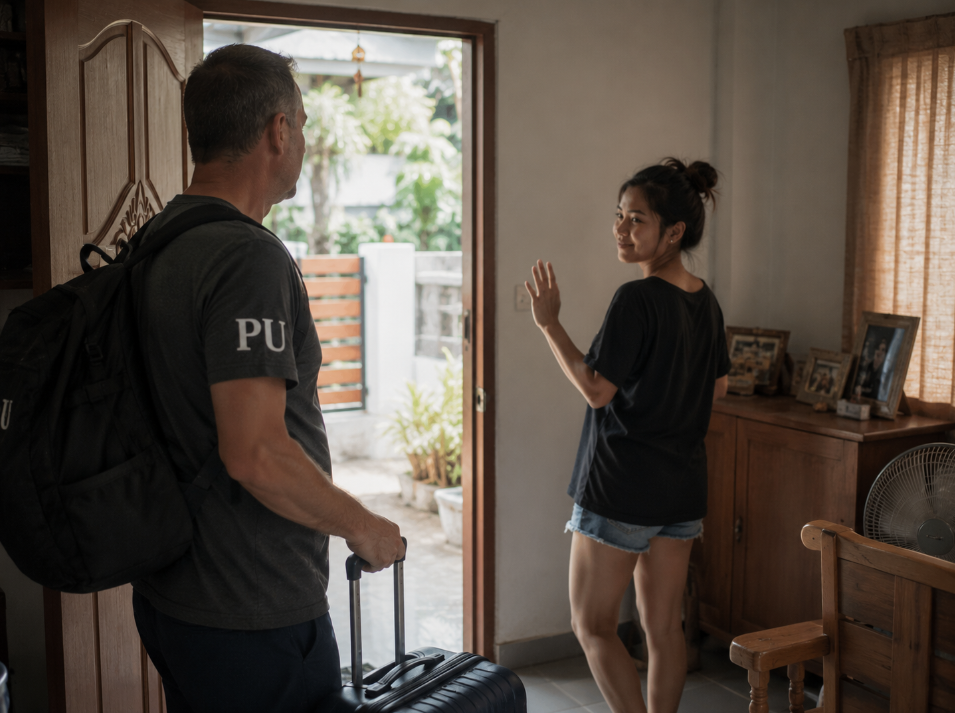
The bags are packed, the taxi is waiting, and the relationship is over.
The Western man stands in the doorway, expecting the emotional script he grew up with. He expects tears. He expects a dramatic fight, begging, a final desperate embrace, or at least a string of frantic text messages at 3:00 AM. He expects the profound, messy struggle of holding on.
Instead, the Thai woman looks at him, smiles softly, and says: “Ok. Take care.” Then, she turns around and goes about her day.
The foreigner is instantly devastated. His Western brain processes this reaction in one of two ways: either she never actually loved him, or she is completely heartless.
Both conclusions are entirely wrong. He is simply misreading a deeply ingrained cultural operating system called Ploi wang (ปล่อยวาง).
The Mechanics of “Letting Go and Putting Down”
To understand Thai relationships, you must understand Ploi wang.
Literally translated, it consists of two verbs: Ploi (to let go) and wang (to put down). It does not mean to destroy, to throw away in anger, or to pretend the object never existed. It simply means to open your hands and stop carrying the weight.
This is a fundamental Buddhist concept that permeates Thai culture on a reflex level. Buddhism teaches that suffering is born entirely from attachment. The tighter you grip something that is naturally slipping away, the more it will tear your skin. Ploi wang is not apathy; it is an active, learned skill of pain management through deliberate non-attachment.
The difference in processing grief is absolute:
The Western Model says you must dive into the pain. You must feel everything, cry it out, scream, analyze what went wrong, and only then can you heal and let go.
The Thai Model says attachment is the engine of suffering. Turn off the engine immediately. Let it go before the pain becomes unbearable.
The Three Invisible Layers of Thai Grief
When a Thai woman cleanly walks away from a relationship without the expected Western drama, the foreigner fails to see three critical layers:
It is Emotional Management, Not Emptiness: She is not devoid of feeling. She feels the loss deeply, but she is simultaneously practicing ploi wang. Her calmness is not a lack of emotion; it is the active containment of emotion using a culturally inherited tool.
The Survival Mechanism: In the Pattaya ecosystem, a girl who works in the industry and allows herself to deeply, painfully attach to every foreigner who eventually boards a plane at Suvarnabhumi will psychologically break within a year. Ploi wang begins as a professional necessity to survive the high turnover of human connections, and eventually hardwires itself into her personal character.
The Ultimate Act of Respect: In Thai understanding, desperately clinging to someone who needs or wants to leave is an act of pure selfishness. You are holding them for your comfort, not theirs. To let someone go without making them feel guilty is an act of love, not indifference.
The Two-Week Trap
This cultural misunderstanding usually reaches its peak about two weeks after the breakup.
The foreigner, sitting in his home country, sends a text message to “check in on her.” Subconsciously, he expects her to say she misses him. He hopes she is slightly miserable, waiting by the door, ready to reopen the relationship.
She replies warmly but completely flatly. She asks how he is doing. She tells him she just ate som tum with her friends. She shows absolutely no pain, but also no overwhelming joy at his reappearance.
The foreigner reads the text and thinks: “See? I meant nothing to her.”
The reality – She just spent the last 14 days practicing ploi wang. She did the heavy, invisible internal work of putting the emotional baggage down on the floor. When he suddenly texts her, she is now being asked to pick that heavy bag back up. Her even tone is not indifference—it is the boundary of a person who has already processed the loss and refuses to cancel all that hard emotional work for a single text message.
Why This Explains Pattaya
Ploi wang is the reason why relationships here end so differently than they do in the West.
There is rarely a dramatic climax. There are no three-month-long email chains analyzing “what went wrong” with a therapist. The cord is cut quickly, cleanly, and silently. It is not because the relationship was fake, transactional, or meaningless.
It is simply because when something breaks in Thailand, the culture teaches you to gently put it down and keep walking.
Leave a Reply