In Pattaya, there is a fascinating financial anomaly. Almost everyone I know in the nightlife and service industry—both men and women—carries a very specific, invisible status attached directly to their Thai ID card: the “Poor Card.”
Some of them genuinely need it. Others have 11 million baht sitting in a bank account or quietly own a network of small resorts up in Isan.
Officially, it is called the State Welfare Card (บัตรสวัสดิการแห่งรัฐ — bàt sà-wàt-dì-kaan hàaeng rát), though the physical plastic cards were phased out and the benefits are now digitally linked to their national ID. The concept is simple: if your official annual income is below 100,000 baht (about $250 a month), the government drops monthly subsidies onto your ID. You get 300 baht for groceries, 750 baht for public transport, and discounts on cooking gas, electricity, and water.
Over the last nine years, the government has pumped over 500 billion baht into this program. Up until this year, 13.2 million Thais claimed this status.
The Great 2026 Purge
Every few years, the government runs an “audit.” They ask old beneficiaries to re-verify their identities, allow new people to apply, and run the entire list through databases checking official income, bank deposits, land deeds, and vehicle registrations.
This year, they decided to be incredibly thorough. They even sent village headmen knocking on doors to physically find the “invisible poor” who don’t have smartphones or internet access. A record-breaking 18.8 million people applied.
But when the system finished filtering the data, only 9.5 million people passed.
Over 9 million Thais suddenly lost their poverty status. And the reasons for rejection read like a classic Thai tragicomedy (any expat who has lived here long enough will smile, because we have heard these excuses a thousand times):
The Landowner Grandma: A grandmother in a village holds the paper deed to 10 rai (1.6 hectares) of dry, dirt-cheap land simply because the family inheritance hasn’t been officially divided among the kids yet. The algorithm flagged her as a “wealthy landowner.”
The Ghost Motorbike: Someone sold their old scooter three years ago using a simple paper receipt, a common practice called an “open transfer” (โอนลอย — oon looi), where the buyer never officially changes the name at the transport office. Congratulations, you still officially own a vehicle and are too rich for the welfare system. Over 40% of all appeals right now are about this exact issue.
The Phantom Employee: This is the sweetest one. The tax database suddenly found withholding tax records for people who have never worked a corporate job in their lives.
The Barbecue of the Destitute
But let’s get back to Pattaya, where the shadow economy reigns supreme and official tax brackets mean absolutely nothing.
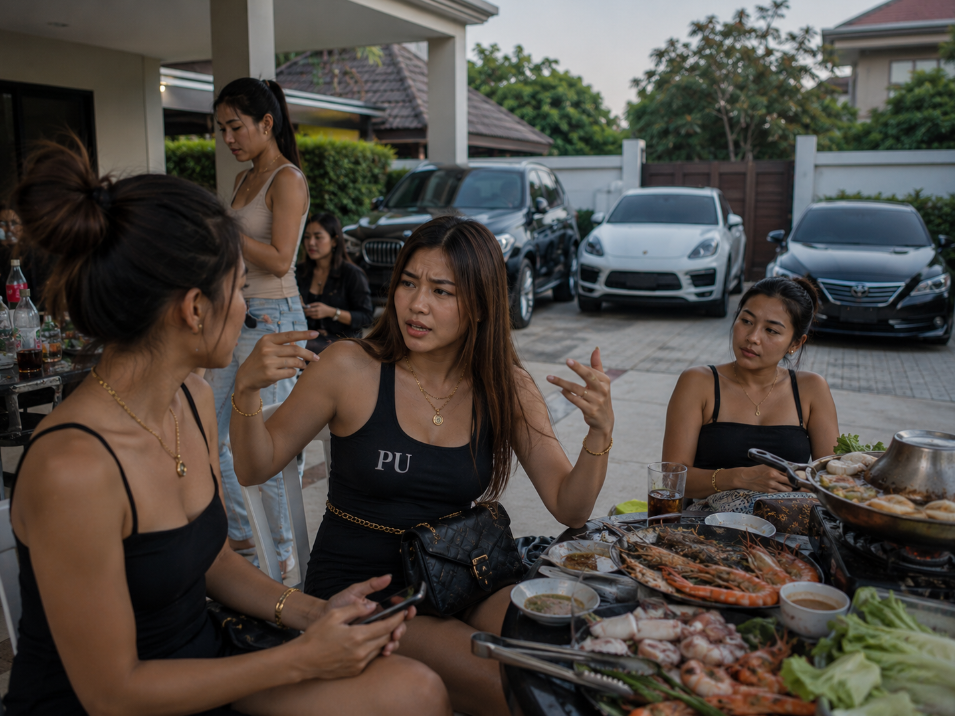
Yesterday, I went to a Sunday BBQ at the house of a girl who used to work in the industry. She now lives in an elite, gated village on the border of Rayong.
Let me set the scene: The driveway was completely blocked by two BMWs, a Porsche, and a “modest” Camry. Every single girl invited to the party was wearing more pure Thai gold than I have owned in my entire life. Authentic designer bags were casually tossed onto the perfectly manicured lawn like cheap grocery sacks.
And as they flipped premium seafood on the grill, what was the main topic of their heated, emotional conversation?
They were passionately, furiously arguing about how on earth they are going to survive now that their “Poor Card” status has been canceled and they can no longer tap their ID cards for discounts on cooking gas, electricity, and wate
Welcome to the Pattaya economy.
Leave a Reply