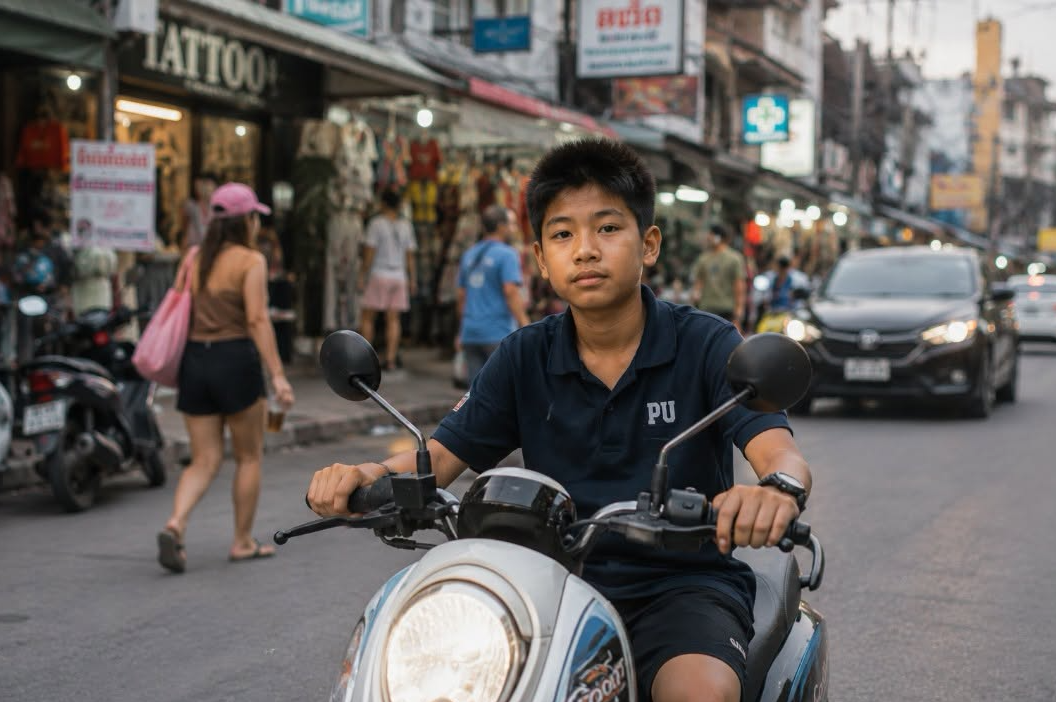
To macro-economists, Pattaya is a tourism hub. To the men on the internet, it’s a playground. To 12-year-old Wut, living in a crowded concrete box off Soi Ko Pai with six relatives, it is simply the only universe that exists.
Wut just turned twelve. His father captains a wooden ferry from Bali Hai to Koh Larn, leaving the house before dawn. His mother stands at the Buakhao market at 5:00 AM, chopping pineapples over crushed ice.
From his parents, Wut has learned the fundamental lesson of traditional, honest Thai labor: It makes you exhausted, it makes you angry, and it gets you a slap on the back of the head for your birthday.
Then there is his aunt.
She leaves the house at sunset and comes back at noon. She wears clothes that look like they belong in a magazine; she smells like Sephora. When she returns from her “trips abroad,” she dumps ten kilograms of duty-free Toblerone onto the linoleum floor, instantly transforming Wut into the most powerful broker in his primary school.
In the moral architecture of the West, Wut’s aunt is a compromised woman. In the moral architecture of Soi Ko Pai, she is the patron saint of the household. She is the only person who looks at Wut without fatigue. She is the one who bought him the second-hand Honda Scoopy.
Wut doesn’t want to hold the wooden wheel of a ferry. He wants to build drones. And when he grows up, he tells himself, he wants to marry a woman just like his aunt.
The Playground Apartheid
After school, Wut walks down the street holding the hand of his classmate, Anna.
A white SUV pulls up. Anna’s mother steps out—covered in full-sleeve tattoos, her skin chemically lightened, radiating the sharp, hyper-vigilant energy of a woman who fought her way out of a beer bar into a monthly allowance.
“Anna! What are you doing?” her mother screams across the pavement. “Why are you walking with Wut? Go play with the Farang kids!”
Anna drops Wut’s hand instantly.
This isn’t just a playground rejection; it is Wut’s orientation day into the Pattaya caste system. At twelve years old, the market has already issued its preliminary valuation on him: You are a local Thai male. You are a depreciating asset. You are not the target demographic.
The Two Fathers
After his market shift shoveling ice for his mother, Wut doesn’t go home. He rides his rattling Scoopy to the house of his schoolmate, Jason.
Jason is half-British. He sits on a sofa playing a PlayStation 5, profoundly bored by his own privilege. Jason’s father is a massive, quiet expat who owns a hardware export shop.
Wut’s own biological father looks at Wut’s radio-club drone and sees a waste of electricity. Jason’s Western father looks at Wut’s drone, reaches into a drawer, hands the boy an envelope containing four imported carbon-fiber propellers, and says: “Put these on. I want to test the telemetry tomorrow.”
It is the quietest, most disorienting tragedy of the city: A stranger from Manchester believes in Wut’s brain more than the man whose blood runs in his veins.
6:00 PM
When Wut gets back to Soi Ko Pai, the evening heat is breaking. The neon sign down the street starts humming. His aunt has just woken up, sitting at the small mirror, applying her eyeliner.
Wut stands in the doorway, jingling the key to the Scoopy.
“The bike is great,” he tells her, his chest swelling with a sudden, desperate urge to be a man. “If you want… I can drive you to work tonight.”
His aunt freezes with the eyeliner pencil halfway to her eyelid. She looks at the boy in his dusty school shorts. She looks out the window at the Soi.
She reaches out, softly ruffles his hair, and forces a smile.
“No, Wut,” she says softly. “You’re still too small for this life.”
We spend endless hours analyzing the psychology of the men who buy a ticket to Pattaya, and the women who stand behind the glass. We almost never talk about the kids sitting on the pillion seat of a Scoopy watching them—trying to assemble a flying machine out of spare parts, trying to figure out which way is North in a city where the compass needle only points toward the money.
Leave a Reply