In Lyon, 55-year-old Pierre is a ghost.
He has three biological children: aged 19, 22, and 25. The last time his eldest son sent him a text message that wasn’t generated by an automated banking app or a notary was during the COVID lockdowns. When Pierre tries to call them on Christmas Eve, the phone rings four times and rolls silently into a French voicemail. In the emotional ledger of Western Europe, Pierre’s account has been permanently frozen. He is a legacy liability. A failed patriarch.
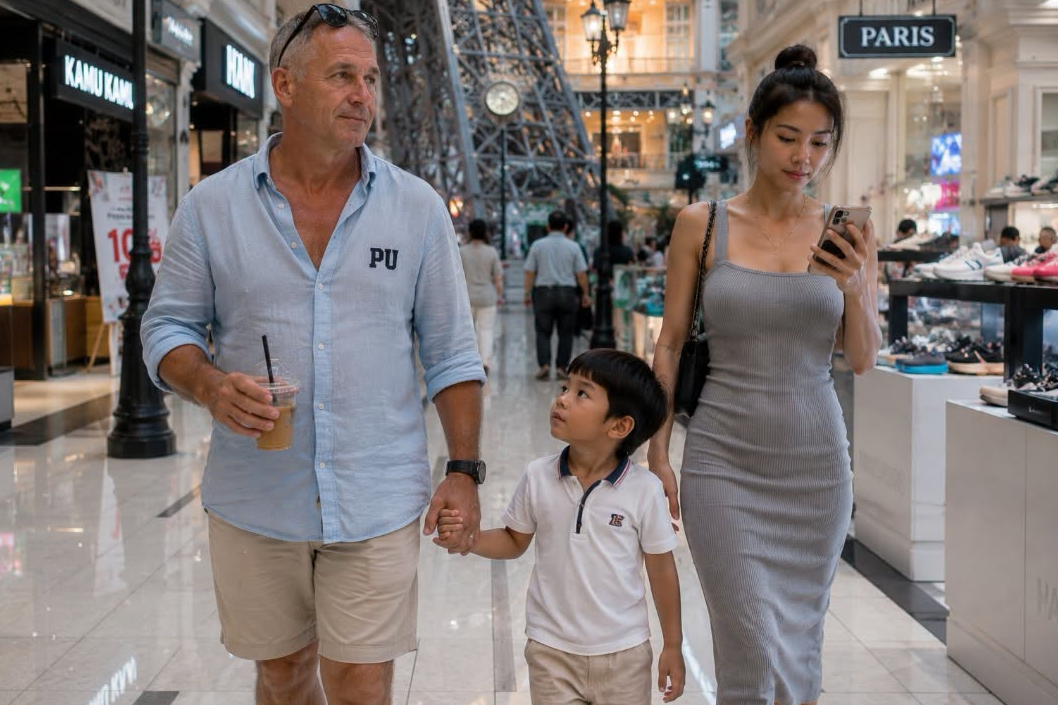
It is Saturday, 2:15 PM. Pierre is walking across the polished marble of the ‘Paris’ floor inside Terminal 21 Pattaya.
His left hand holds an iced Americano. His right hand holds the small, sticky, incredibly warm hand of “Game”—a 4-year-old boy from Roi-Et who does not speak a single syllable of French. Walking half-a-pace behind them is Fon, 23, wearing a tight knit dress from Platinum Mall, casually scrolling her TikTok feed.
They are going to buy sneakers.
1. The Economics of Fatherhood Lite
Back in France, raising a child is a twenty-year war of attrition. It involves grueling co-parenting schedules, passive-aggressive emails through lawyers, teenage slammed doors, orthodontist bills, and 1,200 euros a month in court-mandated alimony.
What Pierre has discovered on the Gulf of Thailand is Fatherhood Outsourcing.
For the cost of a 1,900 THB pair of light-up Skechers, Pierre gets to experience the absolute, unadulterated peak of the patriarchal high: a small boy looking up at him with wide, shiny eyes, pointing at a shelf, and treating him like a benevolent god who commands the universe.
It is Fatherhood Lite. All the dopamine of being a provider, with 0% of the domestic homework. It is a second chance at redemption, purchased at a 70% regional discount.
2. The Underwriter
While Pierre is having a profound, transcendent spiritual moment in the kids’ footwear aisle, what is Fon doing?
She is not looking at a heartwarming family tableau. She is running a stress-test on an asset.
When little Game points to the 2,600 THB Nike Air Max instead of the 800 THB Thai-brand canvas shoes, Fon doesn’t look at the shoes—she looks at Pierre’s micro-expressions. Does his jaw tighten? Does his eye dart to the price tag first, or to the boy’s smile first? She is underwriting his future utility. If Pierre passes the Sneaker Test today, the “Game needs to go to a bilingual private school in Isaan next term” proposal gets officially tabled in November.
The boy puts the Nikes on. He stomps his heel on the carpet; the soles flash bright red and blue.
Fon steps in, nudges her son’s shoulder sharply, and delivers a low, firm imperative in Thai: “Bok khob-khun Papa si, luk.” (Say thank you to Papa).
The 4-year-old looks up at the sunburned French man with the grey chest hair peeking out of his linen collar, presses his small palms together in a clumsy Wai, and says:
- “Khob-khun krab… Papa.”
The word hits Pierre’s central nervous system like a shot of adrenaline. Papa. His actual flesh-and-blood son in Lyon calls him “Pierre” when they are forced to speak at family funerals. This little boy from a rice paddy just handed him his crown back. A hot, overwhelming rush of validation pricks the back of Pierre’s eyes. He hands his Kasikorn Visa card to the cashier before she even finishes scanning the box.
The System Glitch
They ride the long escalator down to the Tokyo floor. Game is holding Pierre’s hand with two hands now, actively stomping every third step to make his heels flash.
Pierre’s phone vibrates in his pocket.
He pulls it out. It’s an automated push notification from Apple Photos: “Memory: 12 Years Ago Today.”
He taps the screen. It’s a digital photograph taken in a grey, drizzling driveway in suburban Lyon. His daughter—then seven years old—standing in a yellow raincoat, missing her front tooth, proudly holding up a wet, muddy Golden Retriever puppy.
Pierre stands motionless on the moving escalator. He looks at the yellow raincoat on his screen. He looks down at the flashing red-and-blue Nikes on the step below him.
For three seconds, the Pattaya simulation suffers a severe frame-rate drop. In that brief, terrifying window of clarity, Pierre realizes the brutal truth of the transaction: He hasn’t healed the wound in Lyon. He has simply bought a very expensive, brightly lit Thai bandage to wrap around it.
The escalator reaches the bottom. Fon slips her slender arm through his, rests her chin against his shoulder, and asks brightly:
“Teerak… we go eat Fuji Japanese restaurant now? Game very hungry.”
Pierre locks his phone screen, slides it deep into his pocket, smiles warmly, and says:
“Oui, bien sûr. Let’s go.”
Leave a Reply