The screen of the MacBook was split into two completely incompatible worlds.
On the right side was Dr. Weber. He was sitting in a perfectly sterile, soundproofed clinic in Munich. He was wearing a slate-gray turtleneck, and behind him, a triple-glazed window blocked out the polite, orderly German drizzle.
On the left side was the protagonist’s webcam feed. Behind his shoulder, a ceiling fan was fighting a losing battle against the 32-degree coastal humidity, and through the open balcony door, the chaotic, metallic screech of a Baht Bus braking on Second Road bled into the microphone.
It was their third online session. It cost €150 an hour. And it was an absolute disaster.
The Clinical Lens
He had spent the last forty minutes trying to explain the reality of his life in Pattaya to Dr. Weber. He tried to explain his relationship with a woman who worked in the local service industry, the complex web of her village debts, the brutal mechanics of the shadow economy, and the strange, quiet comfort they found in each other despite the transactional origin of it all.
Dr. Weber listened intently, nodding with practiced empathy, taking notes on a yellow legal pad. Then, he adjusted his glasses and applied the only tools he had: Western clinical psychology.
“It seems to me,” Dr. Weber said in a soothing, modulated voice, “that you are engaging in a classic pattern of codependent enmeshment. You are drawn to a partner with a perceived lack of agency—a victim of circumstance—so you can project a savior complex. This allows you to avoid the vulnerability of an equal partnership. You are subconsciously buying control to avoid childhood abandonment trauma.”
The protagonist stared at the screen. He felt a profound, suffocating exhaustion wash over him.
How could he explain to this man that there was no “savior complex”? That the woman he was talking about was the toughest, most pragmatic human being he had ever met, entirely capable of destroying a man twice her size in a negotiation over the price of an Isan buffalo? How could he explain that in a city built entirely on neon illusions, their arrangement was actually the most honest relationship he had ever been in?
Freud didn’t live in Pattaya. Jung never walked down Soi 6. The vocabulary of Western therapy—boundaries, trauma projections, toxic dynamics—was built for people depressed by the sterile safety of European suburbs. It was utterly useless when applied to the raw, humid, survival-driven ecosystem of Southeast Asia.
“Our time is up for today,” Dr. Weber said gently. “Let’s unpack this need for control next week.”
The laptop snapped shut. The screen went black. He had paid €150 to feel more isolated, more alienated, and more deeply misunderstood than before the call began.
The Lotus’s Parking Lot
The walls of the condo felt like they were shrinking. He needed air. He grabbed his keys, went down to the parking garage, fired up his Isuzu MU-X, and drove aimlessly down Sukhumvit Road until he pulled into the massive, fluorescent-lit parking lot of Lotus’s.
It was nearing midnight. The heat was still thick and heavy, smelling of exhaust fumes, impending rain, and grilled pork from a nearby cart.
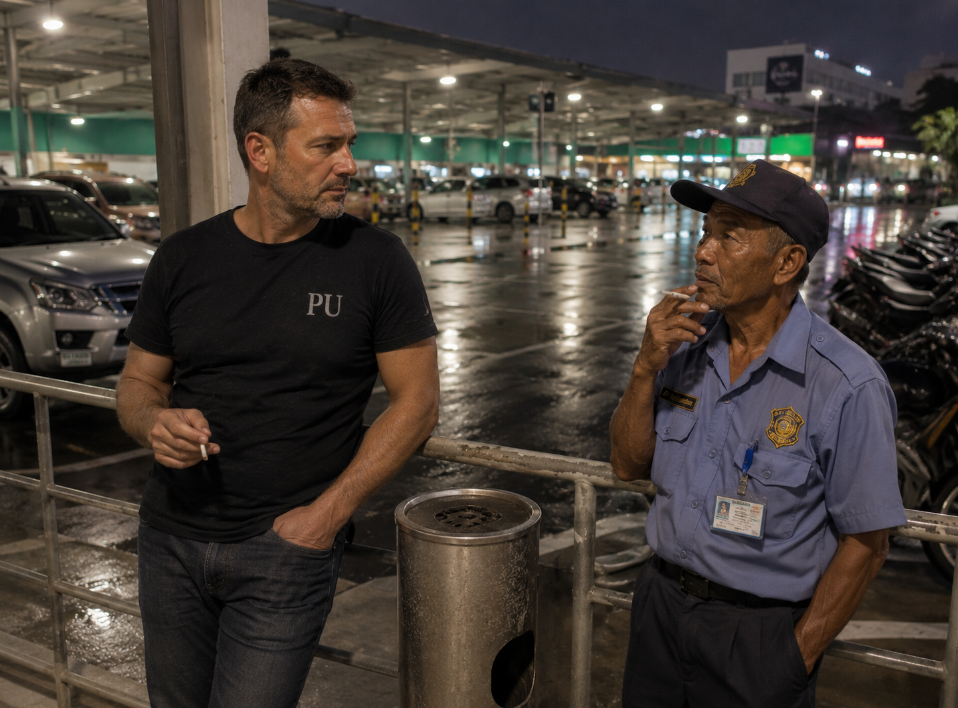
He didn’t go inside the supermarket. He just walked over to the designated smoking area near the motorbike parking, a dark corner under a concrete overhang. He leaned against a metal railing and lit a cigarette, staring blankly at the wet asphalt, feeling the crushing weight of the Munich therapist’s diagnosis echoing in his head. Was he just broken? Was this all a trauma response?
A moment later, a Thai security guard walked over.
He was an older man, maybe in his sixties, wearing a slightly faded, oversized blue uniform with a peeling gold badge. He looked tired in a way that goes deeper than bones, the kind of tired that comes from standing on concrete for twelve hours a day for a minimum wage of 350 baht.
The guard nodded politely, pulled a crumpled pack of Krong Thip cigarettes from his breast pocket, and lit one. They stood in silence for a minute, two men from completely different universes, sharing a cloud of cheap smoke.
The guard glanced at him. He saw the tight jaw, the furrowed brow, the heavy shoulders.
“Kid mak pai, boss?” the guard asked casually in Thai. Thinking too much?
The protagonist sighed, flicking an ash into the darkness. “Yeah, uncle,” he replied in Thai. “Just trying to figure out why my life is so complicated. Trying to understand everything.”
The security guard took a slow, deep drag of his cigarette. He looked out at the empty highway, where a single, heavily loaded cargo truck roared past in the night.
“Farang always want to understand the rain,” the guard said softly, his voice raspy from decades of cheap tobacco. “You want to know where the cloud came from, why it is wet, who made it fall.”
The guard turned his head and looked directly at him, his dark eyes entirely devoid of judgment, but full of a sharp, street-level clarity.
“You don’t need to understand the rain, boss,” he said simply. “You just need an umbrella. If you don’t have an umbrella, you just get wet until the sun comes out. Understanding doesn’t make you dry.”
The Verdict
The protagonist froze. He stared at the security guard.
For fifty minutes, a highly educated German doctor sitting in a pristine office had tried to force him to unpack his emotional baggage, analyze every single item inside it, and explain its origin. It had cost him €150 and left him feeling completely lost.
And here, in a grimy supermarket parking lot at midnight, a man who probably didn’t have a bank account had just solved the entire equation for free.
The therapist wanted him to fix the unfixable. The guard was telling him to just drop it. Ploi wang. Stop trying to intellectually categorize the chaos of Pattaya, and just learn how to stand in the rain.
The protagonist smiled for the first time in three days. He put his cigarette out in the metal bin.
“Khob khun krub, Lung,” (Thank you, uncle) he said, handing the guard a crisp 100-baht note to buy a coffee for the rest of his night shift.
He walked back to his car, unlocking the Isuzu. For the first time in days, he felt infinitely lighter. The invisible weight the therapist had tried to force onto his shoulders was gone, left right there to dissolve into the wet concrete of the parking lot.
Leave a Reply