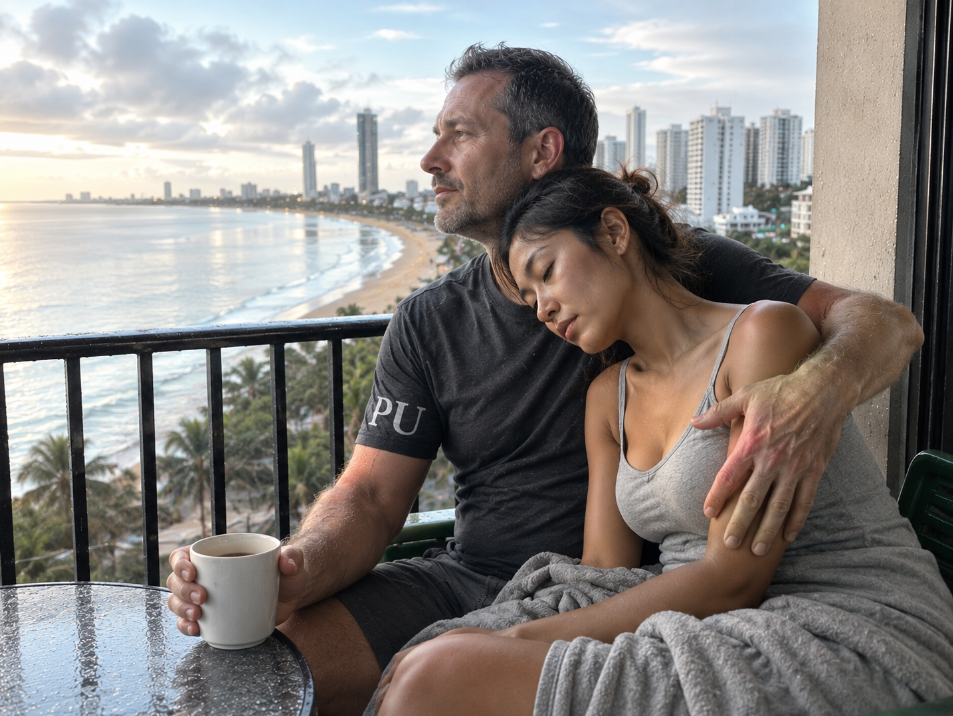
When people talk about Pattaya, they usually force the city into one of two simple stories.
Story A is the romantic fantasy: The lonely expat and the bar girl meet, fall madly in love, and prove that true romance conquers all.
Story B is the cynical reality: It is all a cold, calculated transaction. He is exploiting her for cheap sex, and she is bleeding him dry for money. Nothing is real.
Both stories are comfortable. Both stories give the audience an easy way to understand the world. And both stories completely ignore the brutal, invisible machinery that actually runs this city: The Structure.
The Illusion of Choice
Thomas and Dao did not “choose” to be sitting on a damp balcony in Jomtien at 5:00 AM, watching the rain hit the dark ocean. Not in the way the Western world understands the word “choice.”
In the West, a choice implies a menu of equal, viable options. You choose between a latte and a cappuccino.
Thomas didn’t choose Pattaya. He was pushed here by a crushing, decade-long divorce that stripped him of his house, his savings, and his will to wake up in the morning. He was 46, professionally burned out, and suffused with a cold, terrifying loneliness. He came to Thailand because it is the global waiting room for men who feel like their lives are already over.
Dao didn’t choose Soi 6. She was 26, from a dry, dusty village in Roi Et. Her mother needed kidney medication. Her younger brother needed 15,000 baht for high school tuition, and her family owed the local loan shark for a failed rice harvest. In her village, the only job available paid 300 baht a day for breaking your back in the sun.
The structure of the global economy, the brutal disparity of wealth, and the mechanics of human desperation funneled them both directly into the neon meat-grinder of Pattaya. They were both stripped of options. The system backed them both into a corner.
What Happens in the Corner
And here is the most uncomfortable truth about the Pattaya ecosystem—the one that ruins both the romantic fantasy and the cynical judgment:
Sometimes, in that dark, transactional corner, something entirely real accidentally grows.
When Thomas and Dao met, there was cash involved. That was the structure. But three weeks later, sitting on that balcony, the structure began to crack under the weight of their shared humanity.
Thomas looked at Dao and saw a woman who was just as exhausted as he was. She wasn’t a tropical fantasy; she was a survivor carrying the weight of an entire bloodline on her small shoulders. Dao looked at Thomas and didn’t just see a walking ATM; she saw a man whose eyes held the exact same hollow, defeated look she saw in the mirror every morning.
They had entirely different corners. His was emotional bankruptcy; hers was financial starvation. But they both intimately understood the feeling of having nowhere else to run.
That shared recognition creates a profound, quiet bond that is almost impossible to explain to anyone outside the city. It was the way she instinctively knew to sit in silence and just hold his hand when his anxiety spiked. It was the way he didn’t ask for a performance, but just let her sleep for twelve hours straight in a cold, air-conditioned room, safe from the chaos of the bar.
The system brought them together for a transaction, but the system didn’t anticipate their empathy.
The Inevitable Verdict
When relationships like this eventually end—and they usually do, because circumstances are a heavy anchor—society rushes in to assign blame.
Thomas’s friends back home shake their heads:
“She used you, mate. She was just playing the long game for your money.”
The girls at Dao’s bar whisper:
“He used you. Farangs just take what they want and leave you with nothing.”
Everyone demands a villain and a victim. It is human nature to look for an aggressor who made the active choice to cause harm.
But if a ruthless global structure forced both of them into that exact coordinate in time and space, who is actually to blame? Neither. And both. They were just two tired people participating in a machine they didn’t build and couldn’t control.
To say their connection was fake because money was involved is a lie. To say it was a fairy tale is also a lie. It was something much more fragile, tragic, and deeply human: two people, trapped in the dark by circumstances beyond their control, who managed to strike a match and keep each other warm for a little while.
Leave a Reply