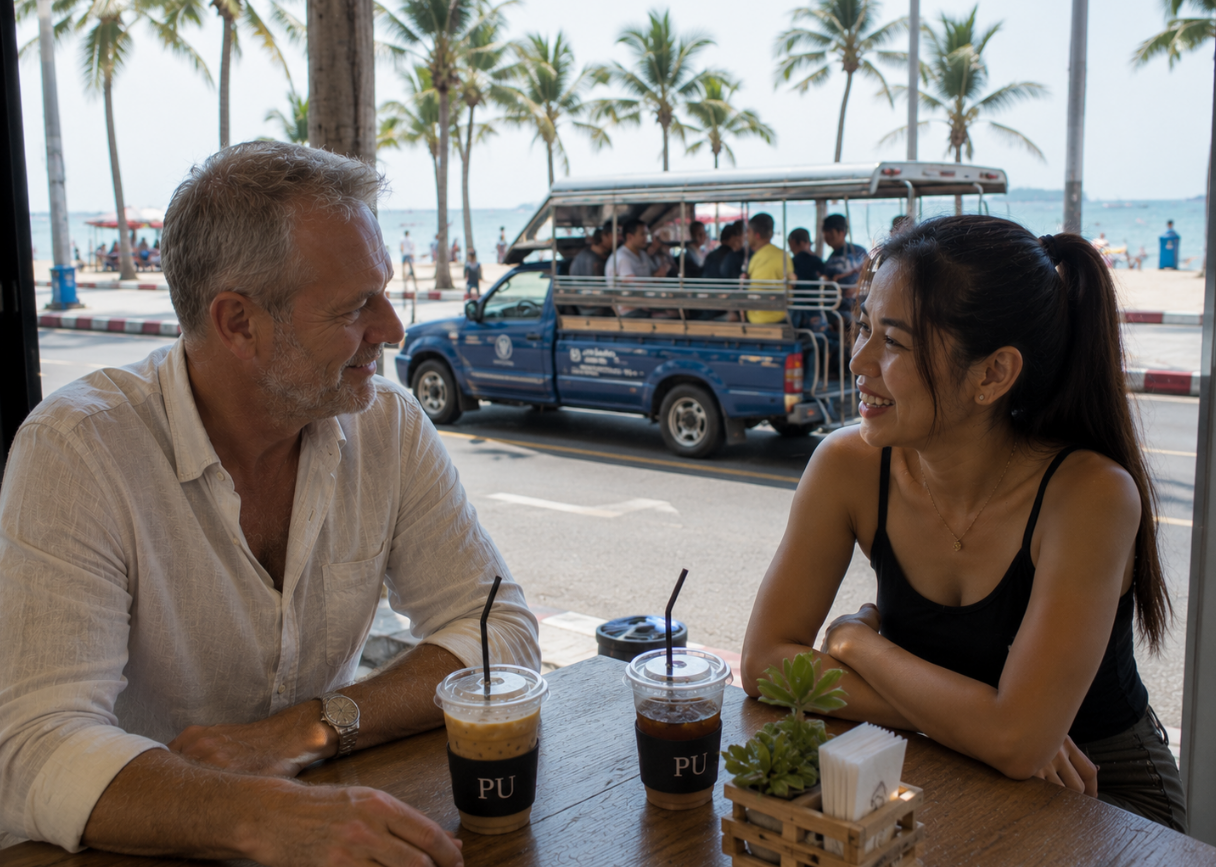
The air conditioning inside the beachside coffee shop was aggressively cold, a sharp, sterile contrast to the heavy, exhaust-choked humidity of the Pattaya afternoon just beyond the glass. Nam sat near the window, tracing the line of condensation dripping down her plastic cup of iced latte.
Across the small wooden table sat Liam. He was fifty-something, wearing a faded linen shirt, currently telling a mildly self-deprecating story about his teenage daughter’s driving lessons in Melbourne. Nam was laughing. It wasn’t the high-pitched, practiced giggle she used at work. It was a real, quiet laugh that crinkled the corners of her eyes.
If you looked at them from the street, they were a cliché. An older Western man and a younger Thai woman in Central Festival. But in a city entirely governed by the strict, ruthless calculus of transactions, what was happening at this table was the rarest phenomenon in Pattaya.
It started three years ago, exactly the way ten thousand other stories start every night. Liam walked into a neon-drenched bar on Soi LK Metro, sat down, and ordered a beer. Nam was sitting next to him. But the script derailed almost immediately. He didn’t ask her the standard, dead-end questions. He didn’t ask where she was from or how many boyfriends she had.
Instead, he watched her subtly massage her temples over the thumping, skull-rattling bass of the sound system, and asked,
“Is the music always this terrible, or are you just having a really bad migraine?”
She looked at him, surprised. She didn’t give him the polished bar-girl smile. She gave him the exhausted, honest truth of a twenty-eight-year-old woman who had been standing in heels for six hours.
They talked for an hour about completely mundane things—the terrible traffic on Beach Road, awful parking job, the stray dogs, and a joke he made about Australian drivers. When he finished his beer and paid his bill, he didn’t buy her a drink. He didn’t ask to take her out. He just stood up, smiled, and handed her his phone.
“You know, I actually have a picture of that awful parking job I just told you about,” he said casually. “Put your LINE in, I’ll send it to you.”
It was so simple, so completely devoid of the usual predatory weight, that she just typed her ID in without thinking. He sent a quick sticker to confirm, thanked her for the chat, and walked out into the humid night.
When he flew back to Australia, there was no clingy, desperate digital aftermath. A month later, true to his word, he sent her the picture of the spectacularly terrible parking job in Melbourne, there was no clingy, desperate digital aftermath. She replied with a laughing emoji. The text exchange continued, sparse and entirely devoid of sexual subtext or financial requests.
Now, it is an annual ritual. Once a year, his flight lands at Suvarnabhumi, and a few days later, her phone lights up:
“I’m in town. Coffee on Tuesday?”
The gravity of this single hour is impossible to explain to anyone who hasn’t lived inside the relentless machinery of the nightlife industry. In Nam’s world, every man wants something. They want her time, her body, her emotional labor, or the illusion of her love.
But Liam wants nothing. He doesn’t expect her to entertain him, and she doesn’t expect him to fix her village debts. Because neither owes the other anything, the weight of the city simply vanishes when they sit down. She doesn’t have to perform. She doesn’t have to pretend she isn’t tired. He knows exactly what she does for a living, where she works, and the mechanics of her world—and he bypasses all of it just to hear what she thinks about life. For a woman whose daily existence is defined purely by her physical and recreational utility, that level of simple, unvarnished human validation is intoxicating.
And perhaps most importantly, Liam is a ghost.
He lives seven thousand kilometers away. He doesn’t know her mamasan. He doesn’t know the loan sharks in her province, and he doesn’t know the other girls on her shift. He is entirely disconnected from her survival matrix. She can sit in the cold air of the cafe and tell him exactly how scared, angry, or exhausted she really is, knowing with absolute certainty that his opinion changes nothing in her real life. He is a vault. The safest confidant she has ever had.
Outside the window, a Baht Bus slowed down. A girl from Nam’s bar was sitting in the back. The girl spotted Nam through the glass, her eyes narrowing as she mentally scanned Liam, trying to calculate his net worth and his role. She gave Nam a knowing, questioning smirk before the truck sped away.
Nam just took a sip of her coffee and smiled to herself.
She knew what her coworker would ask in the makeup room tonight. “Who was that? A new sponsor? How much did he give you?” And when Nam would answer, “Nothing, he’s just a friend,” the other girls would roll their eyes, unable to compute why she was wasting her time talking to a Farang for free.
They wouldn’t understand it, because Pattaya’s dictionary does not possess the vocabulary for this. There is no word for a man and a woman meeting purely for the comfort of shared humanity. It doesn’t fit the Western romantic ideal, and it defies the Thai transactional system. It has no price tag, no expectations, and no logical trajectory.
It is just an iced latte, an annual visit, and an hour of peace. And in a city built entirely on neon illusions, that makes it the most intensely real thing of all.
Leave a Reply