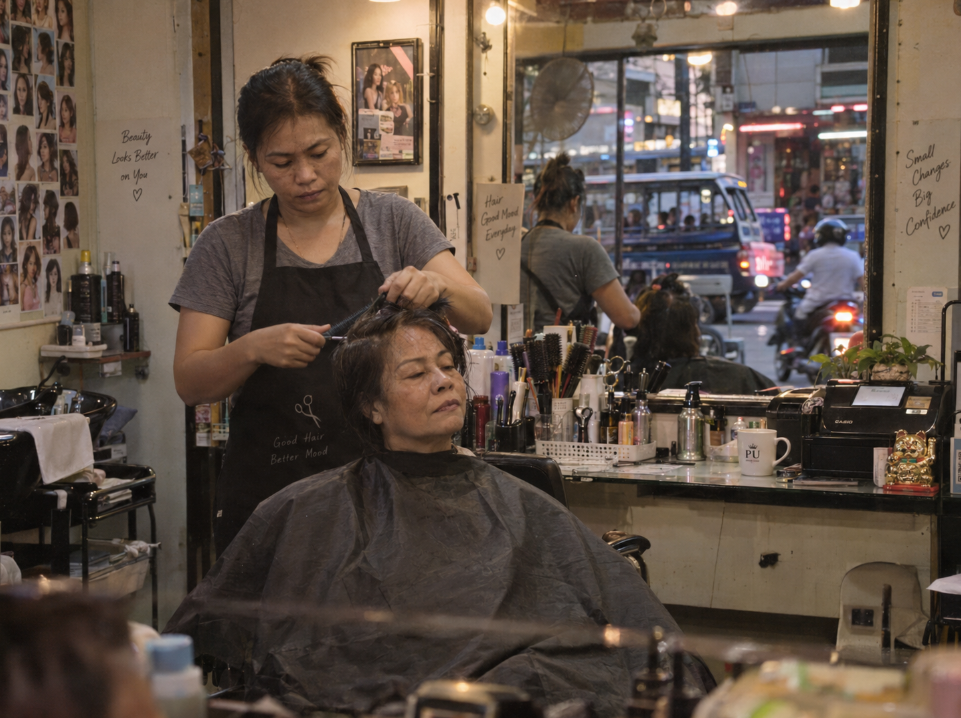
Morning on Soi Buakhao has a completely different texture than the night. The neon is dead, the street sweepers are out, and the air smells like exhaust and strong coffee. Inside a small, air-conditioned salon, Ann, 37, is working dye into the hair of a fifty-year-old Thai woman.
The salon isn’t for tourists. The chairs are filled with local business owners, girls from the nearby bars getting blowouts before their shifts, and a few retired expats who have been coming here for years. Ann speaks in fast, relaxed Thai, laughing at a joke her client just made. Her hands are quick and precise, holding an expensive pair of Japanese scissors.
In the mirror behind her, you can see the reflection of the street: a baht bus rolling by, a motorbike taxi driver eating grilled pork, an early-rising tourist walking past with a bottle of water. Ann doesn’t look at the street. She looks only at the hair.
If you look closely, there is a thin, faded scar on her left wrist. It’s old. She never explains it, and her clients never ask. She has been running this chair for six years. Before that, she spent ten years “in the system.” She doesn’t hide her past, but she doesn’t advertise it either. It isn’t a dark secret. It’s just geography.
When you look at the demographic engine of Pattaya, a persistent question always floats to the surface: Why is everyone from Isaan?
The northeastern region of Thailand isn’t just poor; it is structurally designed to be poor. It holds roughly a third of the country’s population, yet historically generates a fraction of its wealth. The landscape is dominated by rice, cassava, and sugarcane. The soil is harsh, the rain is unreliable, and for a young woman without capital or a university degree, the economic ceiling is made of solid concrete.
A maid or a factory worker in the provinces makes about 300 to 400 baht a day. In the Pattaya ecosystem, a woman can generate three times that amount in a single hour. When a family is drowning in debt, when a mother needs surgery, or when a younger brother needs tuition money, this math stops being an abstract concept. It becomes a survival mechanism.
Add to this the cultural gravity of Isaan’s matrilineal society. Daughters carry the absolute expectation to provide for their parents. Sending money home is not an act of generosity; it is an ironclad duty. When a girl leaves her village for the neon grid, she isn’t abandoning her family. She is fulfilling her obligation in the only way the economy allows.
But this raises the second, more difficult question: Why not everyone?
If you go to a village in Udon Thani, you will find two families living in identical wooden houses, facing the exact same poverty. Yet, one daughter is sitting in a gogo bar in Pattaya, while the other is scanning barcodes at a local CJ Express supermarket on the highway for minimum wage.
Why? Because poverty is just the condition. It is not the cause.
The cause is the trigger.
The girl at the CJ Express isn’t necessarily more moral, smarter, or stronger. She simply didn’t hit the trigger. The trigger is the moment the fragile mathematics of rural poverty finally snap.
It’s the husband who starts drinking and gambling, accumulating a debt to local loan sharks that must be paid by Friday. It’s the sudden, severe illness of a parent that the government hospital won’t fully cover. It’s a bad harvest combined with a broken tractor. The woman who stays in the village simply didn’t catch the spark. The woman who packs a bag for Pattaya had a fire lit under her that left her with zero alternative options.
Ann’s trigger was incredibly ordinary. She was twenty-seven, running a small, struggling hair stall in Udon Thani. Her husband played underground lotteries and bet on football. One day, he simply vanished, leaving her with his debts and the angry men who came to collect them.
She remembers her mother looking at her from across the kitchen table. It was a specific, silent look that Ann had known since childhood. It meant: What are you going to do about this?
She came to Pattaya “for three months” to clear the debt. Three months became a year. A year became five. Five became ten.
“Most people who come to live here have hit rock bottom,” Ann says quietly, mixing a new bowl of color. She doesn’t say it with pity or melodrama. It is just a cold, anthropological observation.
She has seen them all. The girls who came for quick cash and stayed because they forgot how to earn slow money. The Western men who came for a two-week holiday and stayed because nobody was waiting for them back home. The people who swore they were “different,” only to slowly become exactly the same. The city acts as a massive, unspoken border filter for broken timelines. Nobody plans to stay.
And here is the hardest truth about Ann: she isn’t a Hollywood success story. She didn’t “escape” the ecosystem. She just changed her function within it.
The salon is not a grand victory; it is just a different, quieter mode of survival. She no longer works in the bars, but her income still relies entirely on the women who do. Her neighborhood is the same. Her reality is the same, just navigated with a pair of scissors instead of a glass of tequila.
She hasn’t left Pattaya, because she can’t. In Udon Thani, she would be a woman with a “stained” past, the subject of quiet village gossip. But here? Here, she is Pi Ann. She has a trade. She has a network. She has respect. Pattaya is the only place in the world where her past is simply a resume, not a conviction. She didn’t choose freedom; she chose the one city where her scars don’t require an explanation.
It is 7:00 PM. The sun has dropped, and the neon signs outside are beginning to hum.
Ann finishes sweeping the loose hair from the floor. She unties her black apron and looks at her reflection in the large mirror. She is thirty-seven. She looks a little tired, but entirely grounded.
She turns off the main lights. On the front reception desk, sitting next to the cash register, is a small white ceramic coffee mug with a clean black “PU” logo on it. It was a gift from a foreign client who told her it was “just a nice thing for the shop.” Ann doesn’t know what the letters stand for, and it doesn’t really matter. It holds her pens perfectly.
She locks the glass door, steps out onto the pulsing street, and starts the short walk home.
Leave a Reply