Philip hit his breaking point on the math. The 150-baht beers. The 200-baht lady drinks. And a six-month surge in bar fines that had quietly turned every night out on Walking Street into a financial hemorrhage. The old economy of the neon grid no longer made sense.
The final blow came when an old friend visited from Bangkok. He was confident, tech-savvy, and moved at the speed of the capital. Philip took him to his regular bar, expecting to impress him with the local scene. The friend scanned the sticky counters, the flashing neon, and the exhausted women, and said exactly one thing:
“Why did you bring me to this dump? Let’s just grab a couple of sideline girls and go to that rooftop cafe.”
Philip meticulously typed the word sideline into his phone notes.
The next morning, a Google search opened a parallel reality. No mama-sans. No ringing bells. Just hundreds of curated profiles, high-quality photos, and district filters. Smiling at his screen, Philip even downloaded LINE—an app he actively despised—because in this ecosystem, WhatsApp simply does not exist. Digital Asia plays by its own rules.
But he quickly learned that in this system, cash doesn’t guarantee access.
The first three profiles left him on read.
The fourth replied in sixty seconds:
“Sorry bro, she doesn’t take foreigners. Let me look for others. What breast size do you need?”
Philip’s stomach dropped. He realized he wasn’t talking to a girl at all. He was talking to an agent, a boyfriend, or a digital pimp sitting in an internet cafe. The illusion of direct contact shattered.
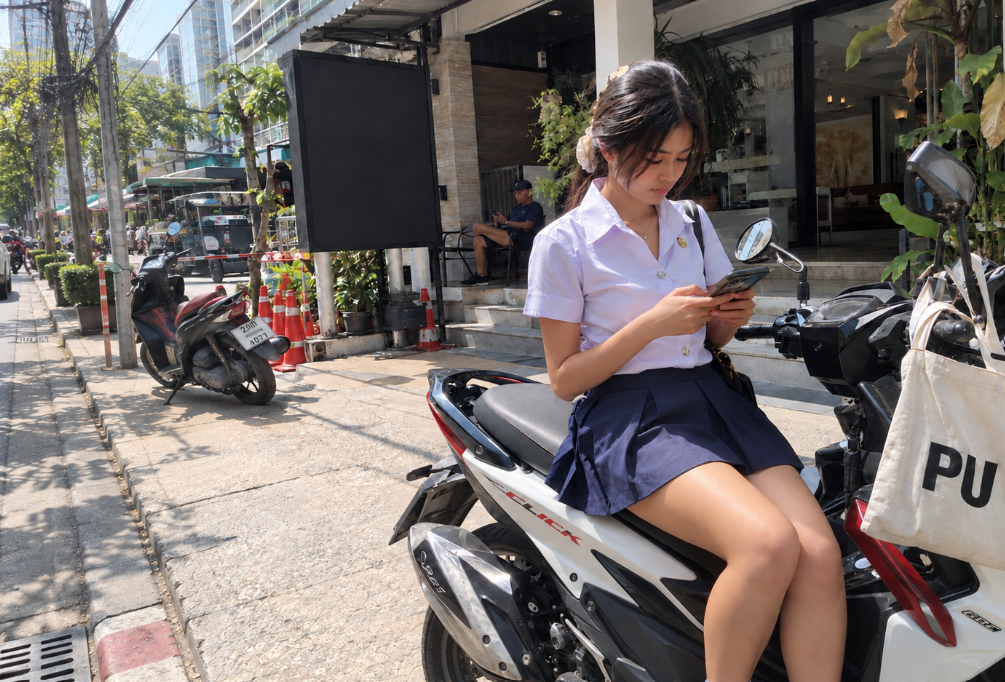
And then his eyes caught one profile. Nong Emmy. She was flawless. Her photo showed her sitting on a scooter, wearing a crisp, white-and-blue Thai university uniform. He sent a message. A standardized price list fired back instantly. Philip did the math in his head: no bar fine, no endless rounds of tequila, no tipping the security guard. He had stumbled into a goldmine.
“How do I meet you, Emmy?”
She replied with a photo of a nondescript hotel sign.
Thirty minutes later, Philip stood under that exact sign. “I’m here,” he typed.
The response was as cold and algorithmic as a bank verification: “Take a selfie with the sign.”
Doubt began to creep in. In a bar, the customer holds the power. Out here, Philip realized he was a suspicious variable being strictly vetted at the door. But the friend from Bangkok wouldn’t steer him wrong. The selfie was sent.
One minute later, the screen lit up: “Room 302B.”
Walking up the stairs, Philip felt like a burned spy in a cheap thriller. Paranoia peaked. He knocked on the door and instinctively pressed his back flat against the hallway wall, exactly like a SWAT team bracing for an ambush.
The door clicked open. No ambush. No guys with baseball bats. Just Nong Emmy and a clean, perfectly empty room.
In flawless English, she invited him inside. The second the door clicked shut, she asked for the money. Philip scanned the room one last time, looking for the trap, the hidden camera, the waiting agent. Nothing. He pulled the banknotes from his wallet and handed them over.
Emmy flashed a wide, genuine smile. The cash vanished into her bag.
“Enjoy na ka,” she said softly, taking his hand and leading him toward the shower.
In that moment, Philip finally understood what Bangkok figured out years ago. The word sideline was engineered for a reason. It creates massive psychological distance. It completely severs the woman from the stigmatized “bar girl” identity. This isn’t a profession; it is a temporary side hustle. It is entirely self-directed.
In a bar, a woman is the venue’s inventory. On a smartphone, she is an independent micro-enterprise. Digital channels have completely shifted the balance of power. And while the old expats stand on Soi 6 screaming over the price of a beer, the students on the scooters have quietly and efficiently taken the economy for themselves.
Leave a Reply