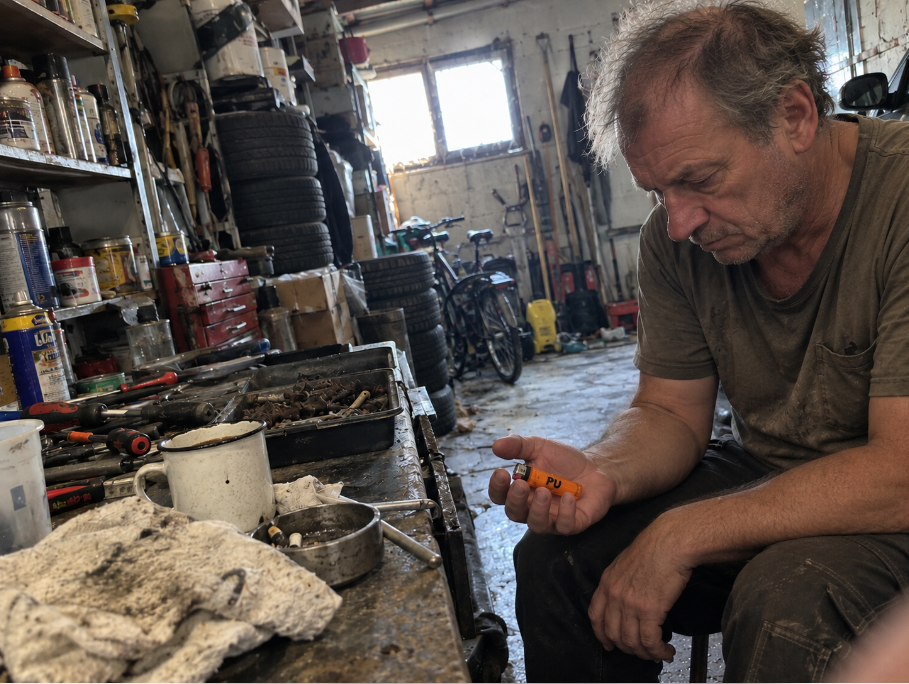
It is a Saturday afternoon in a cold, damp suburb of Essen, and Christian is staring at a rusted vice grip on his workbench. Around him are the standard monuments of a responsible, adult European life: shelves of meticulously organized screwdrivers, winter tires stacked against the concrete wall, and the smell of WD-40, old paint, and wet earth.
He is fifty-eight, he is married, and he is entirely, completely dead inside.
He reaches into a plastic tray of miscellaneous screws and his fingers brush against it—a cheap, faded orange plastic gas lighter with the worn “PU” logo stamped on its side. He picked it up from a sticky bar table on Soi Buakhao years ago, threw it into his pocket, and somehow it survived the flight back, eventually getting tossed into the garage clutter.
As he picks it up, the cold German air seems to vanish, replaced by a sensory assault so sudden it feels like a physical blow.
He doesn’t just see the lighter; he smells it. The heavy, sweet scent of jasmine garlands mixing with stale beer, diesel exhaust, and the distinct, warm aroma of her skin—of Apple, the woman who had sat beside him on those torn vinyl stools. In an instant, the clutter on his workbench dissolves. He is no longer surrounded by drill bits and socket wrenches; he is back in that small, sweltering room with the rattling fan, feeling the desperate, breathless proximity of her, the way she would pull him back to the bed for “one more round” while the morning traffic roared outside on the street. It is a memory so intense it catches in his throat like a panic attack.
“Christian! Did you look at the lawnmower? It’s still making that noise!”
His wife’s voice cuts through the garage, sharp and demanding, drifting down from the kitchen door. She’s talking about the mower, or the garbage, or some other domestic chore—something mundane and endlessly tedious. He doesn’t look up. He just stares at the faded “PU” logo on the plastic in his palm, her voice nothing but background noise to the storm in his head.
His mind drifts further, refusing to stay in the garage. He is on Samet. That one night they took the bus out of Pattaya, escaping the noise to wander along the dark, quiet beach. He remembers the warm, wet sand beneath their feet, the gentle crash of the surf, and the quiet desperation in his own voice when he held her and promised he would find a way—any way—to stay there with her forever. They had spent the entire night together, clinging to each other in a cheap beachside bungalow, only for him to pack his bags and board a flight to Europe forty-eight hours later.
He returned to his job, his mortgage, and his sensible marriage. He did what was expected of him.
He looks back at his workbench, the screwdrivers and the cold concrete.
Twenty years of being a good husband, a reliable employee, a quiet neighbor. And yet, the agonizing truth is that he has only really been alive for those two weeks in Pattaya. The rest of it—the decades of routine, the scheduled dinners, the endless Saturdays in this garage—has just been survival, a slow, quiet waiting for the end. He holds the cheap lighter, the only physical proof that he wasn’t always a ghost, and puts it back in the tray, knowing he will never go back, and that he will never really return.
Leave a Reply