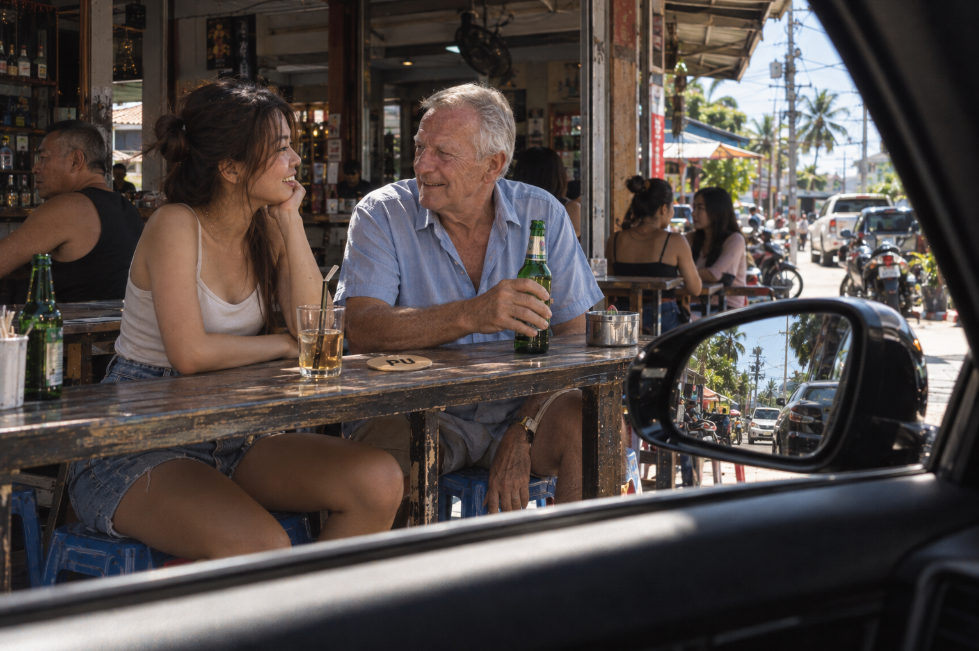
Saturday afternoon. A Porsche with Bangkok plates is crawling through the tight, sluggish traffic of Pattaya. Inside, the air conditioning is set to a crisp 22 degrees. The driver and his girlfriend, both in their early thirties, are heading back from Na Jomtien. They just spent the afternoon drinking 250-baht iced Americanos, eating premium seafood, and taking photos at a high-end beach club.
Around the middle of Soi Buakhao, the entire lane grinds to a complete dead stop. Up ahead, a battered songthaew has blocked the narrow street, its driver idling the diesel engine while leaning out the window to negotiate at length with a group of Indian tourists. Right behind him, an ice delivery truck has stopped mid-lane—the driver simply cut the engine, threw a bag of crushed ice onto a bar counter, and walked off to grab a bowl of noodles from a street cart. Nobody honks. Nobody moves.
The Porsche is stuck.
Just outside the tinted window, a seventy-year-old Englishman in a faded football shirt is sitting on a plastic stool at an open-air bar, drinking a 70-baht Leo. Next to him is a Thai woman less than half his age.
Technically, the people in the car and the man on the stool are spending the weekend in the exact same city. Culturally, they may as well be in different solar systems.
Which raises an uncomfortable, rarely asked question: What does the Thai guy behind the wheel actually think when he looks out the window?
To understand the answer, you first have to understand that the “Foreign Pattaya” often mistakenly believes it is the only Pattaya. For a long-term expat living around Buakhao, the city is a rigid ecosystem of English breakfasts, cheap pints, bar girls, and neon nightlife. But a Bangkok professional might visit this city ten times a year and never interact with that ecosystem once.
His Pattaya is a closed loop: a boutique hotel, a photogenic café, a seafood dinner, a beach club, and the highway back to the capital. He isn’t actively avoiding the “real Pattaya.” As far as he is concerned, his Pattaya is just as real as yours. It just doesn’t involve you.
If you read through Thai-language forums and youth discussions, you notice a distinct pattern in how the urban middle class views the Western pensioner. The first reaction usually breaks the expat expectation of hostility. It is simply indifference.
A man of retirement age decides to live by the sea? Fine. The weather is warm, the beer is cold, the cost of living beats a freezing winter in Europe. To many Thais, that is a perfectly logical, even attractive retirement plan. The old farang quietly eating his breakfast and minding his business bothers absolutely no one.
But change the visual slightly, and the cultural reaction shifts hard.
Take that same 70-year-old man. Put a 22-year-old girl on his lap. Add a bar environment, loud day-drinking, a sense of deep entitlement, and a booming voice explaining to his friends that Thai women “just understand how to treat a man.”
This specific image triggers a profound, quiet resentment among younger, educated Thais. The discussions online are sharp. They talk about the massive age gap, the blatant financial dependency, the objectification, and the damage this specific dynamic does to the international reputation of Thai women.
The discomfort often isn’t, “Why is an old white man in Thailand?”
It is, “Why does this particular kind of old white man seem to think this is what Thailand is?”
And this is where the great status illusion of Pattaya fractures entirely.
Inside the bar ecosystem, a specific breed of expat has grown used to a certain hierarchy. He assumes that his Western passport, his pension, and his disposable income automatically grant him high status. He is the customer. He is the one with the money.
But to the Bangkok professional bubble, the scale is entirely different. The 35-year-old Thai businessman idling in the Porsche likely went to university in the UK. He speaks flawless English. He wears a Rolex, manages family capital, and flies to Japan for long weekends.
When he looks out the window at the 65-year-old foreigner arguing over a 20-baht on his bar bill, he does not see a representative of the wealthy, superior West. He sees an economic migrant. He sees a budget retiree trying to stretch a modest pension in a developing country.
This is where the status hierarchy violently flips. In the bar, the retired European may be the man with the money. In the Porsche waiting behind the ice truck, he simply looks like a man living cheaply overseas.
Perhaps the strangest thing about Pattaya isn’t that these two heavily contrasted worlds clash. It is how rarely they actually do.
The Bangkok couple will spend their Saturday drinking cocktails by the sea, insulated by their wealth. The retired Englishman will spend his Saturday drinking Leo on Buakhao, insulated by his routine. They may sit trapped next to each other in a temporary traffic jam, separated by half an inch of tinted glass.
Neither envies the other. Neither particularly understands the other. And on Sunday, both will go home fully convinced that they spent the weekend in Pattaya.
Leave a Reply