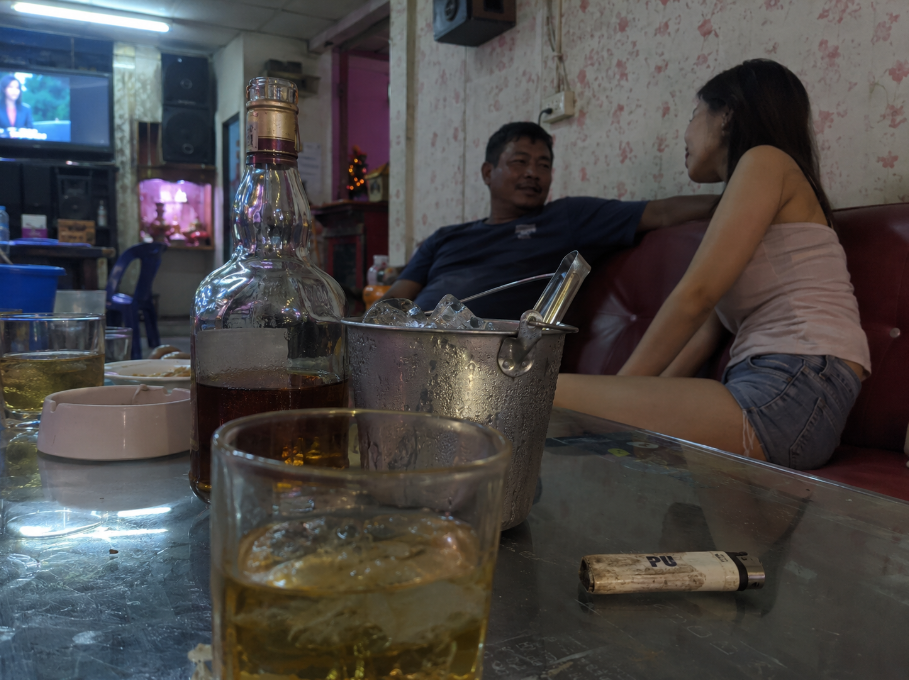
A thirty-nine-year-old guy from the Czech Republic sits at a beer bar on Soi 8. He just paid the bar fine. He is buying the lady drinks. He feels like the buyer, the boss, the undisputed center of the local economy. He looks around at the flashing lights and the rows of girls waiting for customers, and he genuinely believes that he is the industry.
He has absolutely no idea that at this exact moment, three kilometers away in a dim karaoke joint on Sukhumvit Road, a Thai truck driver is paying for the exact same service for a third of the price. Or that deep down Soi Chaiyapoon, in a curtained massage parlor that foreigners never even notice, a Thai bank manager is doing the same—without bar fines, without lady drinks, and without haggling in broken English. The Czech tourist thinks he is the center of the universe. He thinks he is the tip of the iceberg, completely unaware that the underwater mass is twenty times larger than the fraction he can see.
Statistically, 95 percent of the sex work in Thailand consists of Thai clients with Thai workers.
The industry operates in four distinct tiers, and the tourist only has access to one of them. The first tier is street-level prostitution—fast, anonymous, cheap, and strictly local. The second tier comprises local brothels, curtain-massage parlors, and domestic escorts hidden deep within Thai neighborhoods, completely devoid of English signage. The third tier is the neon grid: the beer bars and Go-Gos where foreigners visually and financially dominate. The fourth is the digital space of independent operators.
Foreign sex tourism exists almost entirely within that third tier. It is the most visible, the most heavily documented, and the most heavily scrutinized by international media, but it is just a marginal fraction of the market. As sociologist Ronald Weitzer highlights in his 2024 analysis of the trade, the highly infamous foreign sex market in Thailand is nothing more than a publicized branch of an enduring, deeply ingrained social institution.
The Thai man buying sex does not go to Walking Street. He does not pay a mamasan a “bar fine” just to release a girl from her shift. He doesn’t write detailed reviews on expat forums, he doesn’t vlog about his experiences, and he doesn’t exist in the Western moral discourse about Pattaya. The foreign tourist only sees the infrastructure built specifically to extract his currency. He sees the English menus, the inflated prices, and the girls who have learned his language, and he arrogantly assumes this is all there is. He thinks this is Thailand. He is entirely wrong. The Thai client pays less, visits more frequently, and operates in total silence. He is the true engine of the economy.
Yet, the entire Western discourse surrounding sex tourism is built on the archetype of the villain. The narrative insists that the client is a predatory, aging white male traveling to a developing country to exploit impoverished women, safely insulated from the social consequences he would face back home. Weitzer dismantles this simplistic trope, noting that sex tourists are actually incredibly diverse—many are young, many are Asian, some are women, and a massive percentage are desperately seeking genuine romantic relationships rather than just transactions.
But more importantly, the Thai client shatters the villain archetype completely. To the local driver, manager, or waiter, purchasing sex isn’t a colonial conquest. It is simply a normalized social transaction. Prostitution here isn’t viewed by the broader society as an honorable profession, but it is widely accepted as a necessary and pragmatic economic utility. The “client as villain” narrative is merely a Western psychological projection. It allows the Western reader to comfortably distance themselves from the reality of the trade, pointing a finger and saying, “They are the exploiters, not us.” But foreigners are just a loud, high-paying minority.
If 95 percent of the industry operates Thai-to-Thai, then foreign sex tourism is not the root cause of the industry; it is merely a lucrative symptom. The system existed long before the American GIs arrived, it existed before mass European tourism, and it will continue to operate long after the last expat flight departs.
Pattaya is not a city built by foreigners. It is a Thai city that cleverly sells a curated, neon-lit version of itself to foreigners while continuing to live for its own people in the shadows. The Thai client dictates the baseline prices. The Thai client sets the underlying social norms. The Westerner just adapts to these rules without ever realizing he isn’t the one making them. He thinks he is the master of the house, but he is just a wealthy guest in an institution far older, deeper, and larger than he will ever understand.
Back on Soi 8, the Czech tourist finishes his beer. He pays his inflated tab and leaves, still feeling like the undisputed king of the grid. Three kilometers away, the Thai truck driver walks out of the karaoke bar, having paid a fraction of the price with zero fanfare, and simply goes home to sleep.
Left behind on the scratched wooden counter of the Soi 8 bar is a cardboard coaster with a dark “PU” logo, wet with condensation. No one looks at it. It is entirely invisible. Just like 95 percent of the industry.
Leave a Reply