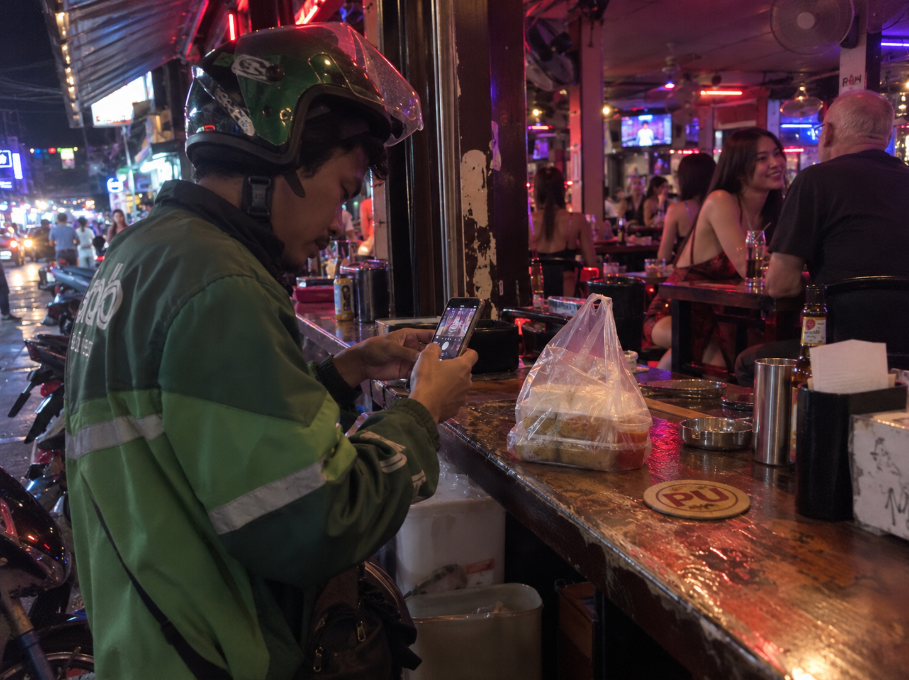
The chaotic noise of Soi Buakhao at nine in the evening is deafening, but the rider on the battered Honda Wave moves through it with absolute, mechanical precision. He is a Thai man in his early thirties, wearing the heavy, sweat-stained green jacket of a Grab delivery driver. He pulls up to the glowing entrance of a crowded open-air bar, kicks down the stand, and pulls a plastic bag containing two orders of spicy tom yum and rice from his thermal box.
He doesn’t step inside. He doesn’t scan the dimly lit room or make eye contact with the women lined up in tight dresses near the entrance. He simply places the plastic bag on the very edge of the service counter, mutters, “Order for Nong,” and snaps a quick, timestamped photo with his cracked smartphone to prove the delivery was completed. He turns his back on the neon lights, gets back on his motorcycle, and merges seamlessly into the roaring traffic to chase his next ping.
He isn’t the stereotypical “destitute local” that tourists pity; he is a functioning gear in a relentless gig economy. He has a financed motorcycle, a smartphone, and a grueling workday that starts at ten in the morning and rarely finishes before two in the morning. He grinds out thirty to fifty deliveries a day to earn somewhere between five and eight hundred baht.
He has never pulled out a stool to sit at that bar. He has never bought a lady drink, and he will certainly never pay a bar fine. This isn’t necessarily because he lacks the desire, but because the mathematical reality of his life strictly forbids it. The financial canyon between his exhausting fourteen-hour shift and a single casual evening on the grid is uncrossable. Furthermore, he is a local Thai man operating in an ecosystem engineered exclusively for foreign currency; he would likely be turned away before he even ordered a beer. He cannot afford the luxury of being a customer. He can only afford to serve.
The physical counter where he leaves the food marks a profound, invisible border. The foreigner sits comfortably inside, paying for the illusion of affection and undivided attention, while the courier stands entirely on the outside, getting paid pennies to transport calories. They share the same humid air, they exist in the exact same micro-economy, yet they are separated by a chasm that defies traditional definitions of race or class. It is a strict segregation of roles. One is the buyer; the other is the invisible infrastructure. The courier doesn’t waste energy comparing his life to the men sitting inside holding cold beers. If he allowed himself to truly analyze the staggering disparity, the resentment would drive him insane. So he chooses numbness, focusing only on the GPS map glowing on his handlebars.
But the neon grid is built on hidden complexities, and the truth about the courier is much heavier than a simple delivery route. He isn’t just an anonymous driver dropping off soup; he is the man she actually lives with.
She might be his legal wife, or perhaps they have just been sharing a cheap room for the last two years. When he walked up to that counter, he knew exactly who the food was for. He knew she was sitting somewhere in the shadows of that bar, smiling at a foreign stranger, drinking watered-down alcohol, and playing a role. He intentionally didn’t look for her.
He doesn’t throw a jealous fit or demand that she come home. Because if he shatters the illusion and forces her to quit, the fragile economic house of cards they have built together will instantly collapse. Who will pay the monthly installments on the Honda Wave? Who will cover the rent for their apartment? Who will wire the crucial medical money back to her mother in the provinces? His silence is not a progressive embrace of an open relationship; it is a brutal economic necessity disguised as domestic routine.
From her perspective, the dynamic is equally calculated. The man in the green jacket is her actual life. He is the one who waits for her in the dark, the one who doesn’t ask exhausting questions, and the one who accepts her without requiring a cash transaction. Yet, when he walks up to the edge of the bar, she doesn’t wave. She doesn’t blow him a kiss or shout a greeting.
She ignores him entirely, not out of cruelty, but out of flawless professional preservation. If the client buying her drinks realizes she has a Thai husband delivering her dinner, the carefully maintained fantasy shatters. The client will immediately pay his bill and walk to the next bar. If he walks, she loses her commission. If she loses her commission, the bank transfer to her village bounces. She ignores the man she loves with the same calculated precision she uses to tell her fifth customer of the night that she loves him. It is simply the emotional tax they both have to pay to survive the city.
The Pattaya ecosystem doesn’t just divide humanity into wealthy tourists and desperate workers. There is a massive, silent third tier holding the entire machine together: the Thai men who service the grid without ever participating in it. The electricians keeping the neon buzzing, the motorcycle taxi drivers ferrying drunk expats, the food couriers keeping the staff fed. They are the invisible caste of the poverty economy. They do not write reviews on expat forums, and nobody makes YouTube documentaries about them. They just quietly orbit the edges of the red-light districts, selling their youth and their time, completely surrounded by an industry they can never touch.
Just past midnight, he accepts his final delivery of the shift. He pulls up to the exact same bar on Soi Buakhao. He sees her this time. She is standing near the entrance, laughing at a joke made by an older European man holding a glowing bill folder. The courier doesn’t break his stride. He sets the plastic bag down, snaps his photo, and walks away.
He rides back to a cramped, 3,500-baht room tucked deep down a dark alley near Sukhumvit Road. He takes a cold shower, lies down on the mattress, and stares blankly at the ceiling, listening to the hum of the refrigerator. He waits. She will come through the door at two, maybe three in the morning, smelling like cigarette smoke and cheap perfume. She will lie down next to him in the dark.
When the sun comes up, they will drink instant coffee in complete silence, never once discussing the night before. He will put on his green jacket and log into his app. She will stay in bed to recover before putting her makeup back on for the evening shift. The cycle will reset, flawlessly and ruthlessly, not because either of them wants it to, but because this is exactly how the system demands to be fed.
Leave a Reply