Every man who falls for a girl in Pattaya eventually hits the exact same wall—and almost every man invents the exact same villain to explain it.
It usually starts after the flight home. While he was in Thailand, things were easy, fun, and uncomplicated. Then he lands back in London, Frankfurt, or Chicago, steps out into the gray rain, and suddenly his phone lights up.
I miss you. I can’t stop thinking about you. You’re different from all the others.
To a man staring at a damp commute and a silent apartment, it feels like a miracle. She didn’t ask for money while he was there, and she doesn’t ask for it now. In fact, she says the eight words that disarm a Western man’s skepticism faster than anything else in the English language: “I don’t want your money. I just want my freedom to work.”
He feels a surge of pride. He isn’t one of those controlling expats trying to lock a woman down. He respects her independence. He “allows” her to stay in the bar while they build something real over video calls at 4:00 AM. For two months, it feels like a modern fairy tale. She tells him how much she hates the nightlife, how trapped she feels, how she has worked for years with nothing to show for it—and how, with him, she finally sees a future.
Then, almost overnight, the temperature drops.
The good-morning voice notes stop. Her replies shrink to single words sent six hours late. When she finally calls, the warmth is gone, replaced by a flat, businesslike exhaustion. Suddenly, every conversation circles back to overdue rent, a broken motorbike, or a bill that needs paying today. When he offers encouragement and reminds her of their future together, she goes completely cold.
Sitting seven thousand miles away, he tries to make sense of the wreckage. His ego cannot survive the simplest explanation—that she grew tired of giving away free emotional labor to a man who wasn’t sending a single baht, or that someone sitting at her bar last Tuesday actually opened his wallet.
So he finds a scapegoat.
It’s the mamasan.
In his mind, a dark, manipulative figure is standing in the shadows of the bar, whispering poison into her ear, corrupting her pure heart, and turning her against the only man who genuinely loves her. Her bar friends are dragging her down, using her until she is no longer useful to them, trapping her in a cage she desperately wants to escape. If only she would stop listening to them, he tells himself, he would stand by her side through everything. He would be her future husband.
Meanwhile, in Pattaya, it is 1:30 AM.
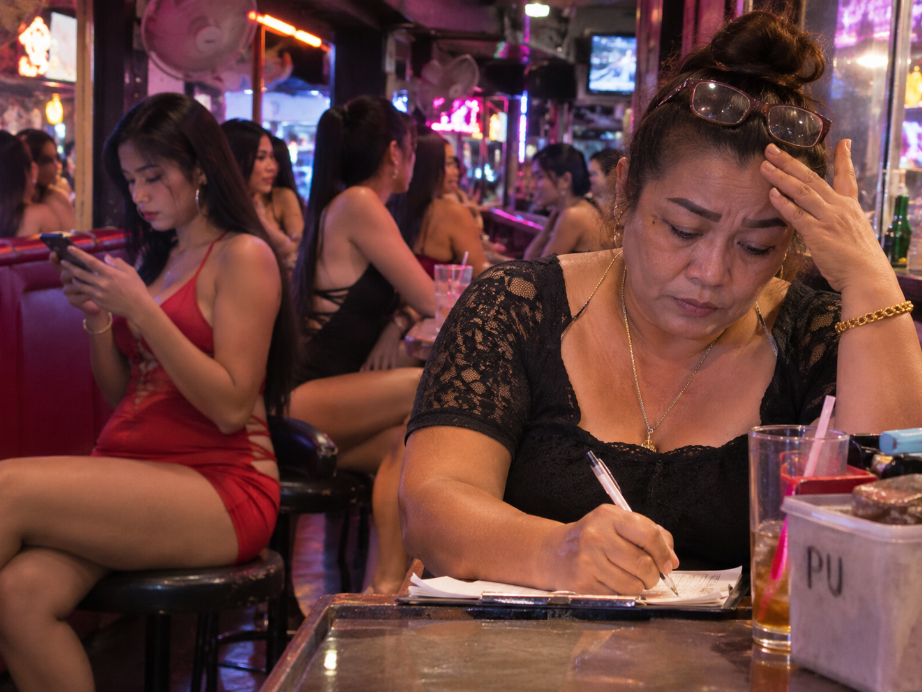
The mamasan isn’t a scheming villain plotting the downfall of a long-distance romance. She is a forty-six-year-old woman with swollen ankles and a clipboard, rubbing menthol oil into her temples while trying to hit the bar’s nightly drink quota so the owner doesn’t scream at her in the morning. She doesn’t know his name, she doesn’t know what country he lives in, and she couldn’t care less who his girl texts on her break.
And the girl sitting near the entrance isn’t a helpless hostage waiting to be rescued. She is a grown woman doing basic arithmetic.
For two months, she gave a man on a phone screen her time, her attention, and the comforting illusion that she didn’t care about money. In return, she got promises about a future wedding and his “permission” to keep working twelve-hour shifts on her feet in a loud, smoky room. Eventually, the novelty wore off, the rent came due, and reality walked through the front door of the bar with cash in his pocket.
Men love to believe that a good woman in Pattaya gets ruined by the whispers of the people around her. It is a comforting story, because it leaves the man’s halo completely intact.
The truth is much colder. Nobody in that bar had to whisper a single word into her ear. When a woman is working until four in the morning to pay her bills, empty promises from across the ocean speak loud enough on their own.
Leave a Reply